How Much Is 65 Per Hour Annually

Ever found yourself scrolling through job listings, seeing that tempting hourly rate, and then immediately launching into some mental gymnastics to figure out what that actually looks like over a year? You're not alone! It's a common modern-day puzzle, especially when you're dreaming of that next big life move or simply trying to get a clearer picture of your financial landscape. Today, we're taking a deep dive into the numbers behind a cool $65 per hour and translating it into its annual equivalent. Get ready for some enlightening insights, practical tips, and a few fun facts!
So, you've landed a gig or are eyeing one that pays a neat $65 an hour. Sounds pretty sweet, right? But what does that translate to when you’re thinking about your annual income, vacation planning, or even just your daily coffee budget? Let’s break it down with some classic assumptions.
What's the Annual Scoop?
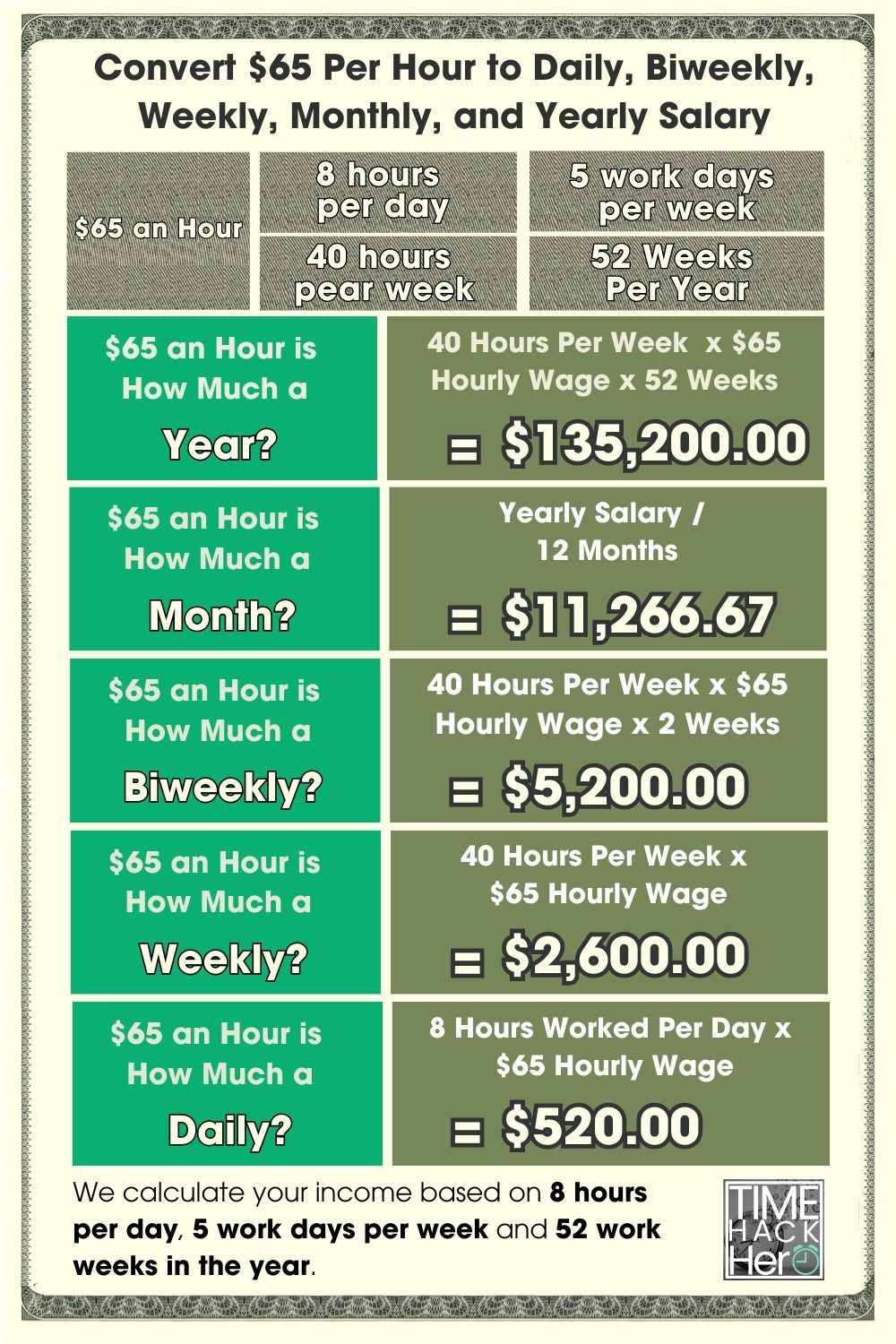
The standard full-time work week in many parts of the world, including the U.S., is considered 40 hours. And a typical working year? That's usually 52 weeks. So, if we do the math, it looks like this:
Must Read
- $65 per hour
- x 40 hours per week
- = $2,600 per week
- x 52 weeks per year
- = $135,200 per year
There you have it! A solid $135,200 annually. Not too shabby, right? This figure represents your gross annual income, meaning it's the total before any deductions take a bite. Think of it as the starting line for your financial journey.
Of course, this is a baseline. Some jobs might offer overtime, pushing that number even higher, while others might be salaried positions that equate to $65/hour but come with different expectations about hours worked. Always read the fine print! Also, remember that not all 52 weeks are necessarily "working" weeks. Most full-time jobs come with paid time off for holidays, vacation, and sick days, which is a fantastic perk of being gainfully employed.

Gross vs. Net: The Real Talk
Now, let's get real about what actually hits your bank account. Your gross income is a lovely number, but it's not what you'll see on your bi-weekly paycheck. This is where the magic (or sometimes, the slight disappointment) of deductions comes in. We're talking about:
- Federal Income Tax: Uncle Sam needs his share, and the exact percentage depends on your tax bracket, filing status, and deductions.
- State Income Tax: If you live in one of the states that collects it.
- Local Taxes: Some cities or counties have their own income taxes.
- FICA Taxes: This covers Social Security and Medicare, essential safety nets for everyone.
- Health Insurance Premiums: If you're getting coverage through your employer.
- Retirement Contributions: Like your 401(k) or 403(b) contributions (which are super smart!).
After all these deductions, you're left with your net income, or your "take-home pay." This is the number you'll actually be budgeting with. It's a good idea to factor in that your take-home pay might be anywhere from 60% to 75% of your gross, depending on where you live and your specific deductions. A quick online payroll calculator can give you a more personalized estimate!

Living Your Best Life on That Income
Earning $135,200 annually (gross) puts you in a very comfortable position in many parts of the world. In the U.S., it generally means you can afford a good quality of life, save for the future, and enjoy some luxuries. However, the exact lifestyle it affords can vary wildly depending on your cost of living. $135k in, say, Omaha, Nebraska, will feel very different from $135k in New York City or San Francisco.
Here’s what you might consider with this income:
- Housing: You'll likely have good options for renting or even buying a home, depending on your location and down payment.
- Savings: This income level allows for robust contributions to an emergency fund, retirement accounts, and other investment goals. Financial experts often recommend saving 15-20% of your gross income.
- Discretionary Spending: There's room for travel, hobbies, dining out, and other lifestyle choices that bring you joy.
- Debt Management: You should have ample flexibility to pay down student loans or other debts efficiently.
A fun fact: Historically, the "upper middle class" in the U.S. has often been defined by incomes that fall around this range, allowing for financial stability and upward mobility. It's a sweet spot where responsible financial planning can really pay off!
Beyond the Dollar Signs
While the numbers are important, remember that a job paying $65/hour is often about more than just the paycheck. It typically comes with a certain level of responsibility, skill, and expertise. Are there good benefits? Opportunities for growth? A healthy work-life balance? These "intangibles" contribute significantly to your overall job satisfaction and financial well-being.
So, what does $65 an hour annually really mean? It means a significant step towards financial freedom, the potential for a comfortable and enjoyable lifestyle, and the ability to plan for a bright future. It’s not just a number on a spreadsheet; it’s a gateway to choices, experiences, and peace of mind.