
How Much Fumes Does Abs Give Off Comapred To Pla
Okay, so picture this: I'm happily printing away, churning out a ridiculously oversized articulated dragon (because, why not?). PLA, smelling faintly of caramelized sugar, fills the air. No biggie. But then, a friend pops by, takes one sniff, and wrinkles their nose. "Dude," they say, "that's...intense. Is that stuff toxic or something?" It got me thinking: We all obsess over print speeds, layer heights, and perfect adhesion, but how often do we really consider what we're breathing in?
The question buzzing in my head, and probably now yours too, is: How much nastiness are we inhaling from ABS versus PLA? Let's dive in!
The VOC Lowdown: What are we talking about here?
First, a quick science lesson (don't worry, it'll be painless). 3D printing, especially with heated filaments like ABS, releases something called Volatile Organic Compounds (VOCs). These are basically gases emitted from solids or liquids. Common examples? Think paint fumes, nail polish remover, even some cleaning products. Not all VOCs are created equal; some are harmless, others… less so.
Must Read
The concern with 3D printing is that prolonged exposure to certain VOCs, particularly in poorly ventilated areas, could potentially cause health issues. Keyword: could. But better safe than sorry, right?
Side note: If you're thinking, "Wait, I thought I smelled plastic, not chemicals!" you're not wrong. The "plastic" smell is often a cocktail of various VOCs being released. Delicious, isn't it? (Said completely sarcastically, of course.)

ABS: The Fume-y Friend
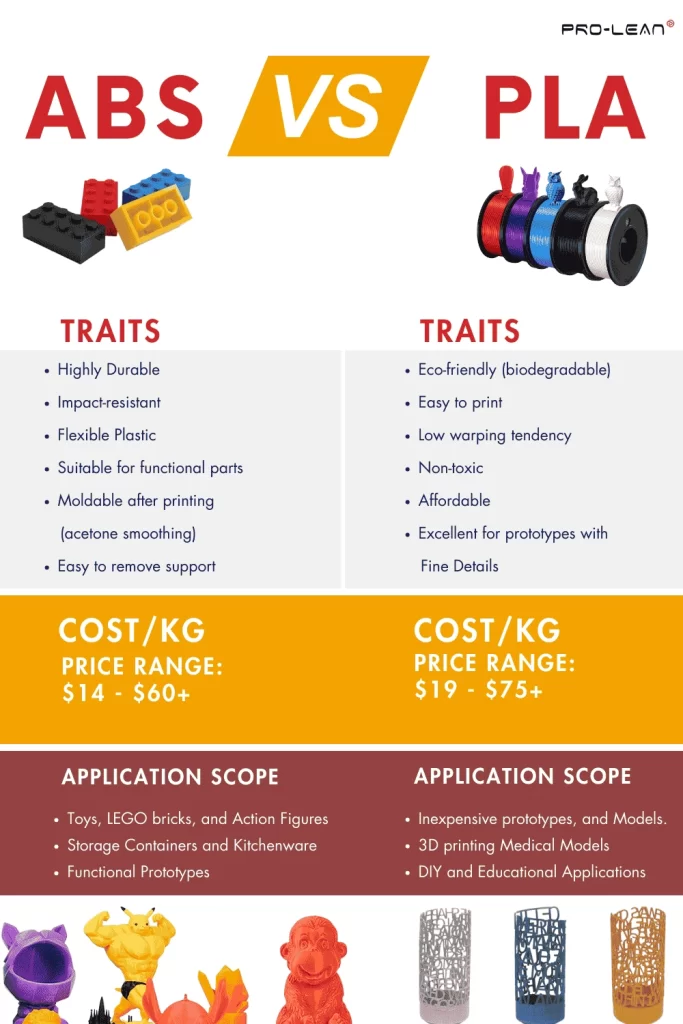
Here's the thing about ABS: It's a champ when it comes to strength, durability, and heat resistance. Perfect for functional parts that need to withstand some serious wear and tear. But… it also tends to release more VOCs than PLA. Specifically, ABS is known to emit styrene, a chemical that's on some people's "avoid at all costs" list.
Studies (yes, actual scientific studies!) have shown that ABS releases significantly higher levels of VOCs and ultrafine particles (UFPs) compared to PLA. These UFPs, tiny airborne particles, can penetrate deep into your lungs, which is… not ideal. The general consensus is that ABS is the more "fume-y" of the two.
![Thermal and mechanical properties of ABS and PLA [35]. | Download](https://www.researchgate.net/publication/372606151/figure/tbl2/AS:11431281177254653@1690418735408/Thermal-and-mechanical-properties-of-ABS-and-PLA-35.png)
Think of it this way: ABS is like that friend who always brings the party but leaves a trail of chaos in their wake. Great fun, but requires some cleanup.
PLA: The Sweeter, Gentler Option?
PLA, on the other hand, is often touted as the "eco-friendly" choice. Made from renewable resources like cornstarch or sugarcane, it's generally considered less harmful. And, in terms of VOC emissions, it's definitely the winner. PLA releases fewer VOCs overall, and the types of VOCs it emits are generally considered less toxic.

However! Don't get too comfortable. PLA isn't completely fume-free. It can still release some VOCs, including lactic acid (hence the slightly sweet smell) and other compounds. And, again, the UFPs are still a concern, even if they're fewer in number compared to ABS.
Basically, PLA is like the friend who brings a polite bottle of wine and cleans up after themselves. Less drama, overall.

So, What's the Verdict? And More Importantly, What Do I Do?
Okay, here's the bottom line: ABS generally produces more and potentially more harmful fumes than PLA. That doesn't mean PLA is completely harmless, but it's definitely the safer bet from an air quality perspective.
But what can you do about it? Here are a few tips to keep your lungs happy:
- Ventilation is Key: Print in a well-ventilated area. Open a window, use a fan – get that air moving! (This is a non-negotiable, folks.)
- Enclosures: Consider an enclosure for your printer. Many enclosures include filtration systems that can help capture VOCs and UFPs. (Especially important for ABS!)
- Filtration: Look into air purifiers specifically designed to remove VOCs and UFPs. HEPA filters are great for particles, but you'll want activated carbon filters for VOCs.
- Material Choice: When possible, opt for PLA. If you absolutely need ABS for a project, be extra diligent about ventilation.
- Low-Emission Filaments: Some manufacturers are now offering "low-VOC" or "eco-friendly" filaments. Do some research and see if they're a good fit for your needs.
Ultimately, the goal is to minimize your exposure to potentially harmful fumes. A little awareness and some simple precautions can go a long way in keeping your 3D printing hobby fun and healthy. Now, if you'll excuse me, I'm off to ventilate my dragon-printing lair!