
How Much Electricity Does A Mini Refrigerator Use

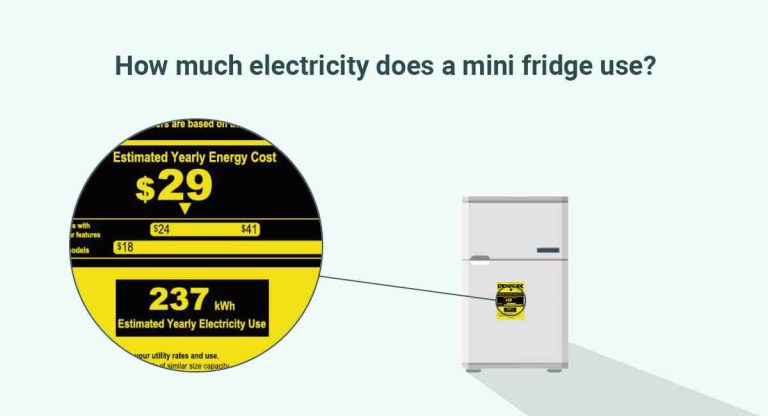
Let's talk mini fridges. Those compact cubes of coolness are the unsung heroes of dorm rooms, home offices, and man caves everywhere. But how much juice do these little guys actually suck up? We're diving deep (well, not that deep, they're mini after all!) into the world of mini-fridge electricity consumption. Consider this your energy-saving cheat sheet to keeping your drinks chilled without sending your electricity bill into orbit.
The Watt's Up Breakdown: Understanding Mini Fridge Power
First things first, let's talk wattage. Most mini fridges range from 50 to 150 watts. Think of it like this: a 50-watt fridge is like a super-efficient little hummingbird, sipping energy sparingly. A 150-watt fridge? More like a slightly larger, slightly thirstier hummingbird.
But wattage is just a snapshot. To figure out how much electricity your mini fridge is actually using, we need to consider how often it's running. Mini fridges don't run 24/7. The compressor kicks in to cool things down, then shuts off. This "on-off" cycle depends on a few things:
Must Read
- The temperature setting: Lowering the temperature means the compressor runs more often. Think of it like setting your thermostat to “Arctic Blast” in summer – your AC will work overtime.
- How often you open the door: Every time you open the door, warm air rushes in, forcing the fridge to work harder to cool back down. So, resist the urge to stand there and contemplate your beverage options like you’re in a 7-Eleven.
- Ambient temperature: A mini fridge in a sweltering garage will naturally work harder than one in a cool, air-conditioned room.
Calculating Your Consumption: A Little Math (We Promise It's Easy!)
Okay, time for some quick math. Don't worry, it's not calculus. Let's say your mini fridge uses 100 watts and runs for about 8 hours a day (a pretty typical estimate).
Here’s the formula:

(Wattage x Hours Used Per Day) / 1000 = Daily Kilowatt-hour (kWh) Consumption
So, (100 watts x 8 hours) / 1000 = 0.8 kWh per day.
Now, to calculate your monthly consumption, multiply the daily kWh by the number of days in the month. Let's assume a 30-day month:
0.8 kWh/day x 30 days = 24 kWh per month.
Finally, to find out how much this costs, multiply your monthly kWh consumption by your electricity rate (check your electricity bill – it's usually listed in cents per kWh). Let's say your electricity rate is $0.15 per kWh:

24 kWh x $0.15/kWh = $3.60 per month.
Not bad, right? A measly $3.60 a month for frosty beverages! Of course, this is just an estimate. Your actual consumption may vary.
Pro Tips for Energy Savings: Keeping it Cool (and Cheap!)
Want to minimize your mini fridge's energy footprint? Here are some easy tips:
- Keep it full (but not too full!): A full fridge retains cold better than an empty one. Think of it like a crowd of penguins huddling together for warmth. But don’t overstuff it – that can block airflow and make the fridge work harder.
- Place it wisely: Keep your mini fridge away from direct sunlight, heat sources (like ovens or radiators), and other appliances that generate heat. Give it some breathing room – don't shove it right up against a wall.
- Defrost regularly: Ice buildup makes the fridge work harder. Manual defrost models need a little TLC every now and then.
- Check the door seal: Make sure the door seal is airtight. A worn-out seal lets cold air escape, forcing the compressor to run more often. You can test the seal by closing the door on a dollar bill. If you can easily pull the bill out, the seal needs replacing.
- Consider an Energy Star model: Energy Star certified appliances meet strict energy efficiency guidelines. They might cost a bit more upfront, but they'll save you money in the long run. Think of it as an investment in future savings.
Remember the phrase "A penny saved is a penny earned" from Poor Richard's Almanack by Benjamin Franklin? Well, an energy unit saved is an energy unit not spent on your bill!
Beyond the Bill: The Bigger Picture
While the cost of running a mini fridge might seem insignificant, every little bit adds up. By being mindful of our energy consumption, we can collectively reduce our impact on the environment. Plus, saving a few dollars here and there allows us to splurge on the things that truly matter, like that extra-large popcorn at the movies or a fancy new gadget.
Ultimately, understanding how much electricity your mini fridge uses is about more than just saving money. It's about being a conscious consumer and making small changes that can have a big impact. So, go forth and chill responsibly!