
How Much Electricity Does A Ceiling Fan Consume

Alright, gather 'round, folks! Let's talk ceiling fans. I know, I know, it sounds about as exciting as watching paint dry. But trust me, we're gonna make this electrifying! (Pun absolutely intended.) We're diving deep into the question that plagues us all: how much juice does that spinning whirlwind hanging from my ceiling actually drink?
Now, I could just throw some numbers at you, but where's the fun in that? That's like serving a cake without frosting. We need to jazz this up! Imagine your ceiling fan as a tiny, perpetually hungry hamster on a wheel. Only instead of hamster food, it craves electricity. Awww, cute, right? But also, potentially pricey.
The Truth About Watts (and What They Mean to Your Wallet)
Must Read
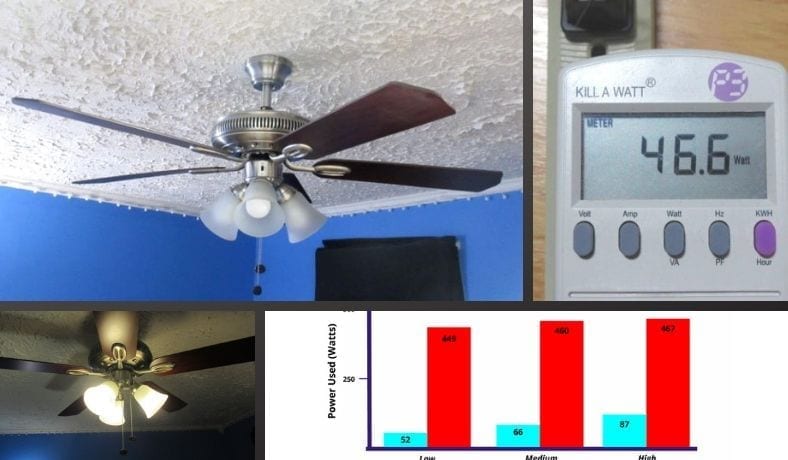
Okay, deep breath. Here comes the techy stuff, but I promise to keep it painless. The amount of electricity a ceiling fan uses is measured in watts. Think of watts like the hamster's appetite. A bigger appetite (more watts) means more electricity consumed. Most ceiling fans, especially the modern ones, are surprisingly energy-efficient. They generally slurp down anywhere from 15 to 75 watts. Compare that to your incandescent lightbulb that might be gobbling up 60-100 watts just to glow! See? Our little hamster isn't such a glutton after all.
Here’s a little secret: DC motor ceiling fans are the rockstars of energy efficiency. They use significantly less electricity than their AC motor counterparts. Think of it like comparing a Prius to a gas-guzzling Hummer. Both will get you there, but one will leave your wallet weeping quietly in the corner.

Speed Demons and Their Electrical Appetites
Just like us on a Monday morning, ceiling fans have different speeds. And just like our energy levels on a Monday morning (low!), the amount of electricity they use varies depending on the speed. On high speed, that hamster is really booking it, and the electricity consumption goes up. On low speed, it's more of a leisurely stroll, and the electricity usage is minimal. Think of it as the difference between sprinting and taking a nap. One requires a lot more energy than the other.
So, How Much Is This REALLY Costing Me?
Alright, let's get down to brass tacks. You want to know how much this whirling dervish is costing you, right? Here's where we do a little bit of math. Don't run away screaming! It's easier than assembling IKEA furniture, I promise.
First, find out how much your electricity company charges per kilowatt-hour (kWh). This is usually printed on your electric bill. Let's say it's 15 cents per kWh (or $0.15).
Next, let's assume your ceiling fan uses 60 watts on average. To convert watts to kilowatts, divide by 1000: 60 watts / 1000 = 0.06 kW.

Now, let's say you run your ceiling fan for 8 hours a day. Multiply the kilowatt usage by the number of hours: 0.06 kW * 8 hours = 0.48 kWh per day.
Finally, multiply that by the cost per kWh: 0.48 kWh * $0.15/kWh = $0.072 per day. That's about 7 cents a day! Basically, the price of a gumball. Or, if you're feeling fancy, maybe half a stick of gum these days.
Over a month (30 days), that's $0.072/day * 30 days = $2.16. So, running your ceiling fan for 8 hours a day will likely cost you around $2.16 per month. Not bad, eh? I mean, you probably spend more than that on coffee. (Guilty as charged!)

Pro-Tips to Become a Ceiling Fan Energy Guru
Want to squeeze even more savings out of your ceiling fan? Here are a few tips:
- Use the Right Size Fan: A tiny fan in a huge room is like bringing a water pistol to a house fire. It’s just not effective. Get a fan that's appropriately sized for the room.
- Use the Right Direction: Did you know ceiling fans have a switch to change the direction of the blades? In the summer, the blades should rotate counter-clockwise to create a downdraft and cool you off. In the winter, switch it to clockwise to gently circulate warm air. This can actually help you save money on heating!
- Turn it Off When You Leave: This seems obvious, but it's worth mentioning. If you're not in the room, turn off the fan! There's no point in cooling or warming an empty space. It's like talking to a wall – pointless and slightly unsettling.
- Clean the Blades: Dusty blades make your fan work harder, which means it uses more energy. Plus, nobody wants to live under a cloud of dust bunnies. A quick wipe-down every now and then will keep your fan happy and efficient.
- Consider a Smart Fan: Technology to the rescue! Smart ceiling fans can automatically adjust their speed based on the room temperature and even turn off when you leave the room. They're like the self-driving cars of the ceiling fan world.
The Verdict: Ceiling Fans - Energy Savvy Heroes
So there you have it. Ceiling fans are actually pretty energy-efficient little devices. They can help you save money on your energy bill, keep you comfortable, and even add a touch of style to your home. Just remember to use them wisely, and don't let that tiny hamster work too hard! Now, if you'll excuse me, I'm going to go adjust the direction of my ceiling fan. It's getting a little chilly in here…