
How Much Electricity Do Led Christmas Lights Use
Okay, so you're staring at your Christmas tree, right? Twinkling, shimmering, radiating festive cheer. But then... BAM! Reality hits you like a rogue snowball. You start wondering, "How much is this magical wonderland costing me?" We've all been there. It's the universal holiday conundrum – the joy versus the electricity bill.
Let's talk about Christmas lights, specifically the LED kind. We're ditching the old incandescent bulbs here. Those things were energy vampires, sucking up power like a toddler slurping down a juice box. Remember how hot they'd get? You could probably cook a mini-marshmallow on one. Not exactly energy efficient.
LEDs to the Rescue!
LEDs (Light Emitting Diodes) are the new cool kids on the block, the energy-sipping superstars of holiday lighting. Think of it this way: incandescent bulbs are like that gas-guzzling SUV your Uncle Jerry drives, while LEDs are like a sleek, electric scooter. One is a wallet-drainer, the other is… well, not.
Must Read
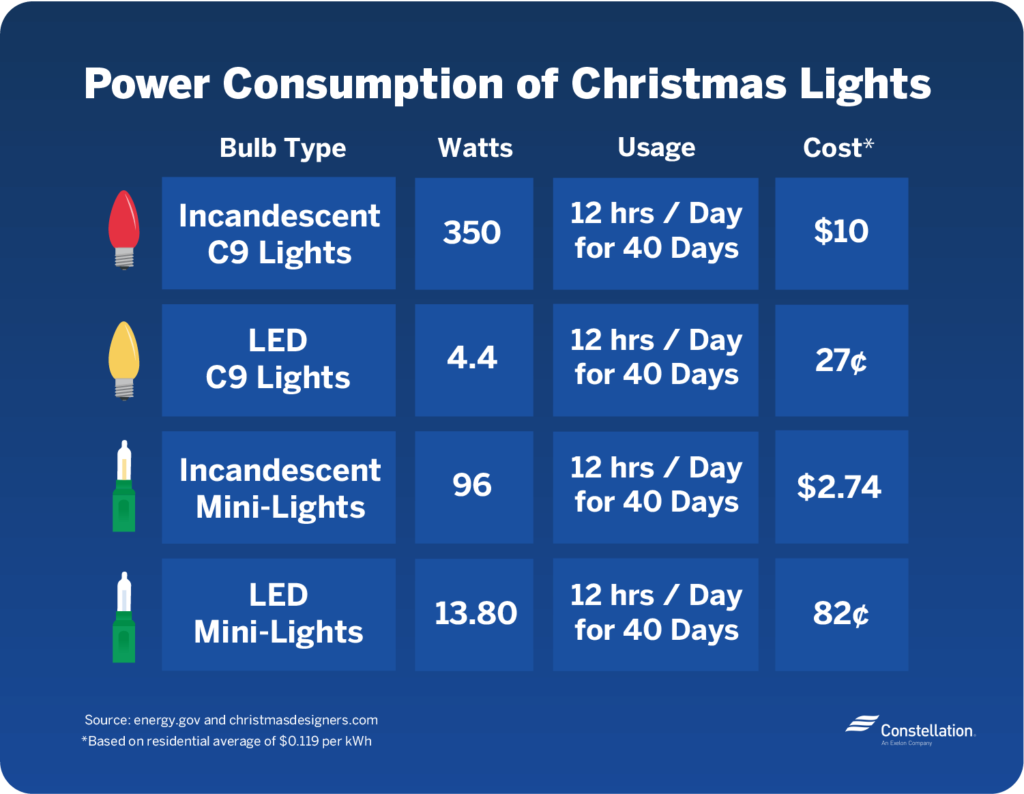
So, how much electricity DO they use? Generally speaking, LED Christmas lights use about 80-90% LESS electricity than their incandescent counterparts. Seriously! That's a HUGE difference. We're talking pennies compared to dollars.
The Nitty-Gritty (But Not Too Nitty)
Let's get a tiny bit more specific, but I promise to keep it painless. The actual wattage of your LED Christmas lights will depend on a few things:
- The length of the strand: More lights equals slightly more juice.
- The type of LED: Some are more efficient than others.
- The manufacturer: Quality matters! Cheaper isn’t always better in the long run.
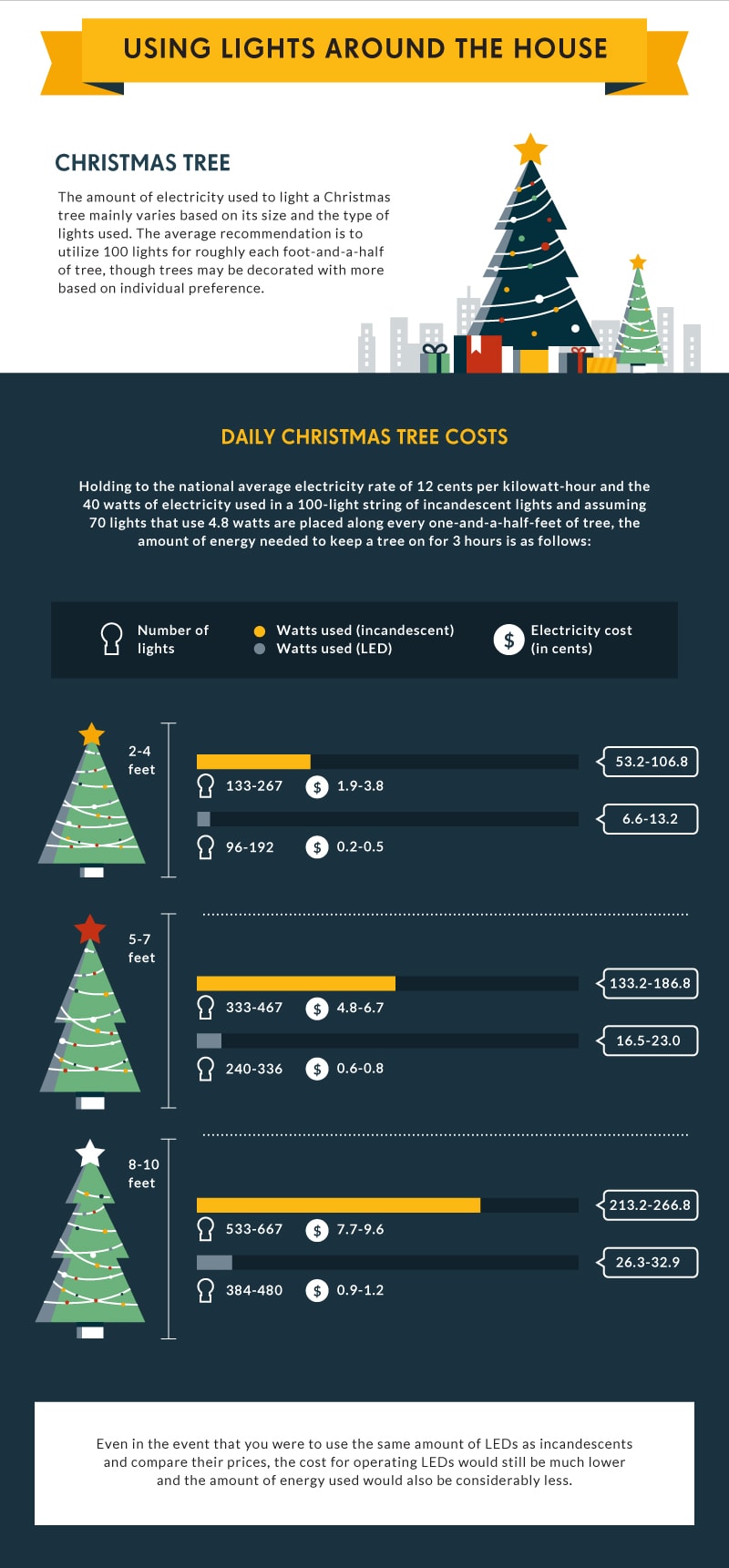
But as a general rule of thumb, a string of 100 LED mini-lights will use around 2-4 watts. That's like… less than your phone charger! To put that into perspective, 100 incandescent mini-lights would gobble up around 40-50 watts. See the difference? Told ya.
To figure out the cost, you need to know your electricity rate. Look at your electricity bill – it's usually expressed in cents per kilowatt-hour (kWh). Let’s say your rate is 15 cents per kWh.
Here's some very simple math that I promise won't make your brain hurt:
- Convert watts to kilowatts: Divide the wattage by 1000. So, 4 watts / 1000 = 0.004 kW
- Multiply by the hours you use the lights: Let's say you leave your lights on for 6 hours a day. 0.004 kW * 6 hours = 0.024 kWh
- Multiply by your electricity rate: 0.024 kWh * $0.15/kWh = $0.0036 per day
That's $0.0036 per day for a string of 100 LED lights. Yes, you read that right. Less than half a cent per day! You could practically power your whole Christmas display with the spare change you find in your couch cushions. (Okay, maybe not quite, but you get the idea.)
Real-Life Scenarios (Because Math Can Be Scary)
Okay, so let's say you have 5 strings of 100 LED lights, and you leave them on for 6 hours every night for 30 days. Assuming the same electricity rate (15 cents per kWh), the total cost would be around… $0.54. That's less than a cup of coffee!
Now, compare that to 5 strings of incandescent lights. You'd be looking at something closer to $10 - $15 for the same period. Ouch!
The Takeaway? Don't Be a Scrooge!
The bottom line is that switching to LED Christmas lights is a smart move. It’s good for your wallet, good for the environment, and good for your holiday spirit. You can deck the halls without feeling like you're single-handedly funding the local power company. Enjoy the glow! And maybe use the money you save to buy yourself an extra present. You deserve it!
So, go ahead, string up those lights and revel in the festive glow. Because this holiday season, you can be merry AND frugal. Now, if you'll excuse me, I'm off to untangle another string of lights... wish me luck!
