
How Many Watts To Run Camper Ac
Ah, the open road! The smell of pine trees, the sound of crickets, and... the sweltering heat inside your camper after a long day of adventuring. You know the feeling, right? That moment when all you want is a blast of glorious, cool air. And that's when the big question often pops into mind: how in the world do I get my AC to work out here? More specifically, how many watts does it actually take to run a camper AC?
It's a question that might sound a bit technical at first, like something only an electrical engineer would ponder. But trust me, once you start diving into the amazing world of RVing, understanding your power needs becomes as exciting as planning your next scenic route. It's about freedom, comfort, and making sure your adventures are always chill – literally!
What's a Watt, Anyway? (And Why Do We Care?)
Let's start with the basics, shall we? Think of a watt as the "oomph" or the "muscle" that an electrical appliance needs to do its job. It's the unit of power. A tiny LED lightbulb might need just 5 watts, while your microwave probably gulps down over 1000 watts. Your camper's air conditioner? Well, it's a bit of a power hungry beast, and for good reason – it's battling against the sun to keep you frosty!
Must Read
Knowing your AC's wattage is super important, especially if you dream of camping off-grid, far away from those precious electrical hookups. Because whether you're relying on a generator or a fancy battery and inverter setup, you need to know if you have enough juice to keep that cold air flowing.
The Tale of Two Wattages: Starting vs. Running
Here's where it gets a little interesting and often confuses people. An AC unit actually has two different wattage numbers you need to care about:
- Starting Watts (or Surge Watts): Imagine pushing a heavy car from a dead stop. It takes a lot more initial effort, right? That's your starting watts! When your AC first kicks on, its compressor needs a big burst of power to get going. This surge can be 2 to 3 times higher than its regular running wattage.
- Running Watts: Once the car is moving and cruising down the road, it takes less effort to keep it going. That's your running watts! This is the amount of power your AC needs consistently to keep cooling once it's already started.
So, a common 13,500 BTU RV air conditioner might need around 2,800-3,500 starting watts for a quick moment, but then settles down to about 1,200-1,700 running watts. A larger 15,000 BTU unit could demand 3,000-4,000 starting watts and then about 1,500-2,000 running watts.
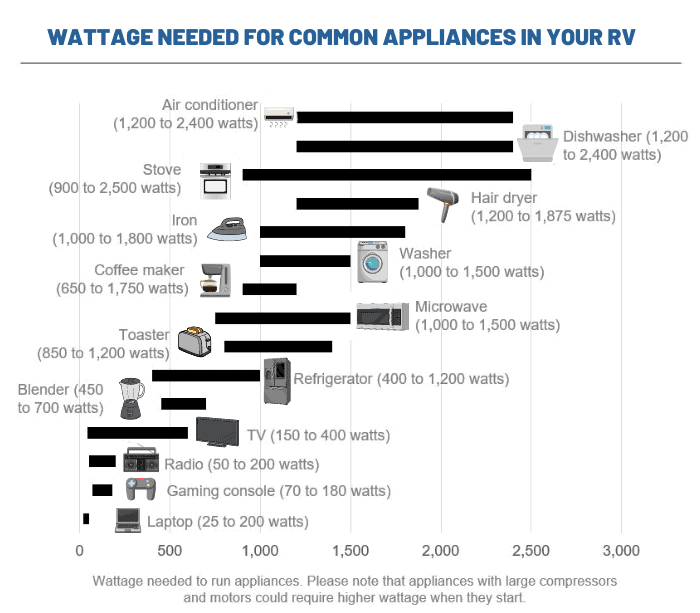
See the big difference? It's crucial for picking the right generator or designing a robust battery system!
What Affects Those Numbers?
It's not just a fixed number for every AC. A few things can influence how much power your unit draws:
- Outside Temperature: The hotter it is outside, the harder your AC has to work, and the more watts it will pull.
- RV Insulation: A well-insulated RV means your AC doesn't have to work as hard, potentially saving a few watts.
- Unit Age & Efficiency: Older units might be less efficient, meaning they need more watts to produce the same amount of cool air.
The "Soft Start" Game Changer!
Okay, here's a super cool trick that many RVers are embracing: a soft start device. Remember those huge starting watts? A soft start essentially gives your AC a "gentle push" instead of a big shove. It cleverly manages that initial surge, often reducing the starting watts by up to 70%!

This means if your AC needed 3,500 starting watts, a soft start could drop that to around 1,200 watts. Why is this awesome? Because it allows you to run your AC on smaller generators, or even with less powerful battery/inverter setups than you'd normally need. It's like giving your AC a calming pill so it doesn't freak out when it first turns on!
Matching Power Sources to Your AC's Thirst
Now that we know the watts, how do we get them?
1. Shore Power (The Easy Button)
If you're plugged into an RV park's electrical pedestal (shore power), you usually don't have to worry too much. Most pedestals provide 30 or 50 amps, which is plenty of power for one or even two AC units and all your other gadgets.

2. Generators (Your Mobile Power Plant)
This is where understanding watts really shines for boondockers! When you buy a generator, its power output is listed in watts. If your AC needs 3,500 starting watts, you'll need a generator that can provide at least that much. A popular choice for running one AC is a 3,000 to 4,000 watt inverter generator. Remember to account for other things you might want to run, like a microwave or coffee maker, which also use a lot of watts!
3. Batteries and Inverters (The Silent Power Solution)
This is the ultimate dream for many: running AC silently on batteries! It's totally doable, but it requires a more robust setup. You'll need:
- A large battery bank: Measured in amp-hours (Ah), this determines how long you can run things. Running an AC for hours on batteries requires a significant investment in lithium batteries.
- A powerful inverter: This converts your battery's DC power into the AC power your air conditioner needs. Your inverter must be able to handle the starting watts of your AC.
This setup usually works best for running your AC's running watts for a sustained period, especially if you have solar panels to help recharge. Without solar, even big battery banks can be drained quickly by an AC.

So, How Many Watts? The Quick Rundown
While checking your specific unit's label is always best, here's a general idea for common RV ACs:
- 13,500 BTU AC:
- Starting: ~2,800 - 3,500 watts
- Running: ~1,200 - 1,700 watts
- 15,000 BTU AC:
- Starting: ~3,000 - 4,000 watts
- Running: ~1,500 - 2,000 watts
And remember, a soft start device can dramatically reduce those starting watts, making your life (and your power planning) much easier!
The Cool Takeaway
Understanding "how many watts to run camper AC" isn't just about numbers; it's about unlocking more possibilities for your RV adventures. It's about knowing you can pull up to that stunning, remote campsite, fire up your power source, and still enjoy a comfortable, cool night's sleep. It's empowering, really!
So, next time you're dreaming of escaping the heat, you'll have a much clearer idea of what it takes to keep your camper a sanctuary of coolness. Happy travels, and may your AC always blow crisp, refreshing air!