
How Many Watts Per Kilowatt Hour
Alright, settle in, grab your imaginary (or actual, no judgment here) espresso, because we're about to dive into one of those questions that makes perfectly sensible adults stare blankly into the middle distance. It's like asking, "How many scoops of ice cream are in a really good song?" You pause. You ponder. And then you realize... wait a minute, those are two entirely different things.
The question at hand, my friends, is: "How many watts per kilowatt-hour?" And if your brain just did a little mental tilt, congratulations, you're not alone! This isn't just a technical query; it's a magnificent little linguistic trickster, a riddle wrapped in an electrical enigma.
Let's Talk Watts: The Oomph Factor!
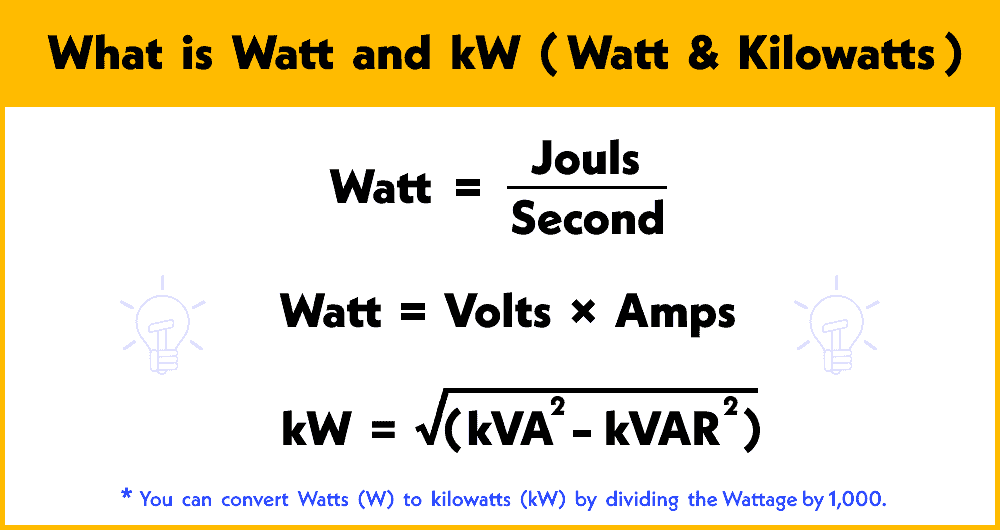
First things first, let's get acquainted with our pal, the Watt. Think of a Watt (W) as a measure of power. It's the "oomph," the "go," the "how fast it's doing something" of electricity. When you look at a lightbulb, a blender, or even your phone charger, you'll see a Watt rating. That tells you how much electrical power it demands at any given moment to do its job.
Must Read
A 100-watt lightbulb uses 100 watts of power. A toaster might be 1500 watts, because toasting needs a lot of instantaneous "oomph." It's like saying, "This car can go 100 miles per hour!" That's its power, its potential speed. It doesn't tell you how far it's actually gone, just how fast it could go.
So, watts are about rate. They're about how quickly something is chugging down that electrical goodness.

Enter the Kilowatt: The Bigger Oomph!
Now, a kilowatt (kW) is simply 1,000 watts. That's it. No magic. No mysterious transformation. It's just a bigger bundle of watts, like saying "a grand" instead of "a thousand dollars." So, if your toaster is 1500 watts, it's 1.5 kilowatts. Easy peasy lemon squeezy.
Still just about that instantaneous "oomph," that rate of power consumption. We're getting somewhere, but we're not quite at the heart of our conundrum yet.
The Plot Twist: The Kilowatt-Hour!
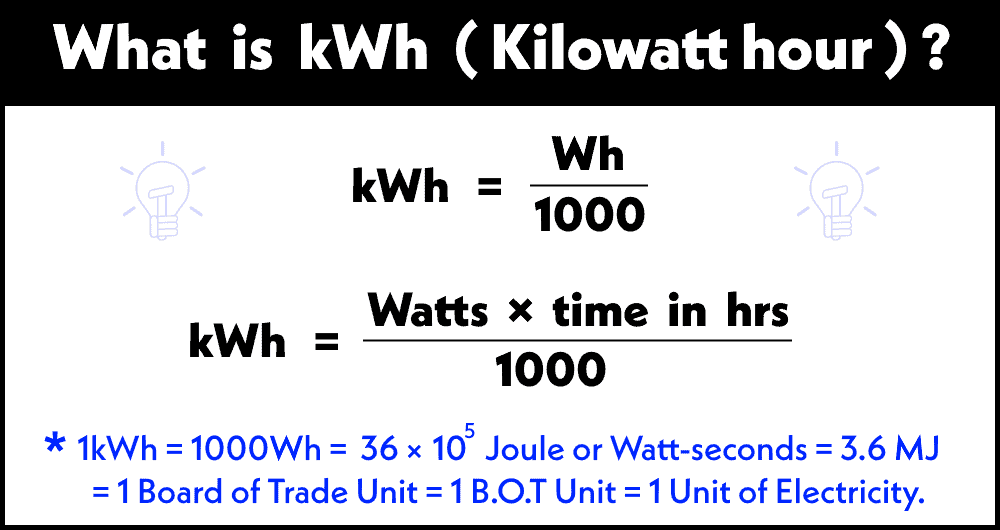
This is where things get interesting, and where the "trick" in our initial question reveals itself. Say hello to the kilowatt-hour (kWh). This isn't just about how powerful something is; it's about how much energy it uses over time. This is the big one. This is what your electricity meter tracks. This is what you pay for!

A kilowatt-hour is literally one kilowatt of power, used for one hour. Think about it this way: if your 100-watt lightbulb (which is 0.1 kW) stayed on for ten hours, it would consume 1 kilowatt-hour of energy (0.1 kW * 10 hours = 1 kWh). If your mighty 1.5 kW toaster was left on for, say, 40 minutes (0.66 hours), it would use 1 kWh (1.5 kW * 0.66 hours = 1 kWh, approximately).
So, while watts measure how fast you're consuming power, kilowatt-hours measure the total amount of energy consumed. It's the difference between "how fast you're driving" (watts/kilowatts) and "how far you've driven" (kilowatt-hours).

The Great Clarification: Why You Can't Have Watts "Per" Kilowatt-Hour
And here's the mic drop moment: You can't ask "how many watts per kilowatt-hour" because they are measuring fundamentally different things. It's like asking "How many speeds are there per journey?" The question itself is a non-starter.
Watts (or kilowatts) are a unit of power (energy rate). Kilowatt-hours are a unit of energy (power over time). You wouldn't ask how many miles per hour are in a mile, right? One is a speed, the other is a distance. Just like one is a rate, and the other is a total quantity.
So, the answer to "How many watts per kilowatt-hour?" is actually... none. The question itself is based on a slight misunderstanding of the units. It's like asking how many apples are in a basket of oranges. You just can't make that direct comparison.
Why This Matters (Beyond Winning Trivia Night)
Understanding this distinction is actually super useful! It helps you:
- Decipher your electricity bill: You're charged for kWh, not just kW. So, a powerful appliance used sparingly might cost less than a less powerful one left on all day.
- Be energy smart: A high-wattage device might seem like an energy hog, but if you only use it for a few minutes (like that toaster!), its total kWh consumption might be quite low compared to, say, a low-wattage fan running for 24 hours straight.
- Impress your friends at parties: "Did you know you can't actually measure watts per kilowatt-hour? It's like apples and oranges!" Guaranteed conversation starter. Or, just a quick way to clear the room, depending on your friends.
So, next time someone throws that question at you, you can smile knowingly, take a sip of your coffee, and explain with newfound clarity that a watt is a measure of instantaneous power, and a kilowatt-hour is a measure of energy consumed over time. They're related, yes, but they're not interchangeable in that "per" relationship.
You're not measuring one within the other; you're using one to calculate the other. And that, my friends, is the entertaining (and slightly mind-bending) truth about watts and kilowatt-hours!