
How Many Watts For A Light Bulb
Alright, settle in, grab your imaginary latte, because we're about to dive into one of life's truly baffling mysteries: how many watts does a light bulb need? Or, more accurately, what in the heck do those numbers even mean anymore?
Remember the good old days? You walked into a hardware store, maybe humming a jaunty tune, and you knew exactly what you wanted. "Give me a 60-watt bulb!" you'd declare, with the confidence of someone who understands basic physics. Sixty watts meant a nice, warm glow. One hundred watts? That was for when you wanted to turn your living room into a sun-drenched operating theatre. Simple. Elegant. And, frankly, a little bit dangerous if you touched it right after turning it off. Ouch!
The Incandescent Era: Watts Meant Brightness (and Heat!)
Back then, with those classic, glowing-filament incandescent bulbs, the wattage number was pretty straightforward. It told you how much electricity the bulb was guzzling down. And, as a happy side effect (or maybe an unhappy one for your electricity bill), more electricity usually meant a brighter light. It was a direct correlation, like saying "the more cake I eat, the happier I am." Mostly true!
Must Read
The catch? Most of that electricity wasn't actually going into making light. Oh no. A whopping 90% of an incandescent bulb's energy was wasted as heat! Think about that for a second. Ninety percent! It's like buying a fancy car where 90% of the fuel just evaporates before it even reaches the engine. We were basically buying tiny, inefficient space heaters that also happened to emit a little bit of light.
So, when you screwed in that old 100-watt bulb, you weren't just lighting your room; you were subtly (and expensively) increasing the ambient temperature. Your electricity meter was spinning like a tiny hamster on an espresso machine, and the planet was quietly weeping into its metaphorical pillow. But hey, it was bright!
Enter the Revolution: CFLs and LEDs Shake Things Up
Then, like a superhero swooping in with a much better power source, came the fluorescent and later, the LED bulbs. And suddenly, our cozy, familiar world of watts got turned upside down. You started seeing bulbs proudly proclaiming "13 watts!" and you'd think, "Thirteen watts? That's barely enough to power a very confused ant's nightlight!"
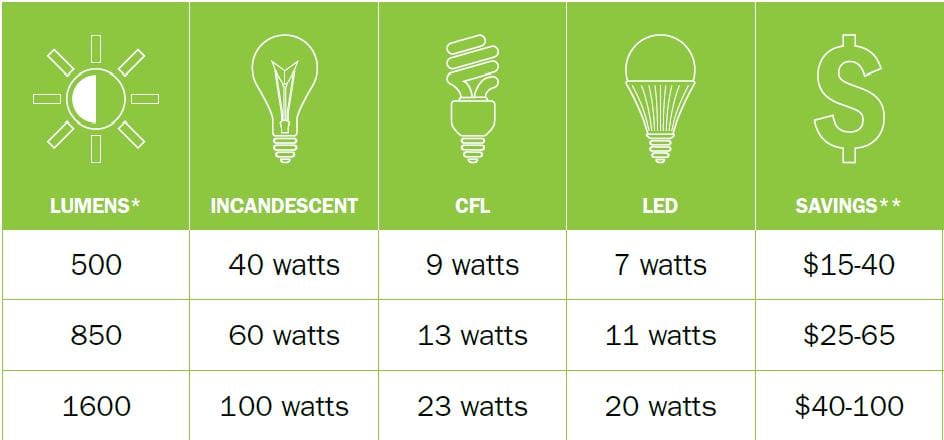
But then you'd screw it in, flick the switch, and BAM! Your room was bathed in light comparable to that old 60-watt incandescent. What sorcery was this? Had the laws of physics been rewritten while we were all busy trying to figure out how to program a VCR?
Not quite. The new bulbs, especially LEDs, are incredibly efficient. They've figured out how to turn most of that electricity directly into light, instead of frittering it away as heat. It's like our car example again, but this time, the engine actually uses the fuel instead of just warming up the driveway.
This means the traditional "watts = brightness" equation went right out the window. Now, a low watt number isn't a sign of weakness; it's a badge of honor! It means you're getting a ton of light for very little energy. Your electricity meter is now gently strolling, perhaps humming a jaunty tune of its own.
So, What Do We Look For Now? The Mighty Lumens!
If watts no longer tell us how bright a bulb is, what does? Get ready for your new best friend: lumens. Lumens are the hero of our story, the true measure of a light bulb's brightness. Think of it this way:
- Watts tell you how much energy the bulb consumes.
- Lumens tell you how much light the bulb produces.
It's like horsepower versus speed. A car might have high horsepower (watts), but if it's ridiculously heavy, it won't go fast (low lumens). Conversely, a lightweight car with less horsepower (low watts) could be incredibly zippy (high lumens)!
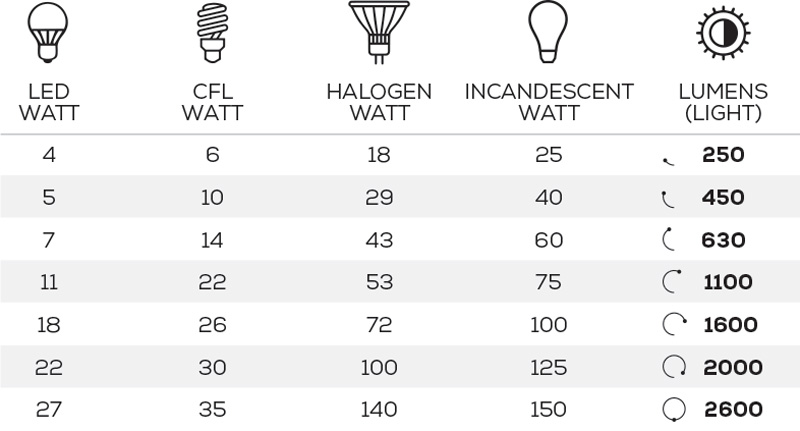
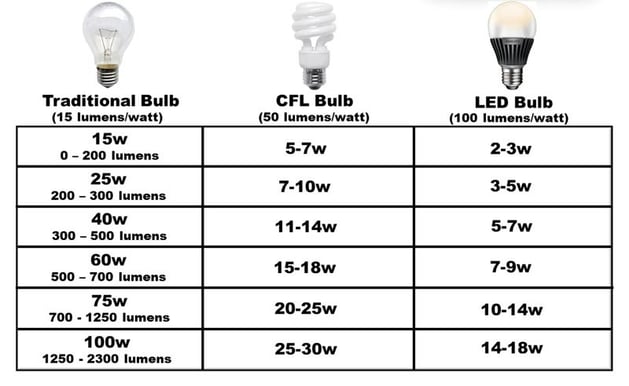
So, when you're staring blankly at the light bulb aisle, trying to decipher the hieroglyphics on the packaging, look for that magical lumen number. A typical old 60-watt incandescent bulb produced about 800 lumens. So, if you want that same level of brightness, look for an LED that gives you around 800 lumens, even if its wattage is a mere 9 or 10 watts. See? It's like getting a Ferrari for the price of a scooter!

Beyond Brightness: Color Temperature (Kelvin)
Oh, but wait, there's more! Because humans are complicated creatures, we don't just want light; we want the right kind of light. This is where Kelvin (K) comes into play. Kelvin measures the color temperature of the light. Are we talking cozy, warm glow, or harsh, "interrogation room" white?
Lower Kelvin numbers (like 2700K) mean a warm, yellowish light, much like your traditional incandescent. Perfect for a relaxing evening, reading a book, or pretending you're in a charming Parisian café. Higher Kelvin numbers (say, 5000K or 6500K) mean a cooler, bluer, daylight-like light. Great for tasks, workshops, or when you want to feel like you're under a super-bright sky, even at midnight. Nobody wants to relax under hospital-grade lighting, trust me.
The "Equivalent" Wattage Trap
Manufacturers, bless their cotton socks, knew we were all going to be utterly confused. So, they started putting "60W Equivalent" on LED packaging. This was a helpful crutch, a bridge from the old world to the new. But it can still be misleading if you don't grasp the underlying concept of lumens.

The "equivalent" means it produces roughly the same number of lumens as a traditional incandescent of that wattage. It does NOT mean it uses that much power. So, if you see a 9-watt LED labeled "60W Equivalent," it means it's bright like a 60-watt incandescent, but it only uses 9 watts of electricity. Your wallet (and Mother Earth) will be doing a little happy dance.
So, How Many Watts For A Light Bulb?
The answer, my friend, is often a wonderfully small number! Stop thinking in watts for brightness. Start thinking in lumens for brightness and Kelvin for mood. The lower the wattage on your LED or CFL, the better, assuming it gives you the lumens you need.
You're not just saving money; you're also reducing your carbon footprint and enjoying bulbs that last so long, you might actually forget where you stored the spare ones. We're talking 10, 15, even 25 years for some LEDs! Your grandkids might still be using the same bulb you bought today. How's that for efficiency?
So next time you're in the light bulb aisle, don't be swayed by high watt numbers. They're a relic of a bygone era. Embrace the lumens, pick your perfect Kelvin, and enjoy a brilliantly lit, energy-efficient future. Now, if you'll excuse me, I'm off to find a 1-watt bulb that can light up my entire street. A man can dream, can't he?