
How Many Watts Does Air Conditioner Use Per Hour
Alright, folks, gather 'round! Let's talk air conditioners, those beautiful, humming boxes of sweet, sweet relief. But let's be honest, they're also energy-guzzling monsters. The question on everyone's mind, whispered in hushed tones as the electricity bill arrives, is: "Just how many watts is this thing sucking down per hour?"
Trying to figure out an exact number is like trying to herd cats...with a feather duster...while wearing roller skates. It's messy, unpredictable, and you're probably going to fall down. But fear not, I'm here to give you the lowdown, the skinny, the whole enchilada on AC wattage.
The Wild World of Wattage
First things first, there's no one-size-fits-all answer. It's not like ordering a coffee, where you know a "large" is roughly 20 ounces. Air conditioner wattage varies wildly based on several factors. Think of it like this: your grandma's tiny window unit isn't going to chug power like a central AC system cooling down the Taj Mahal.
Must Read
Size matters. A bigger AC, with more cooling power measured in BTUs (British Thermal Units – sounds impressive, right?), needs more watts to operate. Consider this: a small window unit (5,000 BTU) might use around 450 watts, while a large central AC unit (36,000 BTU) could be sucking down a whopping 3,500 watts or more!
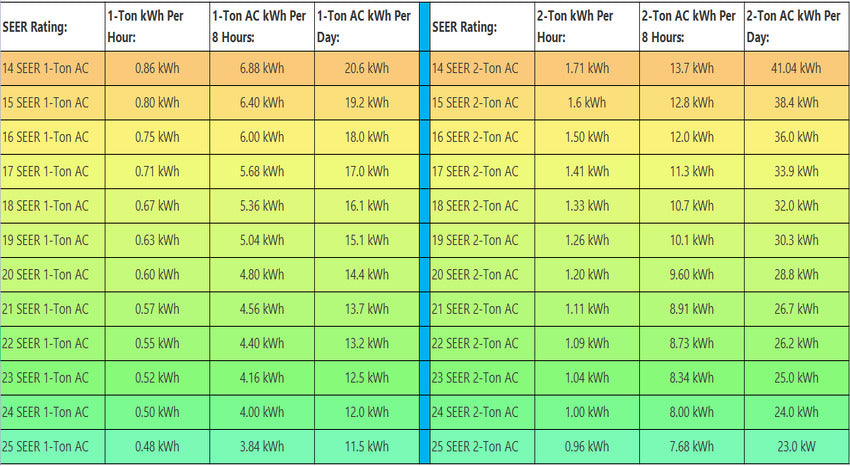
Then you have the energy efficiency. Think of it like comparing a gas-guzzling Hummer to a sleek electric car. Some ACs are designed to be more efficient, using less power to achieve the same cooling. Look for a high SEER rating (Seasonal Energy Efficiency Ratio) – the higher, the better!

Pro-Tip: Buying a super-efficient AC is like investing in a good pair of shoes. It costs more upfront, but your feet (and your wallet) will thank you in the long run.
Breaking it Down: A Wattage Workout
So, how do we get a handle on this wattage business? Let's break it down with some estimates. These are just guidelines, mind you. Don't come yelling at me if your AC decides to break the rules.

- Small Window Unit (5,000 - 6,000 BTU): 450 - 700 watts per hour
- Medium Window Unit (8,000 - 10,000 BTU): 700 - 1,000 watts per hour
- Large Window Unit (12,000 BTU+): 1,000 - 1,440 watts per hour
- Central AC (2.5 ton): 2,000 - 2,500 watts per hour
- Central AC (3 ton): 2,500 - 3,000 watts per hour
- Central AC (4 ton): 3,000 - 3,500 watts per hour
See? That's quite a range! To get a more accurate estimate, check the label on your AC unit. It should list the wattage or amperage. If it lists amperage, you can calculate wattage by multiplying the amperage by the voltage (typically 120 volts in the US).
Wattage = Amperage x Voltage
Yes, there's math involved. I apologize. But hey, at least it's not calculus!

The "On" and "Off" Cycle: It's Not a Party
Now, here's a sneaky little secret. Your AC doesn't run at full power all the time. Most ACs cycle on and off to maintain the desired temperature. This means that the average wattage usage per hour might be lower than the maximum wattage listed on the unit.
Think of it like a marathon runner. They don't sprint the entire race. They pace themselves, speeding up and slowing down as needed. Your AC does the same thing, but with cold air instead of running.

Fun Fact: The cycling frequency depends on factors like insulation, window size, and how often you open the fridge to stare forlornly at the contents (guilty!).
Wattage Woes: Saving Some Dough
Okay, so now you have a (somewhat) better understanding of how many watts your AC is using. The next question is: how can you reduce that wattage and save some money? Here are a few tips:
- Raise the thermostat: Even a few degrees can make a significant difference. I know, I know, it's tempting to turn your house into an ice palace, but your wallet will thank you.
- Use fans: Ceiling fans and portable fans can help circulate the air, making you feel cooler without lowering the thermostat as much.
- Seal up leaks: Caulk around windows and doors to prevent cool air from escaping. Imagine all that precious cool air seeping out into the hot, unforgiving world!
- Close curtains and blinds: Blocking out direct sunlight can significantly reduce the amount of heat entering your home.
- Regular maintenance: Clean or replace your AC filters regularly. A dirty filter makes your AC work harder, using more energy. It's like trying to breathe through a sock.
So, there you have it! The slightly-less-than-definitive guide to air conditioner wattage. Remember, it's not an exact science, but understanding the factors involved can help you make informed decisions and keep your electricity bill from giving you a heart attack. Now, if you'll excuse me, I'm going to go crank up my AC and pretend I'm on a tropical island. Don't judge!