
How Many Watts Does A Ps5 Use
Okay, real talk for a second. The other day, I was staring at my electricity bill, which had mysteriously decided to balloon into something resembling a small novel. My eyes scanned the line items, mentally accusing every appliance in the house. The fridge? Maybe. The gaming PC? Definitely a suspect. And then my gaze fell upon my majestic, beautiful, often-glowing PS5. It sits there, a silent sentinel of digital fun, but also… a potential energy vampire?
You’ve probably wondered too, right? You fire up a massive open-world game, the fans kick in, the 4K HDR visuals explode on screen, and a little voice in the back of your head whispers, "How much juice is this thing actually chugging?" It's a fair question, especially if you’re like me and your wallet has a direct line to your power company.
So, let's dive into the electrifying (pun absolutely intended) world of PS5 power consumption. We're talking watts, folks, and what they mean for your gaming habits and, yes, your electricity bill. Don’t worry, it's not going to be a lecture from an angry utility company; think of it more as a friendly chat over a virtual coffee.
Must Read
The PS5's Thirsty Habits: The Raw Numbers
First off, it's important to understand that the PS5 isn't a one-trick pony when it comes to power. Its consumption varies wildly depending on what it's doing. Think of it like a human: you use less energy napping than you do running a marathon.
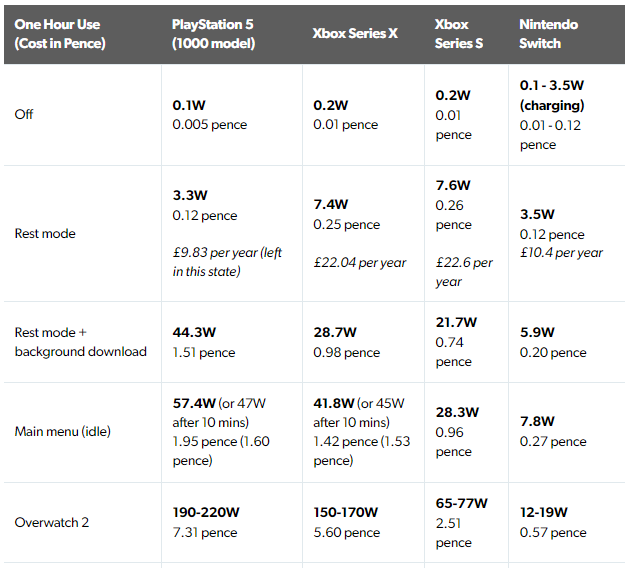
Rest Mode: The Sneaky Sipper
This is where things can get a little tricky. Rest Mode is fantastic for keeping your games updated and ready to go, but it’s not always "off."

- Default Rest Mode: If you leave all the USB power and network features on, your PS5 can pull anywhere from 1.5 to 3 watts. Not bad, right? But it adds up.
- Optimized Rest Mode: If you tweak the settings (turn off "Stay Connected to the Internet" and "Supply Power to USB Ports" when in rest mode, or set the USB power supply to only 3 hours), you can get it down to a ridiculously low 0.5 watts or less. Seriously, this is almost nothing.
Pro tip: Go into your PS5 settings (Settings > System > Power Saving > Features Available in Rest Mode) and customize this! Your future self (and wallet) will thank you.
Idle/Menu: Chillin' Out
Just navigating the PS5's home screen, browsing the PlayStation Store, or sitting in a game's main menu? The PS5 is pretty chill here.
- Expect around 45-60 watts. It’s doing some work, but it’s not breaking a sweat.
This is your "waiting for friends to join the party" power usage. Relatively modest, wouldn't you say?

Gaming: The Main Event!
Alright, this is where your PS5 really flexes its muscles. And like a bodybuilder, when it's working hard, it needs more fuel.
- Lightly Demanding Games: For games that aren't pushing the hardware to its absolute limit (think smaller indie titles, older gen games via backward compatibility, or less graphically intense current-gen games), you're looking at about 100-150 watts.
- Graphically Intensive Games: This is the big league. Playing a massive 4K, HDR, high-frame-rate title like Spider-Man 2, God of War Ragnarök, or Cyberpunk 2077? Your PS5 can easily hit anywhere from 180 to 220 watts. Some peak moments might even see it touch 230 watts or slightly higher!
Yes, that's quite a jump! It's doing a lot of heavy lifting to render those stunning visuals, after all.

Disc Drive: A Brief Boost
If you're installing a game from a Blu-ray disc, or just spinning one up, you might see a small, temporary spike in power usage, perhaps an extra 10-15 watts on top of what the system is already doing. It's not a constant drain, just during initial spin-up and data transfer.
What Makes These Numbers Jiggle?
It's not just "gaming vs. not gaming." Several factors influence how much juice your PS5 demands:
- The Game Itself: As mentioned, a graphically demanding game at 4K resolution with ray tracing will consume significantly more power than a simpler title.
- Resolution and Frame Rate: Playing at 4K? Expect higher usage. Prioritizing performance (higher frame rates) can also increase consumption as the CPU/GPU work harder.
- HDR: High Dynamic Range (HDR) can also contribute to slightly higher power draw due to the increased processing for wider color and contrast ranges.
- External Peripherals: Charging controllers via USB, external hard drives, or other accessories plugged into the PS5 will add a tiny bit to the overall draw.
- PS5 Model: The original "fat" PS5 models (CFI-1000 and CFI-1100 series) generally had slightly higher power draws than the updated CFI-1200 series (often called the "revised" model) and especially the newer
PS5 Slim (CFI-2000 series), which is typically a bit more power-efficient. We’re talking perhaps 10-20 watts less at peak, which isn’t insignificant!
So, Should You Panic About Your Bill?
Probably not. While 200+ watts sounds like a lot, let’s put it in perspective. An old incandescent lightbulb was 60-100 watts. A powerful gaming PC can easily hit 400-600 watts under load. The PS5 is pretty efficient for the horsepower it offers.

If you game for, say, three hours a day at peak usage (200 watts), that's 0.6 kilowatt-hours (kWh). Depending on your electricity rates (which vary wildly!), that might be an extra 10-20 cents a day. Over a month, that's an extra $3-$6. Annually, perhaps $36-$72. Not insignificant, but likely not the sole culprit for a skyrocketing bill unless you’re gaming 12 hours a day and leaving it in full rest mode constantly!
The biggest takeaway here is to be mindful of
Ultimately, your PS5 is a powerful piece of tech, and power equals performance. Enjoy your games, maybe just give your Rest Mode settings a quick once-over, and rest easy knowing you're probably not single-handedly draining the national grid. Unless you're trying to set a world record for continuous Elden Ring playthroughs. Then, all bets are off!