How Many Watts Are In 200 Amps
Ever found yourself staring at an appliance label, seeing numbers like "10 Amps" or "1200 Watts," and wondering what on earth they actually mean? Or perhaps you've heard an electrician mention something about "amps" and "volts" and felt a little lost in the jargon? Well, you're not alone! Today, we're going on a little adventure to demystify these electrical terms, specifically focusing on the intriguing question: how many watts are in 200 amps?
It sounds like a straightforward question, right? Like asking how many inches are in 2 feet. But here's the fun twist: it's a bit of a trick question! The secret lies in understanding what amps and watts actually represent, and realizing there's a crucial missing piece to our puzzle. Think of it as trying to figure out how fast a car is going just by knowing how much fuel it's using – you also need to know how big the engine is and how hard it's being pressed!
So, let's break it down. Amps (short for amperes) measure the current of electricity, which is essentially the amount of electrical charge flowing through a circuit per second. Imagine it as the volume of water flowing through a pipe. Watts, on the other hand, measure power – the rate at which electrical energy is used or produced. This is like the actual force or work that water can do, perhaps turning a water wheel. The key to converting amps to watts, and vice versa, is knowing the voltage. Voltage is the electrical "pressure" or "force" that pushes the current, much like the water pressure in our pipe analogy. Without knowing the voltage, we simply can't tell you how many watts are in 200 amps.
Must Read
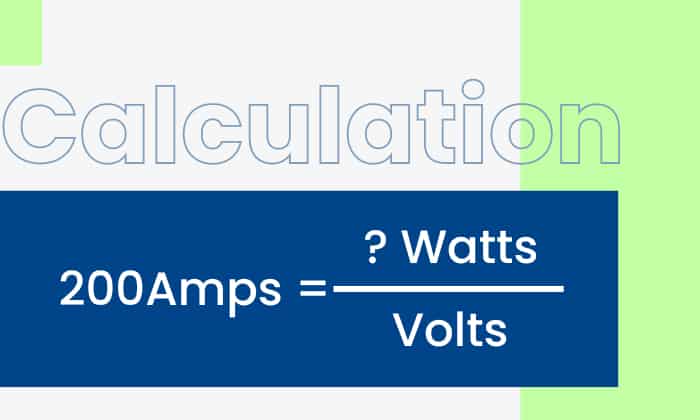
The magic formula that connects them is beautifully simple: Watts = Amps × Volts (or P = I × V). This little equation is incredibly useful in our daily lives! For instance, in most North American homes, standard wall outlets provide around 120 volts. So, if an appliance draws 200 amps at 120 volts, it would be consuming a whopping 24,000 watts (200 A × 120 V = 24,000 W)! That's a huge amount of power, far more than a typical household circuit can handle, which is why understanding this relationship helps us prevent tripped circuit breakers or, more importantly, avoid electrical hazards. If you're looking at a car battery system, which is typically 12 volts, 200 amps there would only be 2,400 watts (200 A × 12 V = 2,400 W), a significant difference! This knowledge is vital for everyone from budding electricians in vocational training to anyone trying to hook up an RV or understand their home's energy consumption.
Want to explore this concept in a fun, practical way? First, always remember: safety first – never mess with live wires! But you can easily become an electrical detective in your own home. Grab a flashlight and peek behind your appliances. Many will list their power consumption in watts or the current they draw in amps. Look at your main electrical panel; circuit breakers are often labeled with their maximum amp rating (like "15A" or "20A"). Then, knowing your typical household voltage (around 120V in North America, 230V in many other parts of the world), you can use our simple formula to calculate the other value. There are also many free online calculators where you can plug in two of the values (amps, volts, watts) and get the third. It's a fantastic way to grasp the invisible forces at play around us and make more informed decisions about everything from buying a new toaster to understanding your electricity bill!