
How Many Solar Panels To Run A Refrigerator

Okay, picture this: I'm camping last summer. Gorgeous lake, crackling fire, the whole shebang. Except… my cooler was basically a lukewarm soup of melted ice and questionable hot dogs by day two. That’s when the thought smacked me upside the head: "Wouldn't it be amazing to have a real refrigerator out here?" And then, of course, the practical side of me kicked in: “But… how?” The nearest power outlet was probably miles away, guarded by squirrels, probably. And thus, my solar-powered fridge obsession began.
So, you're thinking about ditching the ice and embracing the sweet, sweet chill of a refrigerator powered by the sun, huh? Smart move. But before you start slapping panels on your roof like it’s a giant game of solar Tetris, let’s figure out how many panels you actually need to keep that fridge humming.
The Refrigerator's Appetite: Wattage is Key
First, you need to know your refrigerator's wattage. It’s like figuring out how much gas your car needs - except instead of gas, it's electricity and instead of a car, it’s a device dedicated to keeping your pickles cold. Look for a sticker usually inside the fridge door or on the back. It'll tell you the running wattage and maybe the startup wattage. The running wattage is what it uses to, well, run. The startup wattage is a higher number that tells you how much power it needs for a brief period when it first kicks on. This is super important, so don’t skip this step!
Must Read
Let's say your fridge is a fairly energy-efficient model and needs around 150 watts to run continuously. (Older fridges can be real energy hogs – we’re talking 300+ watts!). This is just an example, of course! Yours might be different.
Calculating Daily Energy Needs (Wh)
Fridges don't run 24/7, thankfully. They cycle on and off to maintain temperature. A good rule of thumb is to assume it runs about 1/3 of the day. So, that 150-watt fridge is actually drawing power for about 8 hours a day. That gives us a daily energy consumption of: 150 watts x 8 hours = 1200 watt-hours (Wh). Okay, so that's what the fridge eats in a day. Now we know what we are up against!
Solar Panel Power: It's Not Always Sunny
Now, for the solar panels. They’re rated in watts, too. A common panel might be rated at 300 watts. But here's the kicker: that rating is under ideal conditions – full sun, perfect angle, and no grumpy clouds blocking the rays. In reality, you're going to get less. A solar panel's output depends on your location and the average sunlight hours per day. This number is your friend, look it up!
You need to figure out how many "peak sun hours" you get per day. This is essentially the number of hours your panels are producing at their maximum rated power. It varies wildly based on location. (Think Arizona vs. Seattle – big difference!). You can usually find this data online for your specific area.

Let's assume you get 5 peak sun hours per day. A 300-watt panel will produce 300 watts x 5 hours = 1500 Wh per day. Not bad!
The Math: How Many Panels Do You Need?
Remember our fridge needs 1200 Wh per day, and our 300-watt panel (in our example with 5 peak sun hours) produces 1500 Wh per day. Theoretically, one panel is enough! Yay! BUT WAIT. There's always a but, isn't there?
We need to factor in losses. We are not just running a simple thing here: You'll lose some energy in the inverter (which converts DC power from the panels to AC power for the fridge), and in the wiring. A good estimate for these losses is around 20%. (Sometimes it can be even more than that. So be realistic about it!).

To account for this, we should increase our solar panel production target by 20%. So, we now need our panel(s) to produce 1200 Wh x 1.20 = 1440 Wh.
In our example, one 300-watt panel producing 1500 Wh is still enough... but barely. I like to build in a little redundancy. What if it's a cloudy day? What if the angle of the sun isn't optimal? What if a particularly sassy squirrel decides to build a nest on my panel? (Okay, that last one is unlikely… but you get the idea!).
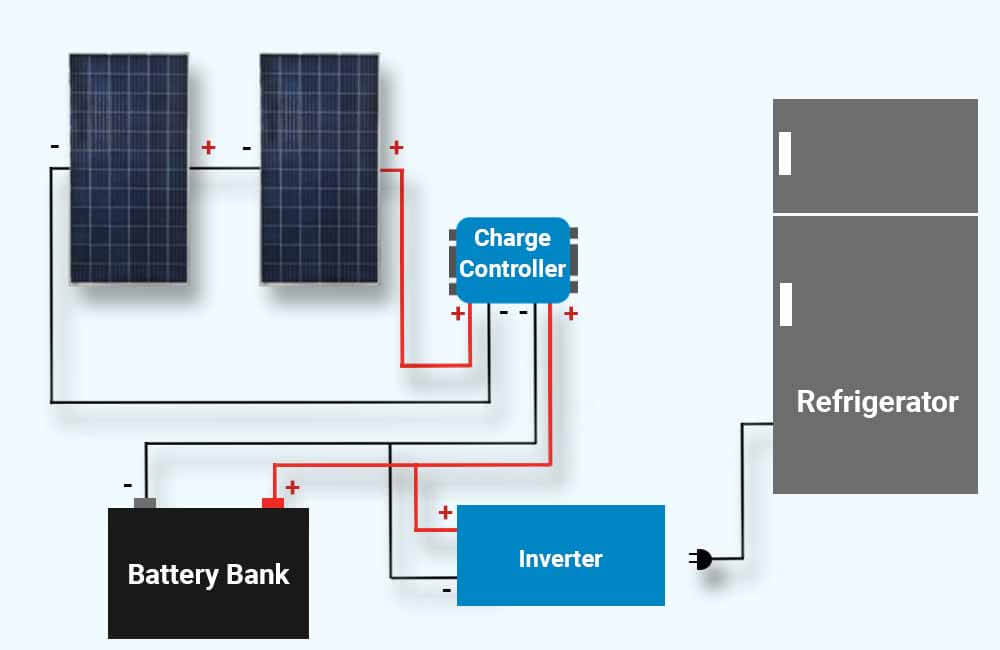
So, in this specific scenario, one 300-watt panel might work, but for peace of mind (and to cover those less-than-perfect days), I’d probably recommend two panels. Better safe than sorry… and warmer beer, right? No one wants that.
Don't Forget the Battery!
I almost forgot the most important detail: Batteries! Solar panels only produce power when the sun is shining. You'll need a battery bank to store the excess energy generated during the day to keep the fridge running at night (or on cloudy days). Sizing the battery bank is another whole calculation depending on how many days of autonomy you want – but that’s a topic for another time! Think of this as your fridge’s food reserves.
This is a simplified explanation, of course. Real-world scenarios are always more complex. But hopefully, this gives you a good starting point for figuring out how many solar panels you need to keep your refrigerator cold and your hot dogs… well, not. Good luck!