
How Many Solar Panels Required To Run A House
So, you're thinking about ditching the grid? Good for you! You want to harness the power of the sun and tell the electric company to take a hike? Awesome!
But then comes the big question: how many of those shiny, rectangular energy-makers do you actually need?
The Great Solar Panel Quest
Figuring out the magic number isn't as simple as counting candles on a birthday cake.
Must Read
It's more like trying to guess how many jellybeans are in a giant jar... while blindfolded. And possibly being chased by a squirrel.
Unpopular Opinion Time: One Size Does NOT Fit All
Here's where I might ruffle some feathers. Brace yourselves.
All those online calculators and "average household" estimates? Take them with a grain of salt the size of a small car.
Why? Because your house isn't average. You aren't average. Your quirky obsession with keeping your holiday lights up year-round? Definitely not average.
Digging Into Your Energy Footprint
First, you've gotta know what you're working with.
Think of it like figuring out how much gas your car needs. You wouldn't just guess, right? You'd check your mileage.
Grab those electricity bills! Stare at them intensely! Let them know who's boss (the sun, soon).
Kilowatt-Hours: Your New Best Friend (Maybe)
See that "kWh" thing? That's kilowatt-hours. That's the key to this whole operation.
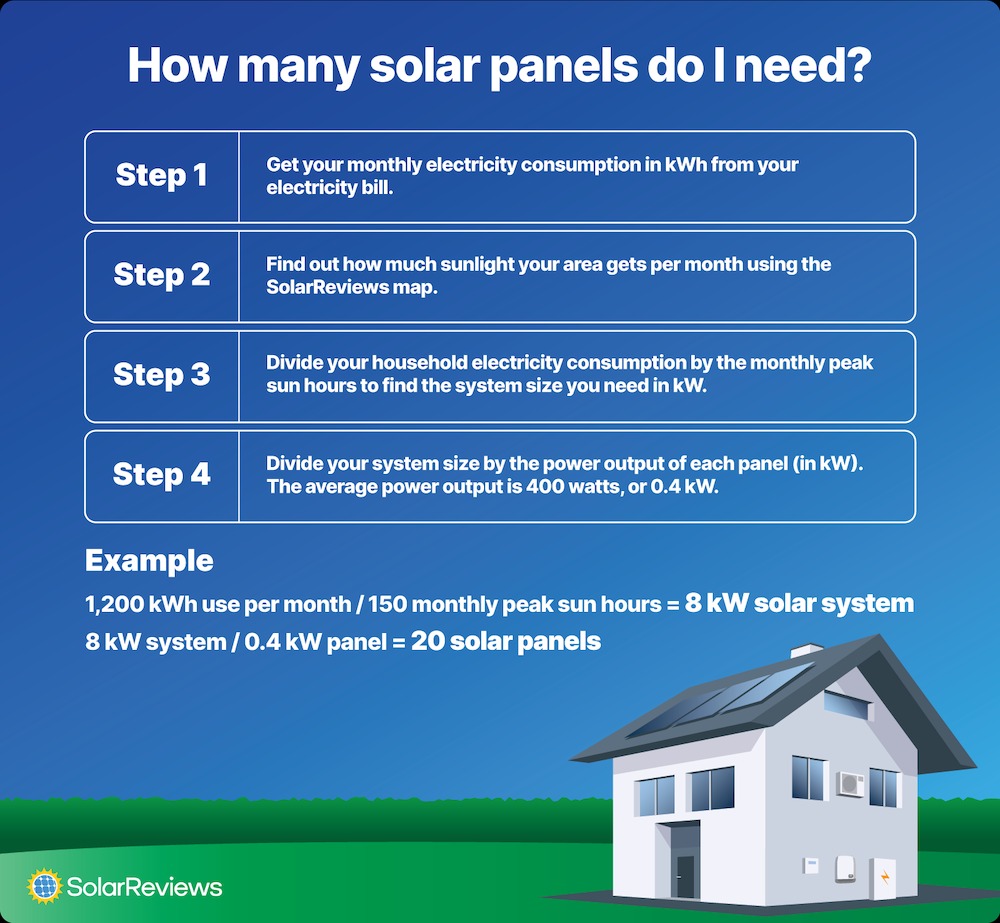
It tells you how much electricity you're using each month. Add up all the kWh from your bills for a year.
That's your annual energy usage. Now we're getting somewhere!
Sunshine, Lollipops, and Solar Panel Math (Kind Of)
Okay, time for a little math. Don't run away!
We're not solving for the mass of Jupiter here. Just need some basic multiplication and division.
First, we need to know how much sunlight your roof gets. This is known as the solar irradiance.
Location, Location, Location (and Sunlight!)
If you live in sunny Arizona, congrats! Your panels will probably be singing a happy tune and generating tons of power.
If you live in Seattle? Well, let's just say you might need a few more panels to compensate for the lack of consistent sunshine.
There are online tools that can help you estimate the average sunlight hours for your location. Use them!
The Panel Puzzle Pieces
Now, let's talk panels themselves.

Each panel has a wattage rating. This tells you how much power it can produce under ideal conditions. (Spoiler alert: ideal conditions rarely exist).
A typical solar panel might be rated at 300-400 watts. Higher wattage means more power per panel.
Efficiency Matters: Don't Be Fooled by Shiny Things
Panel efficiency is another key factor. A more efficient panel will generate more power from the same amount of sunlight.
Think of it like this: a super-efficient panel is like a tiny, super-powered robot. A less efficient panel is... well, a regular robot.
Pay attention to the efficiency rating when comparing panels. It can make a big difference in the long run.
Putting It All Together (The "Sort Of" Formula)
Okay, deep breath. Here's the "sort of" formula:
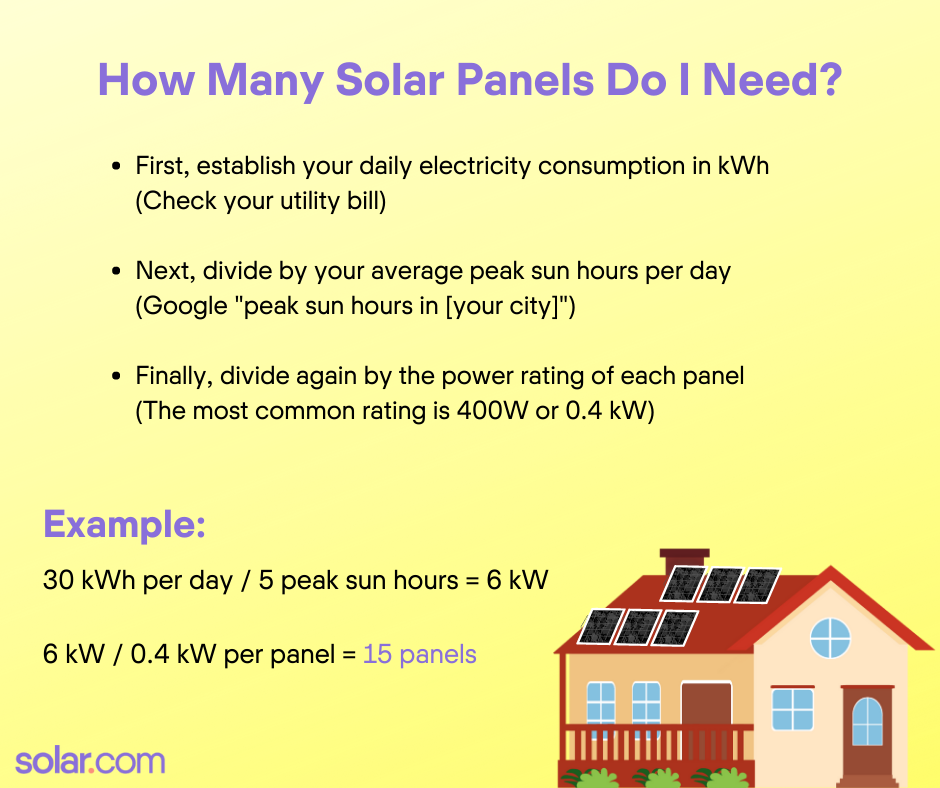
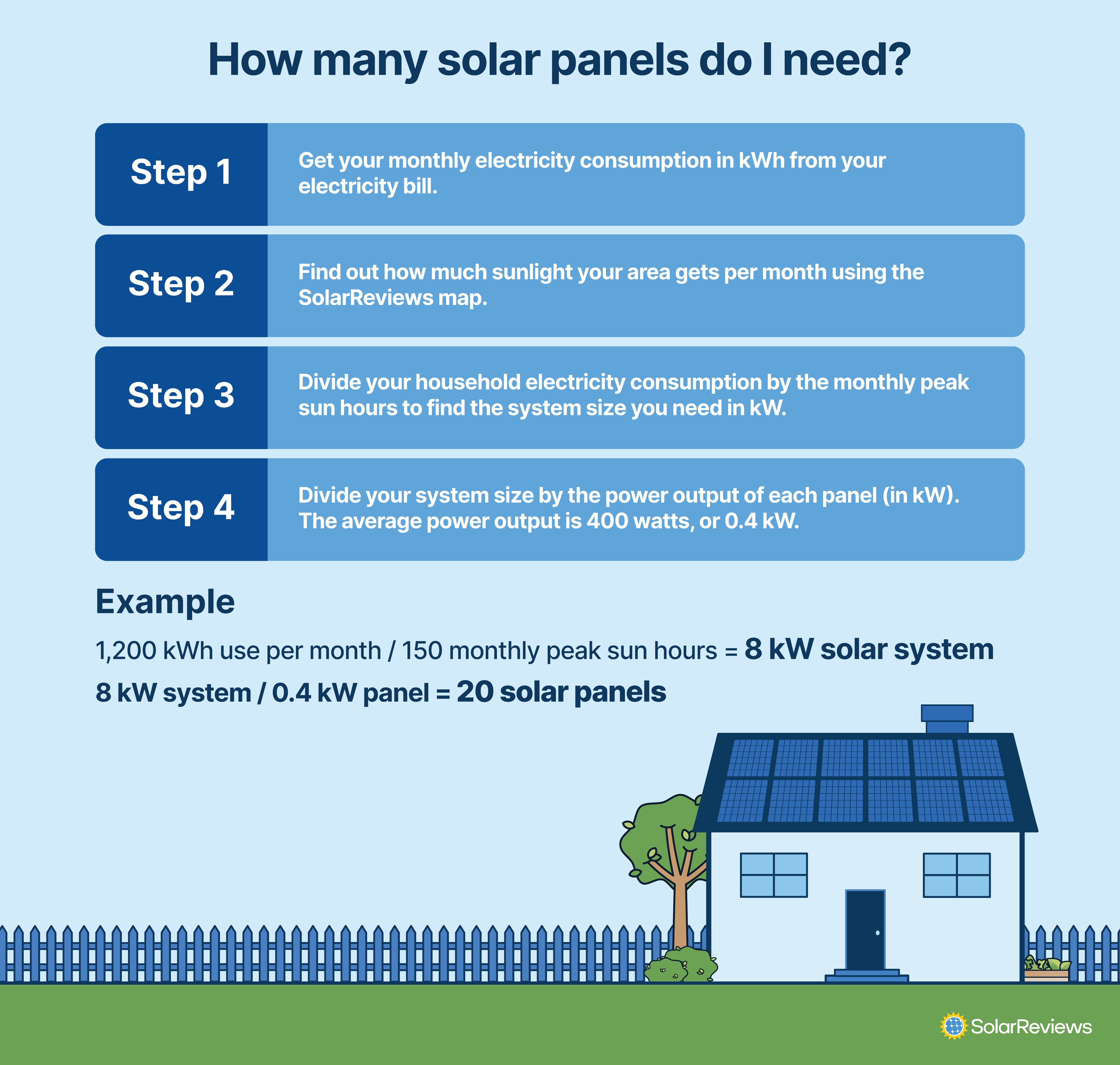
1. Your annual energy usage (in kWh) / Sunlight hours per year (in your location) = Total energy needed from your solar panels (in kWh).
2. Total energy needed from your solar panels (in kWh) / Panel wattage (e.g., 350 watts, convert to kW by dividing by 1000: 0.35 kW) = Number of panels needed.
Remember, this is a simplified calculation. You'll need to account for system losses (inverters, wiring, etc.).
Inverter Shenanigans: The Unsung Hero (Or Villain?)
Your inverter is like the traffic cop of your solar system.
It converts the DC electricity produced by your panels into AC electricity that your home can use. Inverters lose some energy in the process.
Factor in an inverter efficiency of around 90-95% when calculating your panel needs. Nobody's perfect.
Other Factors to Consider (Because Life Isn't Simple)
Roof angle and orientation matter. South-facing roofs in the Northern Hemisphere are generally the best for solar panel placement.
Shade from trees or nearby buildings can significantly reduce panel output. Trim those branches!
Future energy needs: Are you planning on getting an electric car? Adding a hot tub? Factor those things in now, not later.
The "Just In Case" Factor: A Buffer is Your Friend
It's always a good idea to overestimate your panel needs slightly.
Better to have a little extra power than to be constantly running short. Plus, who doesn't love bragging rights about their energy production?
Consider adding 10-20% to your calculated panel number as a safety net.

Calling in the Pros (Probably a Good Idea)
Honestly, calculating your exact solar panel needs can be tricky.
A qualified solar installer can assess your specific situation and provide an accurate estimate. They know all the ins and outs of panel types, inverter options, and local regulations.
Get multiple quotes from different installers. Don't be afraid to ask questions. It's your roof, your energy, and your money.
Don't Be Afraid to Negotiate: It's Like Buying a Car (But for Sunshine!)
Solar panel prices can vary widely. Shop around and don't be afraid to negotiate.
Ask about financing options and government incentives. You might be surprised at how affordable solar power can be.
Remember, you're investing in your future (and the future of the planet). Make sure you get the best deal possible.
So, How Many Panels? The (Unsatisfying) Answer
The truth is, there's no single answer to the "how many solar panels do I need?" question.
It depends on your energy usage, your location, your roof, and your personal preferences.
But with a little research, some careful calculation, and the help of a qualified installer, you can figure out the perfect number for your home. Happy solar-ing!