
How Many Amps Are In 1500 Watts

Ever found yourself staring at an appliance, perhaps a powerful blender or a trusty old hairdryer, and wondered what's really going on inside when you plug it in? You see "1500 Watts" printed on it, and maybe you've heard whispers of "amps" and "volts," but what do they mean for your daily life?
Don't worry, you're not alone! It's like the secret language of electricity, but it's much simpler than it sounds. Think of it as knowing the difference between how much 'oomph' your car has (horsepower) versus how much fuel it's actually consuming (gallons per minute). Today, we're going to demystify 1500 Watts and discover its current alter ego: amps.
The Power Trio: Watts, Volts, and Amps
Before we pinpoint the exact number of amps in 1500 watts, let's meet the three amigos of electricity. Understanding their roles is key to becoming an everyday power pro.
Must Read
-
Watts (W): This is the big one, the headline number often proudly displayed on your gadgets. Watts measure power – the total amount of energy being consumed or produced. Think of it as the total work being done. If electricity were a coffee machine, watts would be how fast it brews your espresso.
-
Volts (V): Imagine voltage as the pressure or 'push' that drives the electricity. It's the force that makes the electrons want to move. In our coffee analogy, volts would be the water pressure pushing through the machine.
-
Amps (A): And here's our star today! Amps, or amperage, measure the current – the actual volume or flow of electrons through a wire at any given moment. Going back to coffee, amps are the actual volume of water flowing through the pipes to make your brew.
The beautiful thing is, these three are intrinsically linked by a simple formula: Watts = Volts × Amps. So, if we know the watts and the volts, finding the amps is just a quick shuffle of the numbers!
So, How Many Amps Are In 1500 Watts? It Depends!
This is where things get interesting. Unlike a simple conversion (like inches to centimeters), the amperage for 1500 watts depends entirely on the voltage of the electrical system you're using. Different regions and different types of circuits use different voltages.
Scenario 1: Standard U.S. Household Outlet (120V)
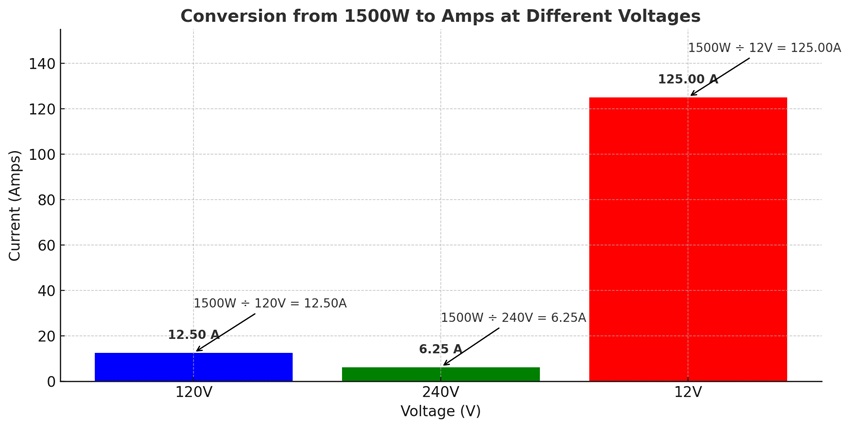
Most of the outlets in your American home are 120-volt (V). This is where you plug in your everyday toaster, hair dryer, or microwave. For a 1500-watt appliance on a 120V circuit:
Amps = Watts / Volts
Amps = 1500W / 120V
Amps = 12.5 Amps
So, your 1500W appliance will draw 12.5 amps from a standard U.S. wall outlet. This is a pretty significant draw! Considering many household circuits are rated for 15 or 20 amps, plugging in one of these can easily become the star of its own circuit. Ever tripped a breaker? High-wattage appliances are often the culprits!

Scenario 2: Higher Voltage Circuits (e.g., 240V)
Some powerful appliances, like electric clothes dryers, ovens, or central air conditioning units, use 240-volt (V) circuits. These are the outlets with unique plug shapes you've probably seen. If our 1500-watt appliance were designed for 240V (less common for 1500W, but let's play along):
Amps = 1500W / 240V
Amps = 6.25 Amps
Notice something? At a higher voltage, the same amount of power (1500 watts) requires fewer amps. This is why higher voltage is often used for heavier loads or longer distances – it's more efficient and requires thinner, less expensive wiring to deliver the same power without excessive heat buildup.
Scenario 3: Low Voltage Systems (e.g., 12V DC for RVs/Cars)
Venturing into the world of RVs, boats, or car batteries, you often deal with 12-volt (V) DC (direct current) systems. Now, if you wanted to power a 1500-watt inverter (which converts 12V DC to 120V AC for your appliances) directly from your car battery:

Amps = 1500W / 12V
Amps = 125 Amps
Whoa! 125 amps is a massive amount of current. This tells you why you need super thick cables for these applications and why running high-wattage appliances from a car battery will drain it incredibly fast. It's a vivid demonstration of the inverse relationship: lower voltage demands higher amperage for the same power.
Practical Tips for the Savvy Homeowner
Understanding these numbers isn't just for bragging rights; it's genuinely useful for safety and efficiency:
-
Know Your Circuits: Check your breaker panel. Most household circuits are 15A or 20A. A 1500W appliance drawing 12.5A takes up a big chunk of a 15A circuit. Plug too many high-wattage items into one circuit, and you're inviting a breaker trip (or worse, a safety hazard!).
1500 Watts to Amps Conversion Guide -
Read Labels: Always check the wattage (W) on your appliances. It's usually printed somewhere discreetly. This helps you plan your power usage.
-
Extension Cord Savvy: Make sure your extension cords are rated for the amperage your appliance draws. Underrated cords can overheat and become a fire risk. Avoid daisy-chaining cords!
-
Feeling Warm? Not Good: If an outlet, plug, or cord feels unusually warm to the touch, it's a sign of excessive current draw or a poor connection. Unplug it and investigate.
A Little Reflection on Power
From the mighty toaster to the discreet phone charger, electricity powers our modern lives in countless ways. By understanding a little about watts, volts, and amps, you're not just learning a few formulas; you're gaining a new appreciation for the silent, invisible force that makes everything happen.
It's about being a more informed consumer, making safer choices, and perhaps even thinking a bit more consciously about the energy we use. So, the next time you plug in that 1500-watt hair dryer, give a nod to the 12.5 amps gracefully (or not so gracefully!) flowing through your wires. You're now in the know!