
How Long Does Light Travel From Sun To Earth
Imagine you're waving goodbye to the Sun. You're giving it a cheerful little salute. Now, imagine that wave, carried by light, is taking a little vacation before it reaches Earth. A cosmic road trip, if you will.
The Sun's Morning Commute: It's Longer Than Yours!
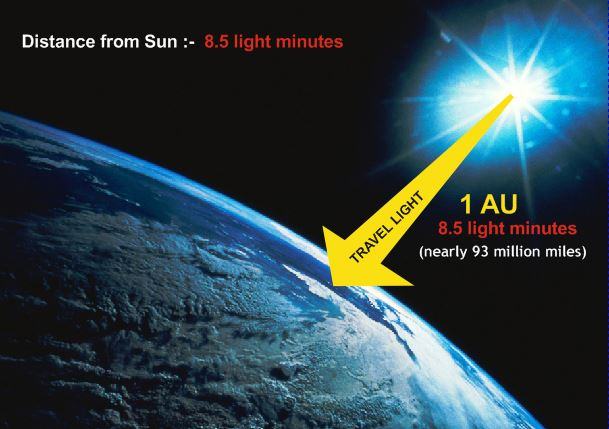
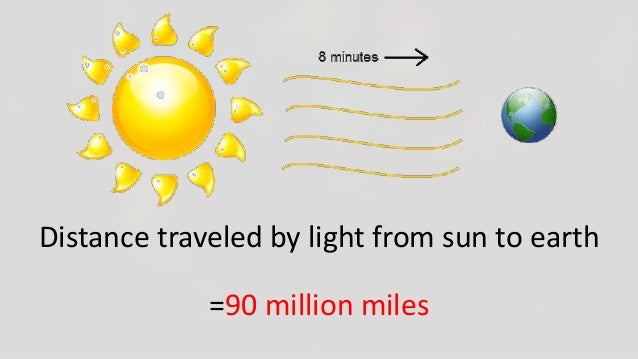
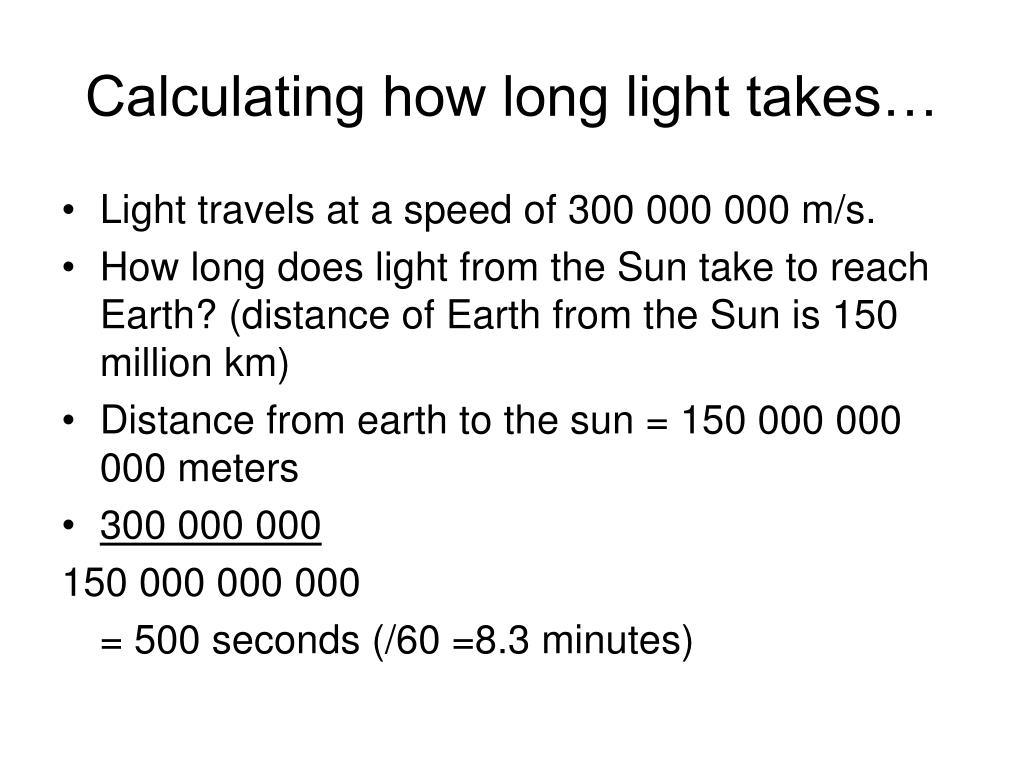
So, how long does this solar commute actually take? Get ready for a number that might make your jaw drop: about eight minutes and twenty seconds. That's right, the sunlight warming your face right now left the Sun over eight minutes ago!
Think about that for a second. Everything you see powered by sunlight? It's all happening in the past! You're living in a solar time warp. Pretty cool, huh?
Must Read
The Light-Speed Express (Kind Of...)
Light travels at an incredible speed. We're talking about roughly 299,792 kilometers per second! That’s fast enough to circle the Earth several times in just one second.
Even at that blazing speed, the Sun is so darn far away. Its light takes a noticeable chunk of time to reach us. It’s like waiting for a pizza delivery from another solar system…okay, maybe not that long.
The distance from the Sun to the Earth varies slightly throughout the year. This is because the Earth's orbit isn't a perfect circle. It's more of an oval, an ellipse if we want to be fancy.
Sunlight: The Ultimate Time Traveler
Because of the Earth’s elliptical orbit, the time light takes to travel varies. At its closest (perihelion), it’s a bit quicker. At its farthest (aphelion), it’s a tad longer.
We're talking about a difference of a few seconds, nothing dramatic. But even those few seconds are a testament to the vastness of space.
It's easy to forget that we're constantly interacting with the Sun's past. The warmth you feel, the light you see – it's all a message sent from the Sun, delivered to you from moments ago. It's like reading a postcard from a star.
More Than Just Sunshine: A Story of Distance
Eight minutes and twenty seconds may seem short in the grand scheme of the universe. But it is a significant amount of time on a human scale. Consider how much you can do in 8 minutes. You can brew a cup of coffee, listen to a song, or even send a quick text message.
The fact that light, travelling at the fastest speed possible, still takes that long to reach us highlights the immense distances involved in our solar system. It makes you think, doesn't it?
Imagine explaining this to someone from the distant past. "Yes," you'd say, "the light you see from the Sun took over eight minutes to get here." They might think you're a wizard!
Cosmic Delays: What If the Sun Disappeared?
Here's a fun, if slightly alarming, thought experiment: What if the Sun suddenly disappeared? Don't worry, it's not going to.
But hypothetically, we wouldn't know about it for eight minutes and twenty seconds. We would still be basking in its (phantom) light and warmth.
The birds would still be chirping, the plants would still be photosynthesizing (briefly), and we'd be none the wiser until darkness abruptly fell. It would be a very strange eight minutes!
A Little Bit of Stardust, A Lot of Sunshine
So, the next time you step outside into the sunshine, remember this little factoid. Remember that you’re bathed in light that began its journey over eight minutes earlier.
It's a tangible connection to our nearest star, a reminder of the incredible distances and speeds involved in the cosmos. It's a silent greeting, a cosmic hello from a giant ball of burning gas.
And think about this: the light you're seeing now might have helped a flower bloom, powered a solar panel, or simply made someone smile on the other side of the world. All thanks to that little eight-minute delay.
Beyond the Eight Minutes: The Bigger Picture
Understanding how long light takes to travel isn't just a fun fact. It's fundamental to astronomy. It helps us understand the universe and how we observe it.
When astronomers look at distant stars and galaxies, they're seeing light that's been traveling for millions or even billions of years. They are looking into the past, witnessing events that occurred long before Earth even existed.
This time delay is crucial for understanding the evolution of the universe. It allows scientists to study the history of the cosmos, one beam of light at a time. It's like reading a cosmic history book written in photons!
Embrace the Cosmic Time Delay
So, next time you glance at the Sun, take a moment to appreciate the journey its light has taken. Think about the vast distance, the incredible speed, and the slight time delay that connects us to our star. It's a pretty amazing thing to ponder.
It's a reminder that we are a part of something much larger than ourselves. We're tiny inhabitants of a planet orbiting a star in a vast and ancient universe. And that’s something truly special.
So, go ahead, wave to the Sun. Just remember, your wave won't arrive for another eight minutes and twenty seconds. But that's okay. Good things come to those who wait…or at least, to those who receive sunlight after a short cosmic delay!
And who knows? Maybe, just maybe, somewhere out there, someone is waving back. Though their wave might take a little longer to reach us. After all, the universe is a big place.