
How Long Does It Take For The Sun To Rotate
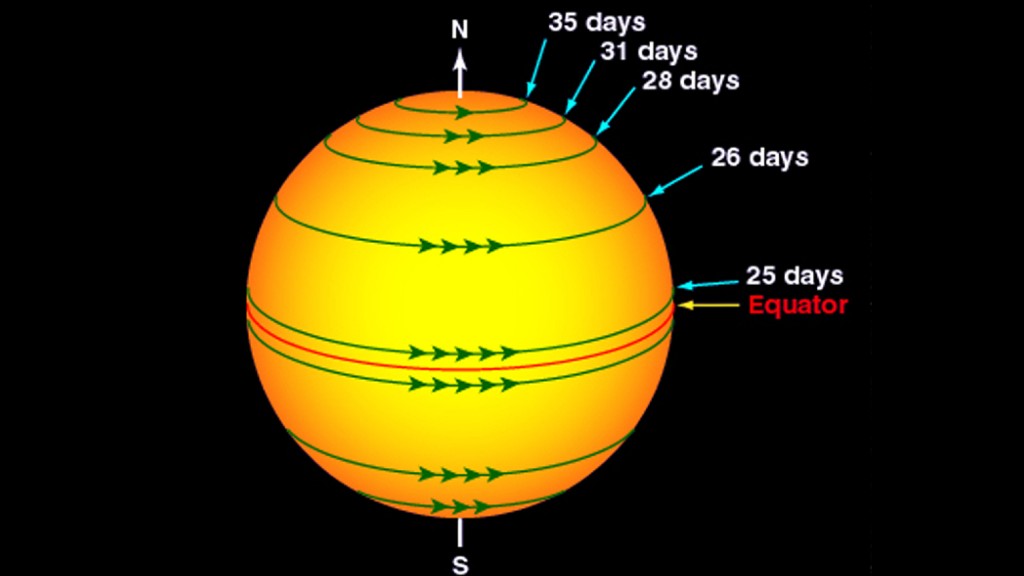
Ever wondered if the sun spins? The answer is a resounding YES! But here's where it gets interesting: it doesn't spin like a solid basketball. Imagine a cosmic blob of hot, swirling gas. That's our sun!
The Sun's Wacky Rotation
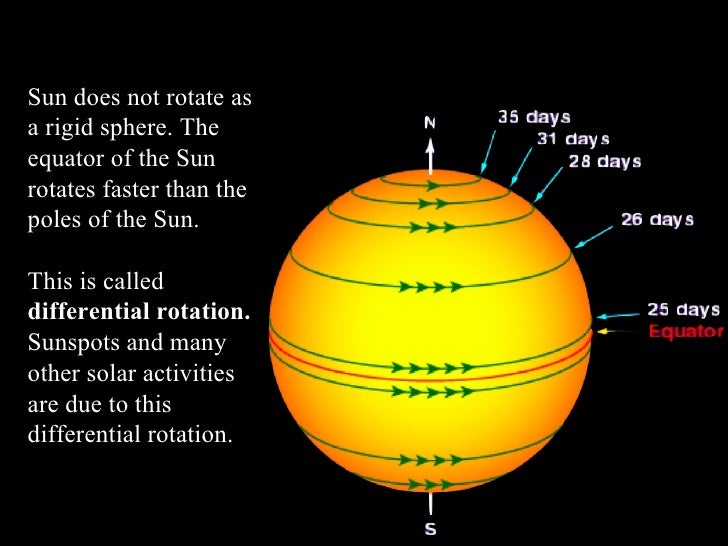
Because it's a giant ball of plasma, the sun's rotation is, well, a bit weird. It’s not a uniform spin like the Earth. The equator zips around much faster than the poles. Think of it like this: the sun’s equatorial region is like a speedy race car, while the polar regions are more like leisurely Sunday drivers.
So, how long does this solar dance take? Brace yourself, because it's not a quick spin. At the equator, the sun completes one rotation in roughly 25 Earth days. That's almost a whole month! But up near the poles, it takes around 36 Earth days. Talk about slow and steady!
Must Read
Now, you might be thinking, "So what? Why should I care?" Well, consider this: the sun's rotation is a key ingredient in the amazing solar show we sometimes get to witness.
Why It's More Than Just a Spin
The sun's differential rotation (that fancy term for the different speeds at different latitudes) is a major player in generating the sun's magnetic field. This magnetic field is what drives all sorts of spectacular solar activity, like sunspots, solar flares, and coronal mass ejections.
Think of the sun's magnetic field as a giant rubber band that gets twisted and stretched by the differential rotation. When this rubber band snaps, it releases huge bursts of energy, which can cause those dramatic solar flares we sometimes see.
And those sunspots? They're cooler, darker areas on the sun's surface where the magnetic field is particularly strong. By tracking the movement of sunspots, scientists can actually measure the sun's rotation rate at different latitudes.
These solar events can even affect us here on Earth. Major solar flares can disrupt radio communications, interfere with satellite operations, and even cause power outages. So, understanding the sun's rotation and its magnetic field is not just an academic exercise; it's important for protecting our technology and infrastructure.
How Do We Know This?
You might be wondering how scientists figured all this out. After all, we can't just hop in a spaceship and plant a flag on the sun to track its rotation (tempting as that might be!).
Instead, astronomers use clever techniques like observing the movement of sunspots and other features on the sun's surface. They also use a technique called Doppler shift. This involves analyzing the light coming from different parts of the sun. Because the sun is rotating, light from the side that's moving towards us is slightly shifted towards the blue end of the spectrum, while light from the side moving away is shifted towards the red end. By measuring these shifts, scientists can determine the sun's rotation rate.
Pretty cool, right? It's like a cosmic speedometer!
Go See For Yourself (Safely!)
While you can't directly see the sun rotating (please, never look directly at the sun!), you can follow space weather reports and see images and videos of sunspots and solar flares captured by telescopes like the Solar Dynamics Observatory (SDO).

Many space weather websites and apps provide real-time information about solar activity. You might even get a chance to witness the aurora borealis (Northern Lights) if a particularly strong solar flare sends charged particles our way. That's when those solar eruptions paint the sky with breathtaking colors! Think of it as the sun's way of putting on a spectacular light show.
So next time you're looking up at the sun (with proper eye protection, of course!), remember that it's not just a static ball of light. It's a dynamic, swirling, rotating powerhouse that's constantly changing and influencing our entire solar system. And that, my friends, is something truly amazing to ponder.
Who knew the simple act of the sun spinning could be so captivating? It's a cosmic ballet happening every single day, and we're all getting a front-row seat!