
How Fast Do The Blades Of A Wind Turbine Spin
Ever driven past those giant windmills – I mean, wind turbines – gracefully twirling in the breeze? You've probably wondered, "Just how fast are those things spinning?" It's a good question, and the answer is… well, it depends!
Not as Fast as You Think (Probably)
Our brains often trick us. We see these enormous blades and assume they're whipping around like helicopter rotors about to launch us into orbit. But surprise! They're actually moving at a surprisingly leisurely pace.
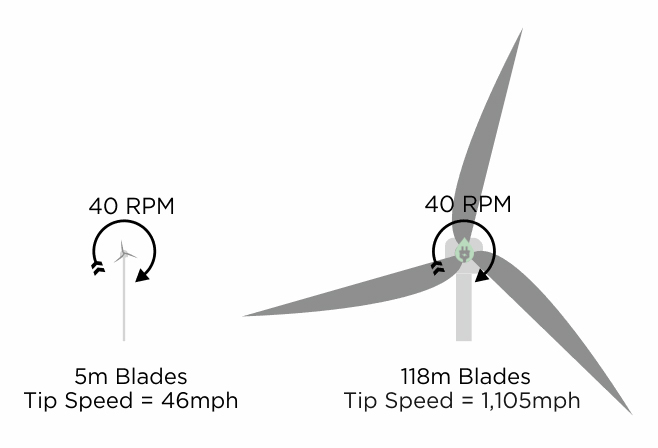
Typically, the tips of a wind turbine blade travel at around 150 to 180 miles per hour. That sounds fast, right? But consider the sheer size of the blades. It takes them a while to complete one revolution.
Must Read
Think of it like this: imagine you're on a really, really big merry-go-round. Even if it's moving quickly, you wouldn't feel like you're about to fly off. That's kind of what it's like for a point on the tip of a wind turbine blade.
RPM: Revolutions Per Minute
Instead of miles per hour at the tip, let's talk RPM, or revolutions per minute. This is how many times the entire blade set completes a full circle in one minute. On average, wind turbines spin at a rate of 10 to 20 RPM.
Ten to twenty! That's slower than your car engine idles. Your washing machine spins faster during the spin cycle. A ceiling fan often rotates faster.
The next time you are near a wind turbine and thinking about its rotational speed, just count it in your head. You'll be surprised at how slowly it moves!
Why So Slow? Safety First!
You might be thinking, "Why not make them spin faster? Wouldn't that generate more electricity?" The answer boils down to a few key factors, with safety being paramount.
Faster rotation means higher stresses on the blades. The forces involved increase dramatically with speed. Imagine the strain on those massive structures if they were constantly subjected to extreme G-forces.
Plus, the faster they spin, the louder they get. No one wants to live next to a giant, whooshing machine that sounds like a jet engine.
The Tip Speed Ratio
There's also something called the tip speed ratio. This is the ratio between the speed of the blade tip and the speed of the wind. Wind turbine designs are optimized for a specific tip speed ratio to maximize efficiency.
Going too far beyond that optimal ratio can actually decrease the amount of electricity generated. It’s a delicate balance to ensure the wind turbines can still operate efficiently.
It’s like finding the sweet spot on a swing. You don't want to push too hard, or you'll just kill the momentum. Wind turbines operate on a similar principle.
Wind Speed: The Real Driver
The speed of the wind is the biggest factor in determining how fast a wind turbine spins. Turbines are designed to start spinning at relatively low wind speeds, around 6 to 9 miles per hour.
As the wind picks up, the blades rotate faster, generating more electricity. However, there's also a maximum wind speed that turbines can handle, usually around 55 miles per hour. Beyond that, they have to shut down to avoid damage.
This shutdown process is called furling. Think of it like a sailboat reefing its sails in a storm. It’s a means of protecting the vessel from being wrecked by harsh winds.
Different Turbines, Different Speeds
It's also important to remember that not all wind turbines are created equal. Different designs have different optimal speeds. Larger turbines, with longer blades, tend to spin more slowly than smaller ones.
Offshore wind turbines, which are typically much larger than those on land, also tend to rotate slower. This is because they're designed to capture the steadier, more powerful winds found over the ocean.

So, when you see a wind farm, keep in mind that the turbines might all be spinning at slightly different speeds, depending on their size, design, and the prevailing wind conditions.
The Art of the Twirl
Ultimately, the speed at which a wind turbine spins is a carefully engineered compromise. It's a balance between efficiency, safety, noise, and the specific characteristics of the turbine and the wind.
It’s a testament to human ingenuity that we’ve created these machines that can harness the power of the wind, not with brute force, but with a graceful, almost meditative twirl.
Next time you see one, take a moment to appreciate the elegant dance of the blades. They’re not just spinning; they’re quietly and efficiently converting a natural resource into clean, renewable energy. They are a sight to behold, especially on a windy day!
More Than Just Machines
There's something almost poetic about wind turbines. Standing tall against the horizon, they seem to whisper a message of sustainability and hope. They're a reminder that we can work with nature, rather than against it, to create a cleaner future.

And even though they might not be spinning as fast as you thought, they're still doing their part to power our world. One slow, steady revolution at a time.
So the next time you see those graceful blades turning, remember the careful balance and the quiet power they represent. They are a marvel of engineering, and a symbol of our commitment to a greener tomorrow.
And remember, you now know how fast those blades are turning! You can impress your friends with your newfound knowledge of RPMs and tip speed ratios. Or, you can just enjoy the view, knowing that those turbines are quietly working to make the world a better place.
Perhaps, the next time you see them, think about the engineers behind the technology. These innovators who have dedicated their lives to improving our world.
Think about how the speed of the turbine is directly related to the power grid and energy to light up your home.
And finally, remember the environment is improving for the future when we have these great sustainable solutions!