
How Does The Wave Energy Work
Imagine standing by the ocean, watching those incredible waves roll in. They crash, they foam, they make that wonderful sound. It's a powerful show, isn't it?
But what if those majestic movements weren't just for looking at or surfing? What if they held a secret superpower, ready to light up our homes?
Welcome to the fascinating world of wave energy, where the ocean's endless dance gets harnessed to make electricity. It's like turning the sea's daily performance into clean power!
Must Read
The Ocean's Own Powerhouse
The core idea is super simple: waves are always moving. They're pushed by the wind, traveling vast distances across the water. All that motion carries a lot of energy.
Think of it as a giant, continuous push and pull. Instead of letting all that amazing energy just splash onto the shore, brilliant minds have figured out ways to catch it.
It's truly special because, unlike solar power which needs sunshine or wind power which needs a breeze, waves keep on coming. They march to their own beat, day and night, rain or shine.
This makes wave energy a very reliable performer on the clean energy stage. The ocean rarely takes a day off from moving!
Meet the "Wave Catchers" – Our Ocean Heroes!
So, how do we actually grab hold of this watery energy? Engineers have dreamed up some truly clever and almost playful machines. Each one has its own unique way of dancing with the waves.
Let's meet some of these amazing devices, each a star in its own right.
The Bobbers: Up and Down We Go!
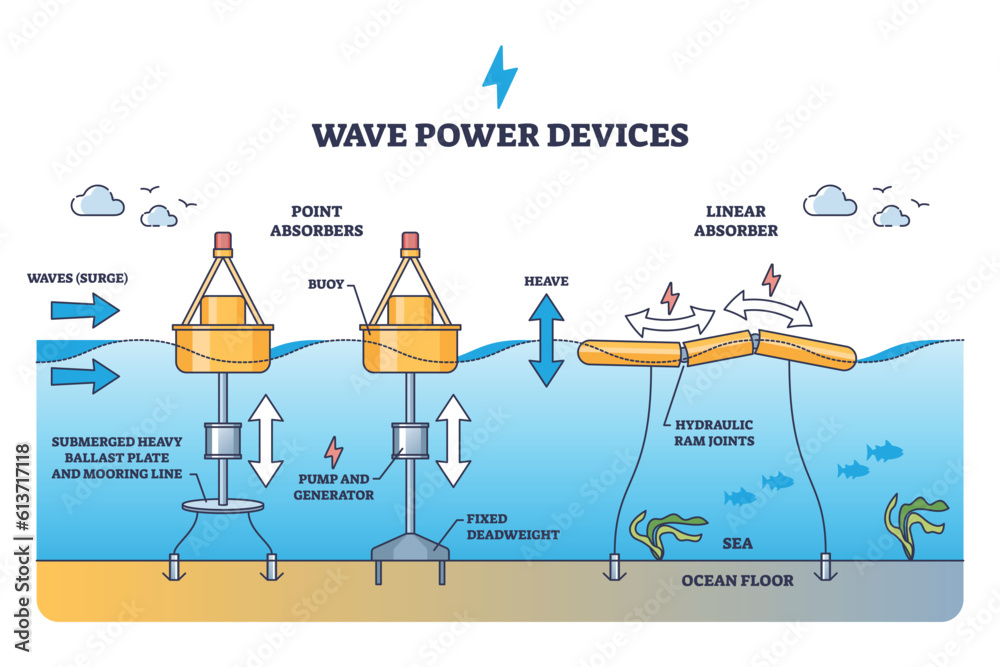
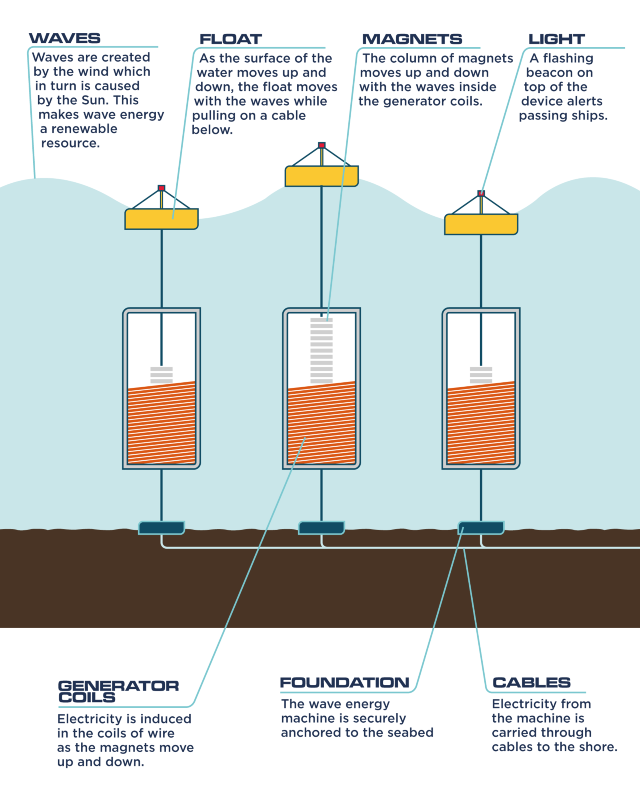
First up are the point absorbers, often called "bobbers." Imagine a giant, fancy buoy floating on the surface of the water. As a wave comes along, this device bobs up and down, just like a fishing float.
This simple vertical motion is pure magic. Inside the bobber, that up-and-down movement is used to push a piston or spin a generator. It's a fantastic example of simple mechanics making big power.
"It's like the ocean is playing with a giant toy, and that toy is making electricity!"
These bobbers are like patient dancers, rhythmically moving with every swell. They're often compact and can be deployed in various ocean depths.
Their design is quite elegant, proving that sometimes the simplest motion can be the most effective. They're definitely one of the most common types you'll hear about.
The Breathers: Air Power from the Sea
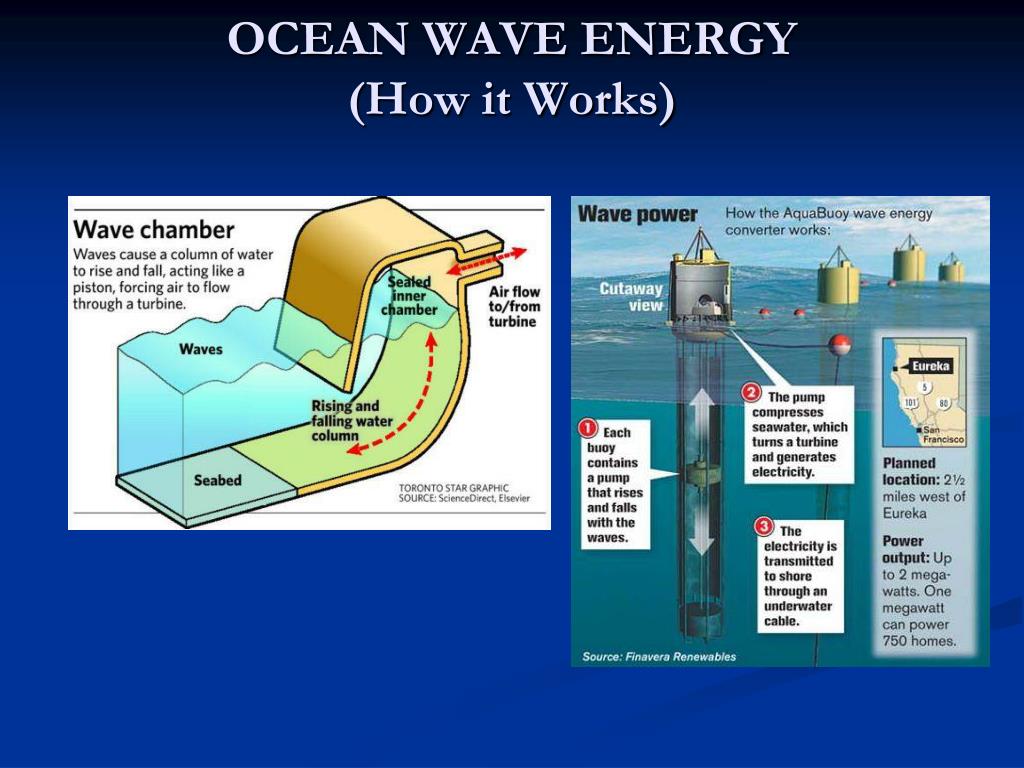
Next, we have the oscillating water column devices, or "breathers." These are a bit like hollow chambers or sea caves, partly submerged in the water.
As a wave crashes into the chamber, the water level inside rises and falls. This change in water level acts like a giant plunger, pushing air in and out of an opening at the top.
That blast of air, moving swiftly, then spins a special turbine. It’s an ingenious way to convert water's force into air's force, and then into electricity.
"The ocean is literally breathing out power with these clever machines!"
It’s like the ocean itself is exhaling and inhaling, powering a turbine with each breath. This method is incredibly robust and often built into coastal structures.
The sound of the air rushing through the turbine must be quite a performance. It's a wonderful symphony of wave and wind, all working together for clean energy.
The Ramps: Waves Making Waterfalls
Then there are the overtopping devices, which are essentially giant ramps or reservoirs. They're designed to let waves flow over them.
When a large wave hits the ramp, it flows up and over into a raised reservoir. Think of a natural wave making its own mini waterfall.
Once the water is in the reservoir, it then flows back down through a turbine, just like in a traditional hydroelectric dam. It's a beautiful blend of wave and hydro power.
"These devices turn every big wave into a temporary, power-generating waterfall."
This system stores the energy of the wave as potential energy in the elevated water. It's a smart way to get a continuous flow, even between waves.
They can be quite spectacular to behold, a testament to engineering ingenuity. Watching a wave elegantly flow up and over the ramp must be a mesmerizing sight.
The Snakers: Wiggling for Watts!
Another fascinating type is the attenuator, often looking like long, articulated "snakes" or "worms" floating on the surface. These devices are made of several hinged sections.
As waves pass underneath, the different sections move relative to each other, flexing and bending. This serpentine motion is then used to pump hydraulic fluid or spin generators.

They literally wiggle and sway with the ocean's rhythm, turning that beautiful undulation into power. It's like the ocean is doing the tango, and the snake is its dance partner.
"These flexible giants ride the waves, turning their graceful sway into powerful electricity."
The longer the 'snake,' the more waves it can interact with simultaneously, potentially capturing more energy. They are a marvel of flexible engineering.
These devices truly embody the idea of "going with the flow" to generate power. Their graceful movement makes them stand out among other wave energy technologies.
The Grand Finale: From Motion to Power!
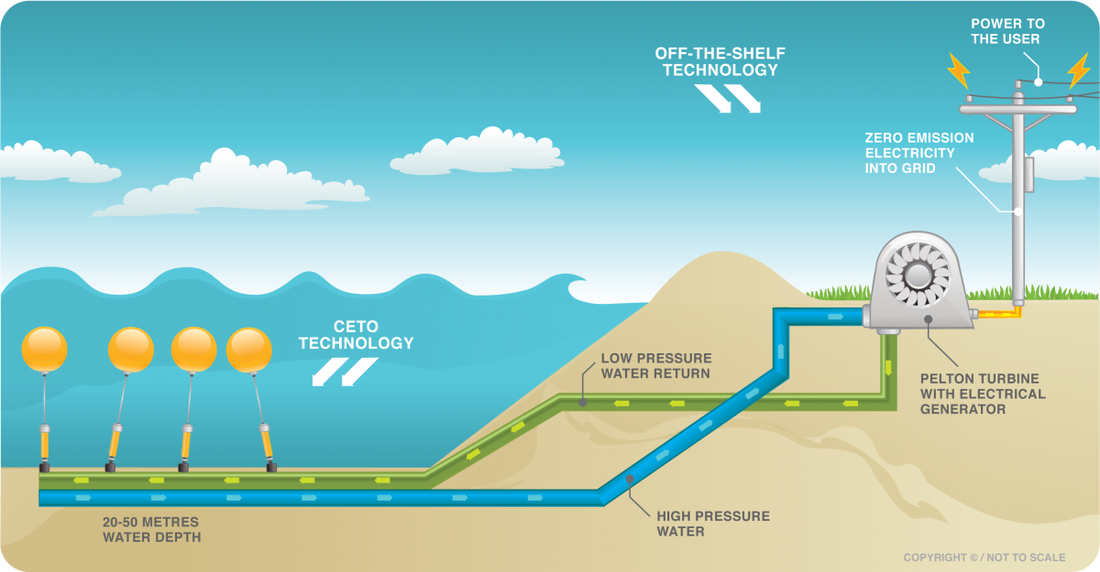
No matter which type of wave catcher is used, the goal is always the same: to turn the ocean's physical motion into a spinning force. This spinning force is what generates electricity.
Most of these devices are connected to a generator, much like those found in wind turbines or car engines. When the generator spins, it creates electric current.
This electricity is then sent through underwater cables to the shore, where it joins the power grid. From there, it travels to our homes and businesses, quietly lighting up our lives.
It’s a truly elegant chain of events: wave movement to mechanical motion, mechanical motion to electricity. The ocean's performance ends with a powerful encore of clean energy.
Why It's So Entertaining and Special
What makes wave energy so captivating goes beyond just its clever mechanics. It taps into the ancient, ever-present power of the sea.
Imagine a future where our energy comes from the gentle, yet powerful, rocking of the ocean. It’s a clean source that produces no greenhouse gases during operation.
The consistency of waves is a huge advantage. They don't disappear when the wind stops or the sun sets. The ocean is a tireless worker.
It's also an exciting frontier of innovation. Engineers are constantly dreaming up new and even more efficient ways to harness this power. The future possibilities are vast.
"Wave energy is the ocean's gift to our planet, a continuous, clean, and utterly mesmerizing power source."
These devices often blend into the seascape or are located offshore, minimizing visual impact. They're designed to work in harmony with the marine environment.
It’s a powerful reminder that nature holds incredible solutions to our energy needs. We just need to listen, observe, and innovate.
Keep an Eye on the Waves!
Wave energy is still developing, with new technologies and designs emerging all the time. It’s a field full of brilliant minds pushing the boundaries of what’s possible.
The next time you gaze out at the ocean, remember that it's more than just a beautiful view. It’s a dynamic, powerful, and potentially electric future.
Who knew the ocean's daily dance could be so entertaining and so important for our planet? Keep an eye out; the waves might just be powering your world sooner than you think!