
How Do You Measure Ceiling Fan
Ever found yourself gazing up at a ceiling fan, perhaps on a lazy afternoon, and wondered, "How on earth do you even measure one of those things?" It might seem like a quirky, almost trivial question, right? But stick with me, because knowing how to properly size a ceiling fan isn't just about technicalities; it's about transforming your living space, making smarter choices, and adding a surprising dash of DIY superpower to your life!
Think about it. We all crave that perfect breeze, that ideal comfort, especially when the mercury starts to rise. And a perfectly chosen ceiling fan? It's not just a fixture; it's a silent hero, a stylish statement, and a year-round comfort provider. So, let's peel back the layers of this seemingly mundane topic and discover how a little knowledge can lead to a lot of cool satisfaction.
Why Does It Even Matter, Anyway?
You might be thinking, "It's just a fan! Don't they all fit?" Oh, my friend, that's where the magic (or the minor mishap) happens! Imagine buying a gorgeous new fan, only to bring it home and realize it looks like a helicopter trying to land in your cozy nook, or a tiny toy struggling to stir the air in your spacious living room. Not ideal, is it?
Must Read
Measuring correctly helps you:
- Achieve Optimal Airflow: A fan too small won't cool effectively; one too large might create a hurricane in your teacup!
- Ensure Safety: Proper height and clearance are non-negotiable. No head bonks, please!
- Enhance Aesthetics: A well-proportioned fan simply looks better and elevates your room's design.
- Avoid Buyer's Remorse: Skip the hassle of returns and get it right the first time.
See? It's about more than just numbers; it's about crafting the perfect atmosphere in your sanctuary. Now, let's get down to the nitty-gritty!

The Main Event: Measuring the Fan's "Sweep" or Diameter
When someone asks for a ceiling fan's size, they're almost always talking about its sweep or diameter. This is the total span of the rotating blades. Don't worry, it's simpler than it sounds!
If the Fan is Already Installed (or Assembled):
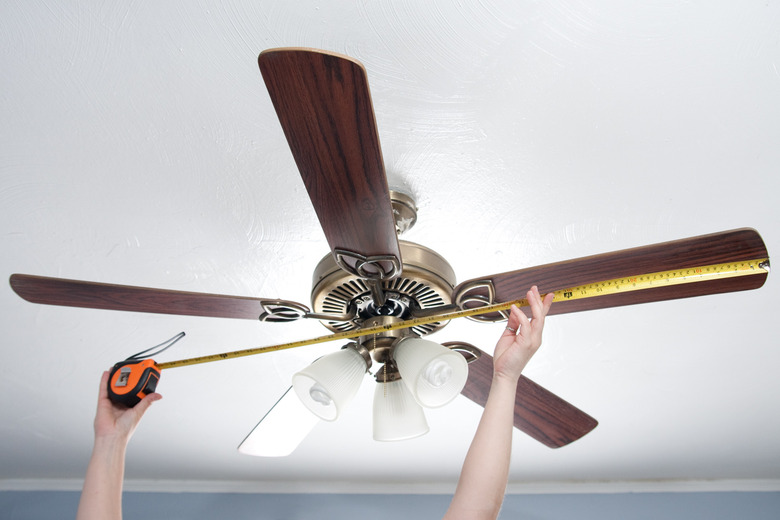
This is probably the most common scenario. Grab a tape measure and a friend (or a sturdy ladder and a good sense of balance!).

- Find the Center: Locate the exact center of the fan's motor housing. This is your starting point.
- Measure One Blade: Extend your tape measure from the very center of the fan to the absolute tip of one of the blades.
- Multiply by Two: Whatever that measurement is, multiply it by two. Voila! That's your fan's sweep or diameter.
For example, if the distance from the center to the blade tip is 25 inches, your fan's diameter is 50 inches (25 x 2). Easy peasy, right?
If the Fan is in a Box (or Unassembled):
This is often even simpler!
- Measure a Single Blade: Take one of the blades out of the box. Measure its entire length, from the part that attaches to the motor all the way to its tip.
- Multiply by Two: Just like before, multiply that single blade length by two. That gives you the diameter.
Why twice the blade length? Because when the fan is assembled, the blades extend from a central point, and the total span covers the length of two blades (one to the left, one to the right, from the perspective of the center). Sometimes, manufacturers also list the diameter directly, which makes it super convenient for you!
Beyond the Big Number: Other Vital Measurements
While the diameter is crucial, it's not the only thing to consider. Let's look at a few other measurements that can make a world of difference:
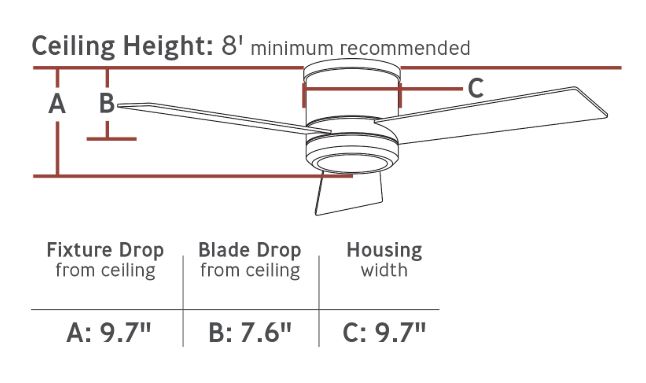
- Downrod Length: This is the pipe that connects the fan motor to the ceiling mounting bracket. Its length dictates how far your fan hangs from the ceiling.
- Ceiling Height Matters! For safety and optimal airflow, fans should typically be at least 7 feet from the floor, ideally 8-9 feet. If you have low ceilings, you'll need a "hugger" or "flush-mount" fan, which requires no downrod or a very short one. High ceilings? A longer downrod ensures the fan is in the optimal zone to move air effectively.
- Blade Pitch (or Angle): While you don't typically "measure" this with a tape, it's an important spec. Blade pitch refers to the angle of the blades. A steeper pitch generally moves more air, but requires a more powerful motor. It's a key factor in how much breeze you'll actually feel!
- Motor Housing Dimensions: Sometimes, for aesthetic reasons or fitting into a specific niche, you might want to know the width and height of the motor housing itself, separate from the blades.
The Joy of Knowing: How This Makes Life More Fun!
So, you've mastered the art of fan measurement. What now? Well, for starters, you're officially a DIY champion! You've tackled a small, seemingly insignificant task and gained practical knowledge that empowers you.

This isn't just about ceiling fans; it's about realizing that with a little curiosity and a tape measure, you can understand and improve so many aspects of your home. Want to pick the perfect rug? Measure! Thinking about new curtains? Measure! The world becomes your oyster of perfect fits and informed decisions.
Imagine the satisfaction of stepping into a room where the fan is perfectly sized, creating that ideal, gentle swirl of air. No more guessing, no more settling. You picked that fan, knowing it was the perfect one for your space, your comfort, and your style. That, my friend, is a truly delightful feeling!
So, next time you look up, don't just see a fan. See an opportunity to learn, to measure, and to make your home just a little bit more perfect, one informed decision at a time. Go forth, measure with confidence, and enjoy the beautiful breeze of your own newfound knowledge!