
How Do You Find The Charge Of A Transition Metal

Hey there, chemistry curious cats! Ever look at a bottle of brightly colored chemicals and wonder, "What's going on in there?" Sometimes, those vibrant hues are thanks to our friends, the transition metals. But these metals aren't always playing by the simple rules you might've learned in basic chemistry. And that's where things get… interesting. We're talking about figuring out their charge.
Think of it like this: imagine a superhero whose powers fluctuate depending on the situation. Sometimes they're super strong, other times they have super speed. Transition metals are similar! They can have different charges (or oxidation states, to use the fancy term) depending on what they're hanging out with.
Why Should You Care About Charge?
Okay, valid question! Why bother figuring out the charge of a transition metal? Well, for starters, it's the key to understanding how they bond with other atoms to form molecules. Knowing the charge helps us predict a compound's properties, like its color (remember those vibrant chemicals?), its reactivity, and even its magnetic behavior. It's like knowing the secret code to unlock their chemical potential!
Must Read
Imagine you're building with Lego bricks. You need to know what size and shape each brick is to make sure your structure is stable, right? The charge of a transition metal is like knowing the "shape" of its electrical personality. Get it wrong, and your chemical "structure" might fall apart (or, more likely, just not form the way you expect).
The Detective Work Begins: Clues from the Neighbors
So, how do we actually find the charge? We're going to be chemical detectives, using clues from the other atoms in the compound. This is where your knowledge of common ions comes in handy. Think of it as knowing the usual suspects in a mystery novel.
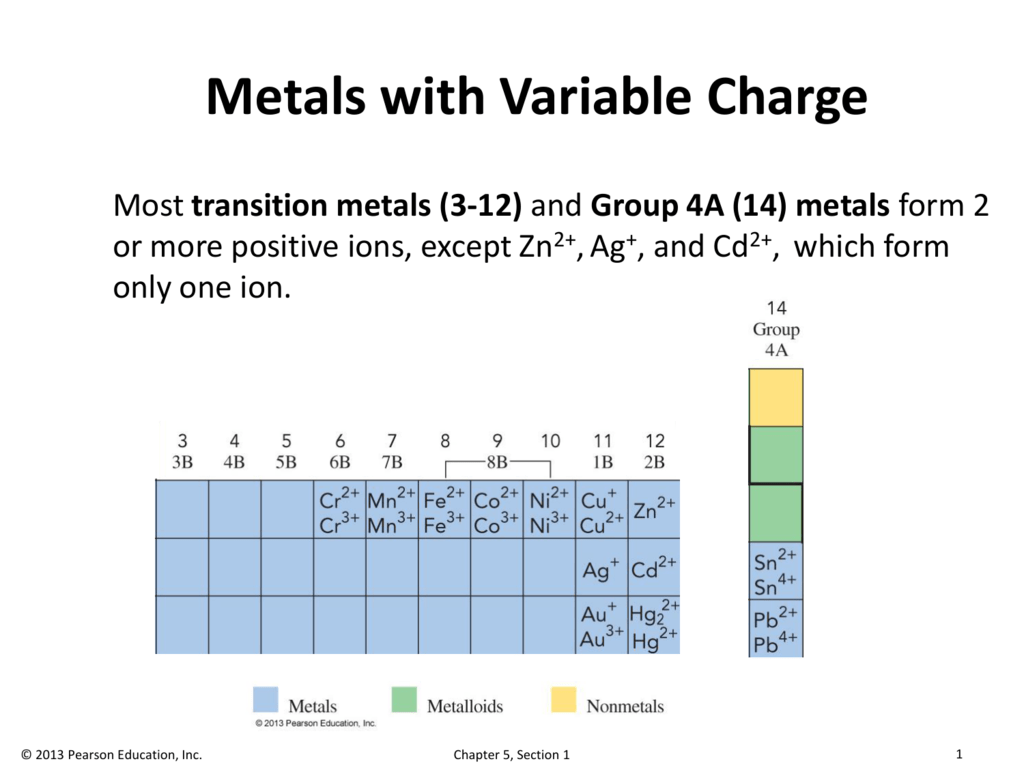
Many elements have predictable charges. For example, oxygen is almost always -2. Chlorine is usually -1. Sodium is almost always +1. Knowing these "usual" charges is the foundation of our investigation.
Here's the key idea: The overall charge of a neutral compound must be zero. That's like saying the books have to balance at the end of the day.
Let's Solve a Case! (An Example)
Let's say we have the compound FeCl3. What's the charge of the iron (Fe)? We know that chlorine (Cl) usually has a -1 charge. And we have three of them, so that's a total of -3. To make the entire compound neutral, the iron must have a +3 charge! Ta-da! Iron(III) chloride.
See? Not so scary, right? We used the known charges of the other elements to deduce the unknown charge of the transition metal.
Here's a simple breakdown:
- Identify the knowns: What elements in the compound have predictable charges?
- Calculate the total negative charge: Sum up the charges of all the negative ions.
- Calculate the total positive charge: Remember, the overall charge must be zero, so the positive charge must equal the magnitude of the negative charge.
- Determine the transition metal's charge: If there's only one transition metal atom, then its charge is simply the total positive charge. If there are multiple, divide the total positive charge by the number of transition metal atoms.
A Few Words of Caution (Because Chemistry Isn't Always Simple)
Now, here's a little twist. Sometimes you might encounter polyatomic ions, like sulfate (SO42-) or nitrate (NO3-). Treat these ions as a single unit with a known charge. Think of them like pre-assembled Lego structures. You don't need to break them down further; just use their overall charge in your calculations.
Also, some compounds are not neutral. They have an overall charge, indicated by a superscript. In that case, the charges of all the ions must add up to that overall charge, not zero.

Why is it so COOL that Transition Metals can have different charges?
Here’s the kicker! This ability to have multiple charges is what makes transition metals so versatile and interesting. It allows them to participate in a wide range of chemical reactions, acting as catalysts, forming colorful complexes, and playing essential roles in biological systems. Without them, life as we know it simply wouldn't exist!
It's like having a toolbox filled with multi-tools. Each transition metal can adapt to different situations, doing a variety of chemical jobs. From the hemoglobin in your blood (iron!) to the catalysts used in industrial processes, transition metals are constantly working behind the scenes.
So, the next time you see a colorful solution or a complex chemical formula, remember that the charge of a transition metal is the key to understanding its behavior. It's a little bit of detective work, a little bit of puzzle-solving, and a whole lot of chemical awesomeness. Now go forth and charge up your knowledge!