
How Do You Find Coefficient Of Kinetic Friction
Ever wondered how slippery something really is? I mean, beyond just a "whoa, that's slick!" kind of feeling? You're about to dive into the wild world of the coefficient of kinetic friction! Get ready to unlock some real-world physics fun!
It's all about measuring just how much two surfaces resist sliding against each other. Think of it as a sliding scale, literally!
The "Drag Race" Method
Okay, so let's imagine we're setting up a super simple experiment. You'll need an object, a surface to drag it across, and a way to measure force (a spring scale is your friend!). This is where the fun begins.
Must Read
Attach the spring scale to your object. Now, gently pull it across the surface at a constant speed.
Keep an eye on that spring scale reading! The force it's showing is pretty crucial. It's fighting the friction tooth and nail!
Step 1: Find the Force That Fights Back
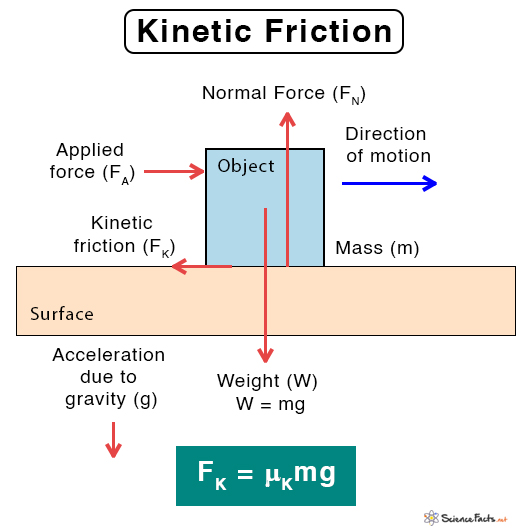
That reading on the spring scale? That’s your force of kinetic friction. It's the force that the surface exerts back on the object to stop it from sliding.
It’s like the surface is saying, "Oh, you wanna move? Not so fast!". We'll call it Fk for short. Nice, right?
Step 2: Weighing In – Finding the Normal Force
Next, we need to know how hard the object is pressing down on the surface. This is what we call the normal force, or Fn. Think of it as the "weight" the surface feels.
On a flat surface, the normal force is usually just the object's weight. You can easily find that using a scale, or by calculating it with some simple math: mass times the acceleration due to gravity (about 9.8 m/s2).
Step 3: The Big Reveal - Calculating the Coefficient
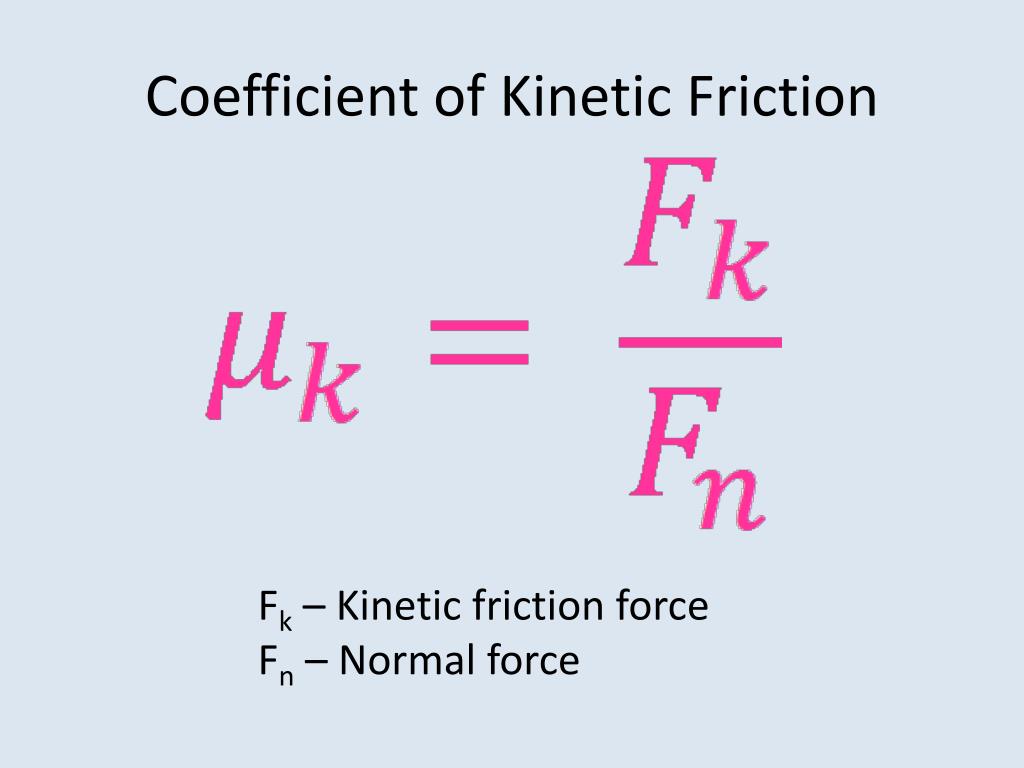
Now for the magic formula! The coefficient of kinetic friction (μk) is found by dividing the force of kinetic friction (Fk) by the normal force (Fn). It's as simple as μk = Fk / Fn.
Plug in your numbers, and BAM! You've got your coefficient! Isn't that pretty easy?
The Inclined Plane Adventure
Ready for a slightly more adventurous approach? Let's ditch the spring scale and play with ramps!
We can use an inclined plane (basically a ramp) to find the coefficient of friction. Get that object of yours!
This method uses gravity to do the work. It relies on the object sliding down the ramp!
Step 1: Finding the Angle of Slippage
Slowly raise one end of your ramp. Watch closely! The object will eventually start sliding.
The angle just before it starts moving at a constant speed is important. We’ll call it θ (theta). This is the “angle of slippage.”

Step 2: Tangent Time!
This is where a little trigonometry comes into play. Don’t worry, it's not scary! You'll need a calculator with a tangent function.
The coefficient of kinetic friction (μk) is simply the tangent of that angle of slippage (θ). So, μk = tan(θ).
Punch that angle into your calculator. Boom! You've got your coefficient again!
Why This is Actually Kind of Awesome
Okay, maybe “awesome” is a strong word, but hear me out. The coefficient of kinetic friction helps us understand the world in a super practical way.
Think about tires on the road. Or how ice skates glide so effortlessly. Or even how your socks interact with your freshly polished floor! It’s all friction, baby!
Understanding this concept can actually make you appreciate everyday things. You might even start noticing friction everywhere!
It's also used in engineering all the time. Design better brakes, conveyor belt, or sliding doors all depend on friction!

Important Things To Keep In Mind
Surface Matters: The type of surface plays a huge role. Different materials create different amounts of friction. Wood on wood is different than ice on steel.
Speed Isn't Everything: The coefficient of kinetic friction is relatively constant at lower speeds. At very high speeds, things can get more complicated. Let's keep it simple for now, shall we?
Temperature’s Influence: Believe it or not, temperature can also affect friction. Generally, it's a small effect for most common materials, but in some cases, it's crucial to consider.
"Friction is a force that opposes motion when the surface of one object moves over the surface of another."
Cleanliness Counts: Dirt, oil, or other contaminants can significantly change the coefficient of friction. Keep your surfaces relatively clean for consistent results!
Beyond the Basics
Want to delve even deeper into the frictional rabbit hole? There's a whole world of tribology out there (the study of friction, wear, and lubrication). Seriously!
You can explore the differences between static and kinetic friction. Static friction is what keeps an object from starting to move, and it's usually higher than kinetic friction.
There are also more complex models of friction that take into account things like surface roughness and adhesion.

You can research the effects of lubricants on friction. Lubricants are often used to reduce friction!
Get Experimenting!
The best way to understand the coefficient of kinetic friction is to experiment. Grab a few different objects, find some different surfaces, and start sliding!
You can test anything from the soles of your shoes to different types of fabrics.
You'll be amazed at the differences you discover, and you'll gain a much deeper appreciation for the forces that shape our everyday world.
Finding the coefficient of friction? It is so entertaining because it reveals the hidden interactions between everyday materials. This helps us see the world around us in a new light.
It is also special because it connects abstract physical concepts to tangible experiences. That helps to bridge the gap between theory and reality.
So, go forth and explore the friction-filled world around you! You'll never look at a sliding object the same way again. Happy experimenting!