
How Do You Convert Kva To Amps
Okay, picture this: You’ve just gotten your hands on the ultimate, must-have gadget for your home or workshop. Maybe it’s a super-fancy espresso machine that practically brews the coffee itself, or a new arc welder that promises to make your metalworking dreams come true. You’re buzzing with excitement, ready to plug it in, and then you see it on the spec sheet, right next to the power requirements: “Requires 10 KVA.”
Your brain, like mine, probably goes, “Ten… KVA? What in the electric heck is a KVA, and will my existing wiring burst into a shower of sparks if I just, you know, plug it in?” You've got breakers rated in amps, your generator probably talks amps, and suddenly, you’re in a different unit universe. It’s like trying to bake a cake with a recipe that calls for "cubits" of flour. Frustrating, right?
Well, my friend, you're not alone in that mini-panic. And that’s exactly why we’re here today. We’re going to demystify the mighty KVA and transform it into something your brain (and your electrical panel) can understand: Amps. Because who doesn't love a good conversion that prevents an unexpected blackout?
Must Read
First Off: What Even IS KVA?
Let's get cozy with our terms. KVA stands for kilovolt-amps. It’s a measure of apparent power. Think of it like this, and this analogy is pretty famous for a reason: Imagine a frosty mug of beer. The actual liquid beer that gets you happy? That’s real power (measured in kilowatts, or kW). But the foam at the top? That’s reactive power. You need it for a good head, but it doesn't get you tipsy.
The entire contents of the mug – the beer and the foam – that’s your KVA. It's the total amount of power that your electrical system needs to deliver, even if some of it isn't doing direct "work." For generators, transformers, and UPS systems, KVA is often the go-to rating because they have to handle the total current and voltage, including that "foamy" reactive power.
And Amps? Oh, Glorious Amps!
Amps (short for amperes) are, in contrast, much more straightforward. They measure the electric current – essentially, how many electrons are flowing through the wire. Think of it like the volume of water flowing through a pipe. More amps mean more flow, more electricity moving. This is what your circuit breakers are rated for, what your house wiring limits, and what you usually think about when you're sizing up an electrical load.
So, Why the Conversion Party?
You need to convert KVA to Amps for a handful of super practical reasons:
- Sizing circuit breakers: You don't want to trip them constantly or, worse, not have them trip when they should!
- Choosing the right wire gauge: Too small a wire for too many amps? Hello, fire hazard!
- Matching a generator: Is your new gadget going to overload your backup generator?
- Understanding existing infrastructure: Can your building’s electrical system handle that new heavy machinery?
Basically, it’s all about safety and making sure things work without melting down. Important stuff, wouldn't you say?
The (Not So) Secret Formulas!
Alright, grab your imaginary calculator (or a real one, if you’re feeling wild). The conversion isn't one-size-fits-all, because electricity isn't always single-phase (like in your house) but can also be three-phase (common in industrial settings). And voltage, my friend, is key!
For Single-Phase Systems (Most Homes):
This is probably what you’re dealing with for that fancy espresso machine or home workshop tool. Most residential power is single-phase, typically 120V or 240V in North America, or 230V in many other parts of the world.
The formula is pretty neat:
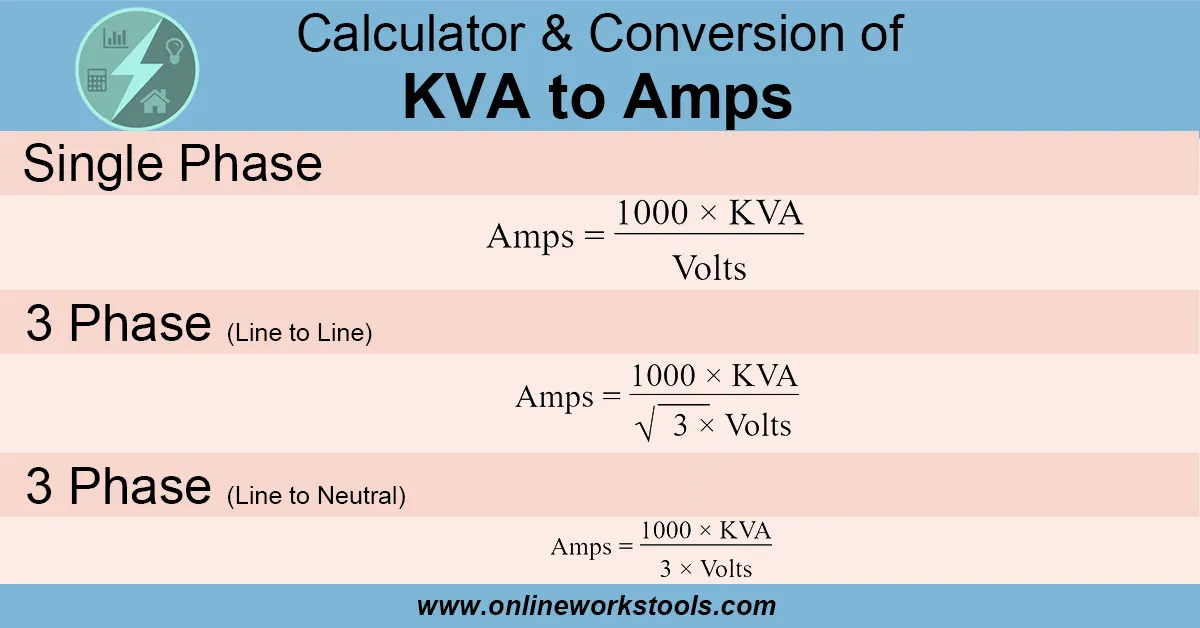
Amps = (KVA * 1000) / Volts
Why the 1000? Because KVA is kilovolt-amps (thousands of VA), and we want plain old VA to get to Amps. A volt-amp (VA) is simply Volts * Amps. So, to find Amps, we divide VA by Volts.
Let's try an example: Your awesome new gadget is 10 KVA and you’re running it on a 240V single-phase circuit.

Amps = (10 KVA * 1000) / 240V
Amps = 10000 / 240
Amps = 41.67 Amps
So, you’d need a circuit and breaker rated for at least 42 Amps (probably a 50A breaker for headroom) for that bad boy. See? Not so scary!
For Three-Phase Systems (Industrial & Commercial):
If you're in a commercial building, a factory, or have really serious power needs, you might be dealing with three-phase power (e.g., 208V, 480V, 600V). It's more efficient for delivering large amounts of power.

The formula here has a little extra ingredient:
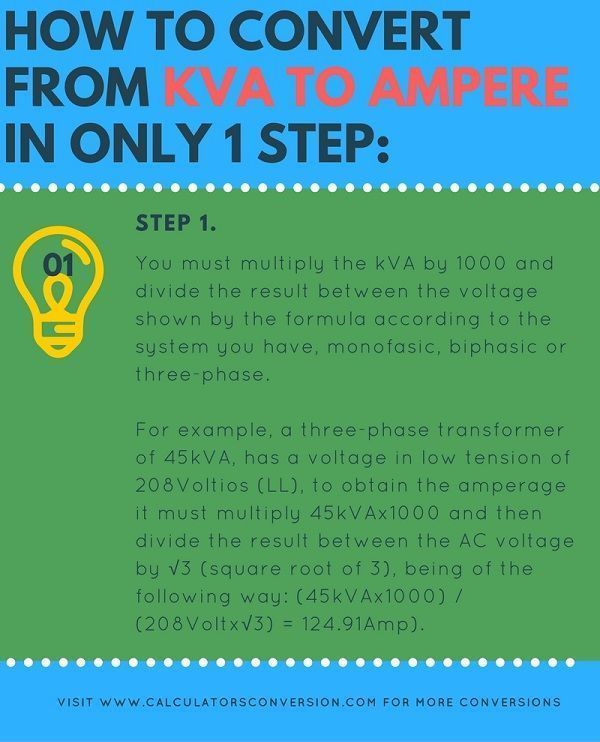
Amps = (KVA * 1000) / (Volts * √3)
Or, since the square root of 3 (√3) is approximately 1.732, you can use that for simplicity:
Amps = (KVA * 1000) / (Volts * 1.732)
Another example: You've got a massive workshop tool that requires 50 KVA on a 480V three-phase system.
Amps = (50 KVA * 1000) / (480V * 1.732)

Amps = 50000 / 831.36
Amps = 60.14 Amps
For this, you'd be looking at a 70 Amp breaker and appropriate wiring. You're practically an electrician already!
Quick Side Note: You might hear about "Power Factor" in relation to kW and KVA. While crucial for calculating real power (kW), it's not directly in these KVA to Amps formulas because KVA already represents the apparent power, and Amps is just the current derived from that total apparent power and voltage. We're directly calculating the current needed for the KVA. So, no need to get bogged down with it for this specific conversion!
A Final Word (A Very Important One!)
While understanding these conversions is super empowering (pun absolutely intended!), please, please remember that electricity is nothing to mess around with. If you're unsure about wiring, panel upgrades, or anything beyond simply doing the math, always call a qualified electrician. They're the real superheroes of the electrical world, ensuring everything is up to code and, most importantly, safe!
So, the next time you see "KVA" on a spec sheet, don’t panic! Just remember your trusty formulas, grab your calculator, and convert that mystery into plain old Amps. You got this!