
How Do You Change Watts To Amps

Ever found yourself staring at a device label, wondering what on earth "1500W" or "10A" actually means for your daily life? Or maybe you're plotting out a new home office setup, dreaming of a perfect coffee station and a multi-monitor wonderland, but a tiny voice in your head whispers, "Will this blow a fuse?" Relax, you're not alone. Understanding the basics of electricity, like how to change Watts to Amps, is a lot less intimidating than it sounds, and surprisingly useful for navigating our gadget-filled world.
Think of it as learning the secret language of your electronics. We're going to demystify this, no advanced physics degree required. Just a dash of curiosity and a willingness to understand the invisible forces making your phone charge and your toast pop.
Why Even Bother with Watts and Amps?
Good question! While you might not be wiring a house from scratch, knowing how these electrical terms relate can save you a headache (and perhaps a scorched outlet). It’s about more than just numbers; it’s about safety, efficiency, and making sure your tech plays nicely together. Whether you’re plugging in a new appliance, setting up a camping inverter, or just trying to understand your electricity bill, this knowledge is your secret superpower.
Must Read
Watts (W) is the universal language for how much power an appliance consumes or produces. It’s like the total energy output – think of it as the horsepower of your electrical device. A brighter bulb has more watts, a more powerful microwave has more watts. It's the "oomph."
Amps (A), short for Amperes, measure the current or the flow of electricity. Imagine it as the volume of water flowing through a pipe. A higher amp rating means more electrons are flowing. It's the "how much is moving."
And then there's Volts (V), which is the electrical "pressure" pushing the current. In North America, most standard wall outlets deliver around 120V, while in many parts of Europe and Asia, it’s closer to 230V. This difference is super important when converting!
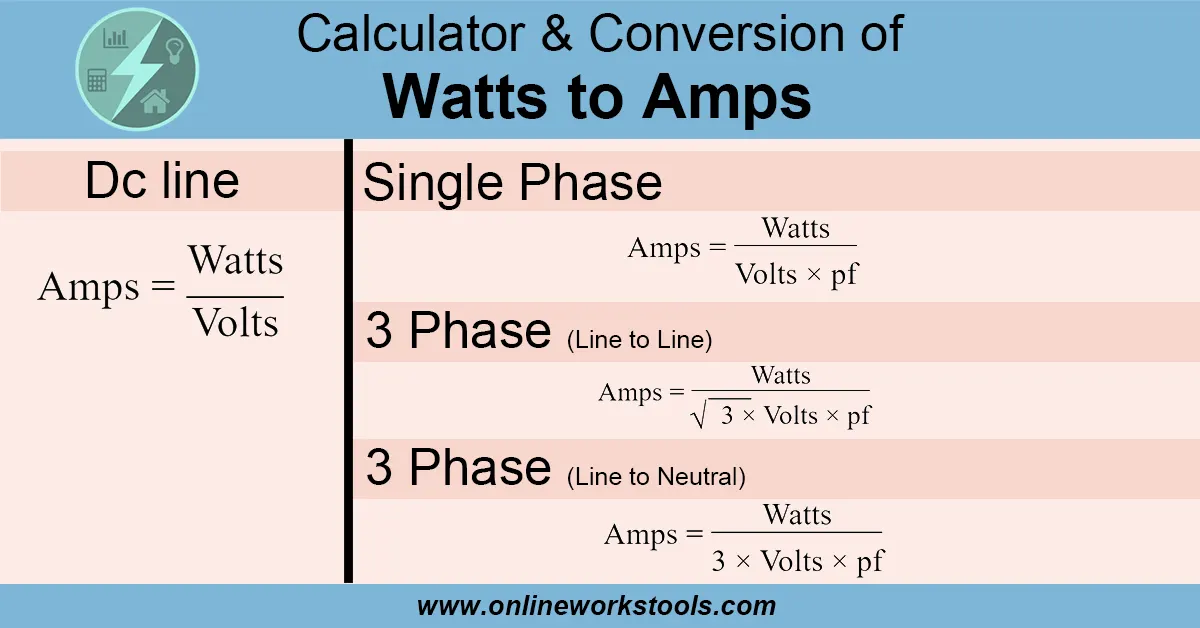
The Magic Formula: Making the Switch
Ready for the big reveal? The relationship between Watts, Amps, and Volts is beautifully simple, thanks to something called Ohm's Law. But for our purposes, we'll focus on the power equation:
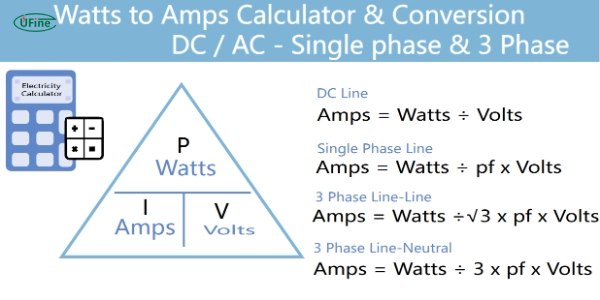
Power (Watts) = Voltage (Volts) × Current (Amps)
Or, in a more memorable format: P = V × I (where I stands for Current).
Now, if you want to find Amps (I) and you already know your Watts (P) and Volts (V), you just rearrange the formula like a pro chef adjusting a recipe:

Current (Amps) = Power (Watts) ÷ Voltage (Volts)
Which translates to: I = P ÷ V
Voilà! That’s it. That's the secret sauce for converting Watts to Amps.
Let's Do Some Real-World Math (It's Easy, Promise!)
Imagine your favorite hairdryer proudly declares "1800W." You live in the US, so your wall outlets are 120V. How many amps is that beast drawing?
Amps = 1800W ÷ 120V = 15 Amps
Suddenly, you realize that your hairdryer, your toaster (say, 900W / 120V = 7.5 Amps), and your kettle (another 1500W / 120V = 12.5 Amps) might be pushing the limits of a standard 15-Amp household circuit if used simultaneously. This is why circuit breakers exist – they're the unsung heroes of your home, preventing overloads and potential fire hazards. Good to know, right?
What if you're traveling to a country with 230V outlets? That same 1800W hairdryer would draw:

Amps = 1800W ÷ 230V ≈ 7.8 Amps
Notice how the Amps go down when the Volts go up for the same amount of Watts? Less current (Amps) is needed at higher voltage to deliver the same power. This is why you see lower-amp plugs in 230V regions for devices that are still quite powerful.
Fun Facts & Practical Tips for the Everyday Explorer
- The Water Analogy: Many people visualize electricity with water. Volts are the water pressure, Amps are the flow rate (how wide the pipe is), and Watts are the total power delivered (like how much water fills a bucket in a minute).
- Check the Label: Seriously, always check the device label. Most gadgets clearly state their Wattage and Voltage requirements. If only Amps are listed, you can work backward to Watts (P = V × I).
- Circuits Have Limits: Your home's electrical circuits are rated for a maximum number of amps (e.g., 15A or 20A). Overloading them will trip the breaker – a minor inconvenience, but a crucial safety feature.
- Travel Adapters vs. Converters: Understanding watts and volts helps here. A simple travel adapter changes the plug shape; a voltage converter actually transforms the voltage. Using the wrong one can fry your device or the outlet!
- Smart Home Savvy: Ever wondered why smart plugs or energy monitors show you power consumption? They're measuring Watts! Now you know how to translate that into Amps to understand the load on your circuit.
Your New Electrical Zen
So there you have it! You’ve unlocked a small but significant piece of the electrical puzzle. No longer will "Watts" and "Amps" be mysterious hieroglyphs. You now understand that a device's Watts tell you its total power, your wall outlet's Volts are the electrical push, and by dividing the two, you get the Amps – the flow of current. Knowing this helps you make smarter choices, from planning your kitchen appliance usage to understanding why certain travel gadgets need converters.
In a world increasingly powered by technology, having a basic grasp of these concepts isn't just for electricians; it's for everyone. It's about being more informed, more empowered, and perhaps a little safer. It’s a bit like knowing how to read a nutrition label – you don't need to be a dietitian to make healthier choices. Now go forth and conquer your gadget-filled life with newfound confidence!