
How Do I Calculate How Many Solar Panels I Need

So, you’re ready to ditch the dinosaur juice (aka fossil fuels) and embrace the sunshine with solar panels? Excellent choice! You’re basically becoming a sun-powered superhero! But before you start picturing yourself single-handedly saving the planet (which, by the way, you kind of are), let’s figure out how many solar panels you actually need.
First things first: Energy Audit – Unleash Your Inner Sherlock!
Think of this as your energy detective work. We need to find out how much electricity your home guzzles down like a thirsty elephant at a watering hole. Grab your most recent electricity bill.
See that number labeled “kWh” or “kilowatt-hours”? That’s your monthly electricity consumption. If you only have bills from different months, calculate the average across 12 months so your results are more reliable.
Must Read
Let's say your bill shows you use 1000 kWh per month. Write that down! That’s our magic number for this energy adventure.
Sunlight Shenanigans: Location, Location, Location!
Okay, so we know how much electricity you use. Now, we need to figure out how much sunlight your roof gets. This is where latitude comes into play.
Think of it this way: someone in sunny Arizona is going to get a lot more direct sunlight than someone in, say, Seattle (no offense, Seattle!). A quick Google search of your location with the words "peak sun hours" can quickly reveal this information.
Let's imagine you live in a place that gets an average of 5 peak sun hours per day. Five glorious hours of sunshine ready to be turned into pure, clean energy!
Panel Power: Not All Panels Are Created Equal!
Solar panels are like tiny electricity factories. They come in different sizes, each producing a different amount of power. You'll usually see this power rating listed in watts (W).

A common solar panel might be rated at 300-400 watts. For our calculations, let's say we're using a 350-watt panel.
Math Time! Don't Panic, It's Easier Than Making Toast!
Ready for some surprisingly simple math? First, let's figure out your daily energy needs. Remember that 1000 kWh monthly usage? We need to convert it to daily usage.
Divide 1000 kWh by the number of days in a month (let's use 30). So, 1000 kWh / 30 days = roughly 33.3 kWh per day. You use about 33.3 kilowatt-hours of electricity every day.
Now, let's convert that to watt-hours (Wh). Since 1 kWh equals 1000 Wh, multiply 33.3 kWh by 1000. That gives us 33,300 Wh per day.
Putting It All Together: The Solar Panel Recipe!
Now for the grand finale! We’re going to divide your daily energy needs (in watt-hours) by the amount of sunlight your area receives and the power of each solar panel.
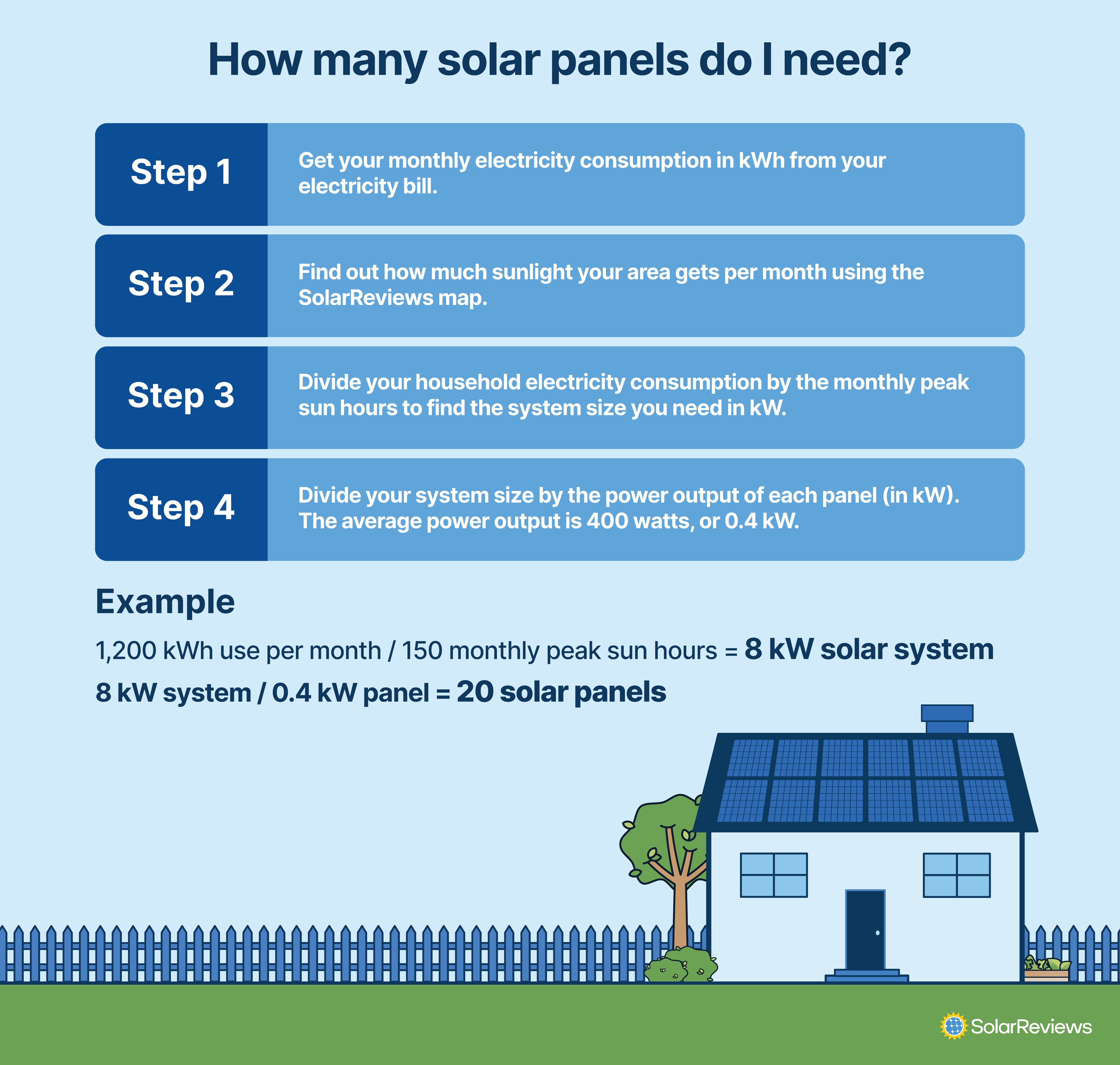
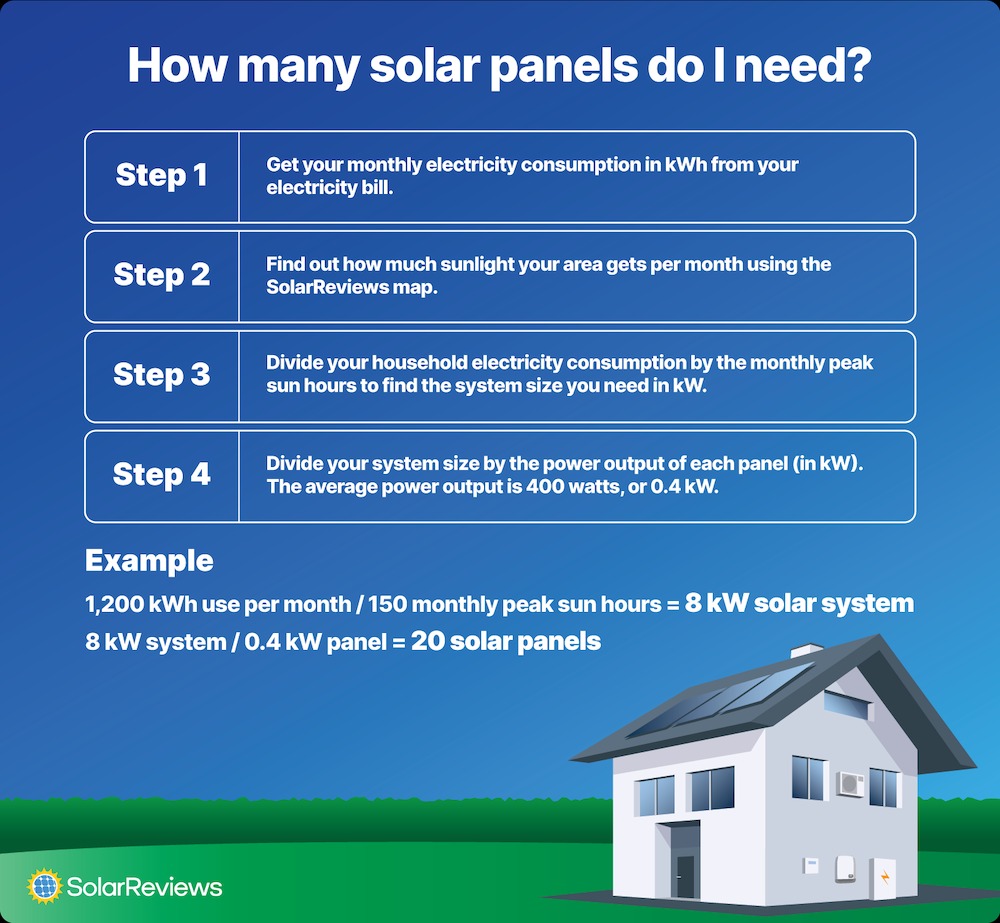
The formula looks like this: (Daily Energy Needs in Wh) / (Peak Sun Hours) / (Panel Wattage) = Number of Solar Panels.
Plugging in our numbers: 33,300 Wh / 5 hours / 350 watts = approximately 19 solar panels. You would need around 19 of these 350-watt panels to cover your electricity usage!
Don't Forget the Inverter – The Panel's Translator!
Solar panels produce direct current (DC) electricity. Your home runs on alternating current (AC) electricity. An inverter is the device that converts DC to AC.
Inverters also come in different sizes, measured in watts. You need to make sure your inverter can handle the total power output of your solar panels. For example, if you have 19 350-watt panels, your total power output is 6650 watts (19 x 350).
Choose an inverter that is capable of handling that capacity. It's usually best to slightly oversize the inverter to ensure smooth operation.
Other Factors to Consider – The Plot Thickens!
Our calculations are a good starting point, but there are other things that can affect how many panels you need. Like roof angle, shade, and energy consumption habits.
A south-facing roof with no shade is ideal. But if your roof faces east or west, or if you have trees blocking the sun, you might need more panels.
Also, think about your energy habits. Are you a master energy saver, or do you leave lights on and blast the AC all day? Adjust your panel needs accordingly. Being energy efficient reduces how many panels you need.
When In Doubt, Call a Pro! The Expert Opinion
Calculating solar panel needs can be tricky. It's like trying to bake a cake without a recipe – you might get something edible, but it’s probably not going to win any awards.
A qualified solar installer can assess your specific situation and give you an accurate estimate. They'll consider all the factors and help you design the perfect solar system for your home.

Beyond the Basics: Net Metering and Battery Storage
Ready to take your solar journey to the next level? Learn about net metering. With net metering, any excess energy your solar panels generate gets sent back to the grid, and you get credit on your electricity bill!
Think of it as the electric company borrowing your sunshine and paying you back. Many utility companies offer net metering programs, so check with your local provider.
And what about battery storage? Want to store all that extra solar energy for a rainy day (or a power outage)? Consider adding a battery backup system. Battery storage gives you energy independence and peace of mind.
Go Forth and Conquer the Sun!
Calculating your solar panel needs might seem daunting at first, but it's actually quite manageable. With a little research and a bit of math (don’t worry, we kept it simple!), you can get a good idea of how many panels you need to power your home with sunshine.
So, what are you waiting for? Embrace the sun, save some money, and help save the planet! You're not just installing solar panels. You're investing in a brighter future for yourself and for generations to come.
Congratulations, sun-powered superhero! You're on your way to a greener, more sustainable lifestyle. You are going to save planet earth, one sunbeam at a time!