
How Are Energy Frequency And Wavelength Related
Hey there, curious cat! Ever wondered how those invisible things like light and radio waves actually work? And how are energy, frequency, and wavelength all tangled up together? Well, grab your metaphorical lab coat (or your favorite comfy sweater, no pressure!), because we're about to dive into the wild world of electromagnetic radiation. Don't worry, it's way less scary than it sounds – promise!
Frequency: The Party Animal
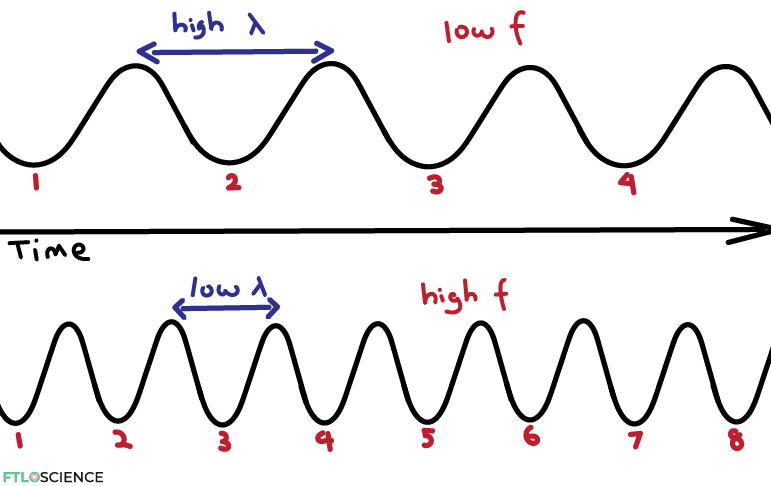
Let's start with frequency. Imagine a wave crashing on the beach. The frequency is basically how many waves crash per second. If a whole bunch of waves are slamming into the shore super fast, you've got high frequency. If they're lazily rolling in, one every few minutes, that's low frequency. Think of it like this: high frequency is a super energetic party animal, dancing non-stop! Low frequency is more like chilling on the couch with a good book (also awesome, just in a different way).
Frequency is measured in Hertz (Hz). One Hertz means one wave cycle per second. So, 100 Hz means 100 waves are happening every second. That’s a lot of waves!
Must Read
Wavelength: The Length of the Party
Now, let’s talk about wavelength. This is simply the distance between two crests (or two troughs) of a wave. In other words, it's how long each wave is. If you have a bunch of short, tightly packed waves, you have a short wavelength. If the waves are stretched out and far apart, you have a long wavelength. Imagine those party animals again: short wavelength is like a tiny, quick jig, while long wavelength is more like a slow, graceful waltz.
Wavelength is usually measured in meters (m) or nanometers (nm – which are super tiny!). Remember, nano means billionth! Science uses some seriously small rulers sometimes.
The Energy Connection: Fueling the Fun
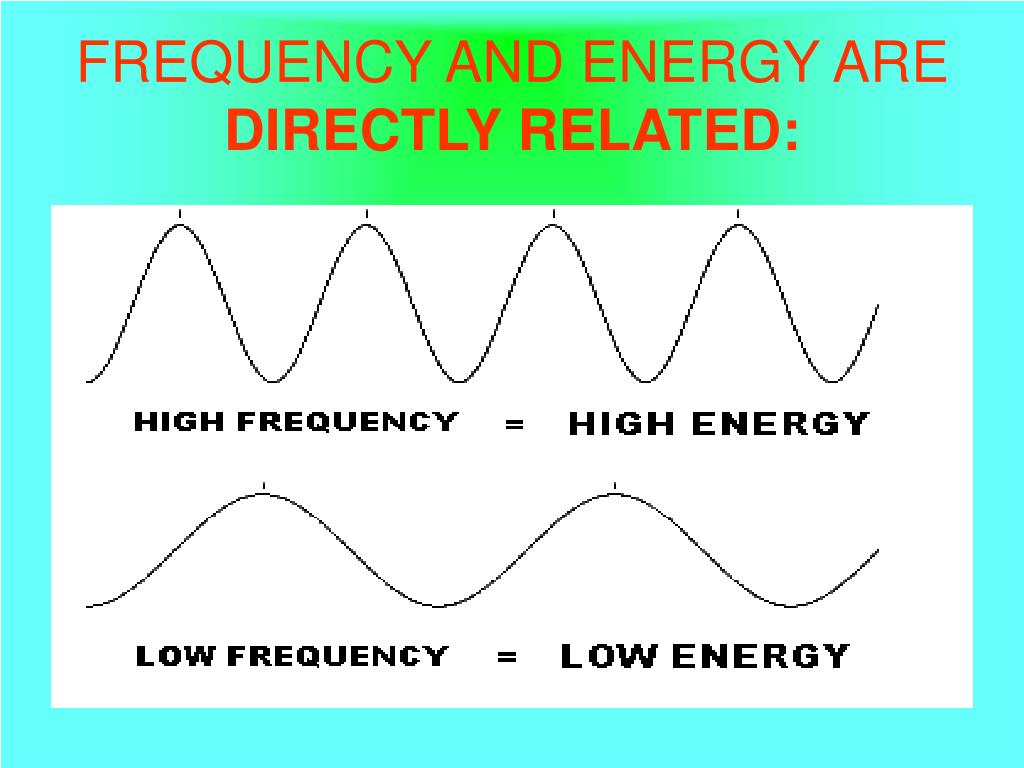
Okay, so frequency tells us how many waves are happening, and wavelength tells us how long they are. But where does energy come in? Well, here's the big secret: the higher the frequency, the higher the energy! It's a direct relationship. Think of it like this: those high-frequency party animals are burning way more calories than the couch potatoes. (No judgment either way, of course!)
Energy is measured in Joules (J). The more Joules, the more oomph the wave has. This is why things like X-rays and gamma rays (which have very high frequencies) are so powerful and can be used in medicine (or, you know, give you superpowers in comic books!). Radio waves, on the other hand, have low frequencies and low energy, perfect for listening to your favorite tunes without turning you into a superhero.
The Equation That Ties It All Together
Ready for a super simple equation? (Don't worry, it's not scary math!) Here it is:
Energy (E) = Planck's Constant (h) x Frequency (f)
Planck’s Constant (h) is just a tiny number that scientists figured out – you don't need to memorize it! The important thing is that this equation shows us that energy and frequency are directly proportional. As frequency goes up, energy goes up. Simples!

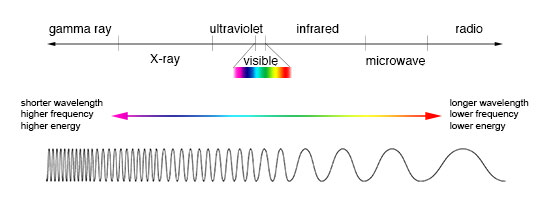
And guess what? Wavelength and frequency are inversely proportional. This means that as wavelength goes up, frequency goes down, and vice versa. Long waves are slow and chill, short waves are fast and energetic! Think of a seesaw – one side goes up, the other goes down. Same principle!
Why Does This Matter?
Knowing how energy, frequency, and wavelength relate helps us understand everything from how our microwaves heat up food (using low-frequency microwaves to vibrate water molecules) to how doctors use X-rays to see inside our bodies (using high-frequency X-rays that can penetrate soft tissue). It's all interconnected! Pretty cool, huh?
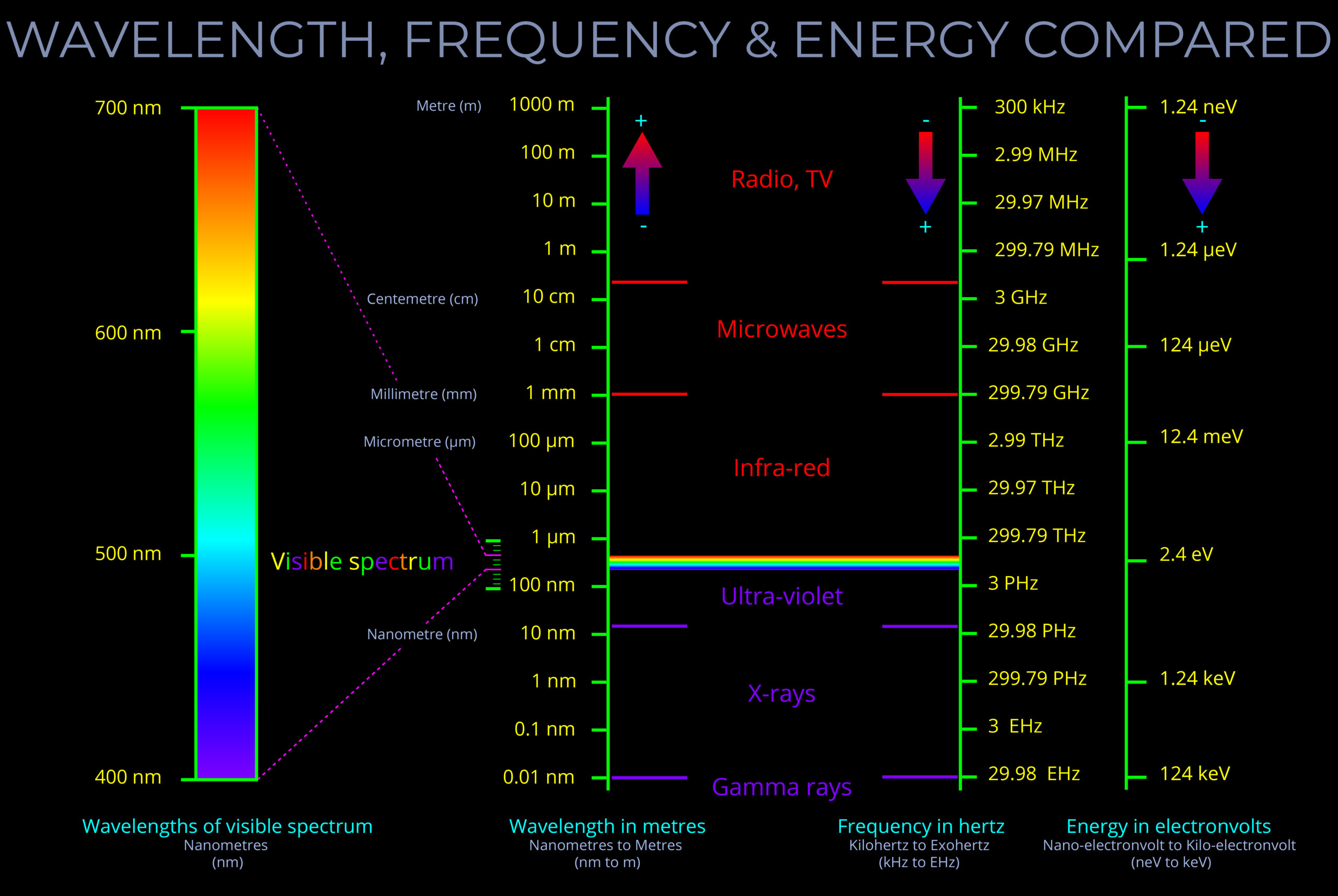
Think about the colors of light! Red light has a longer wavelength and lower frequency than blue light. That's why red light isn't as energetic as blue light. It also explains why your mom always told you not to stare at the sun – all that high-energy, high-frequency light can be harmful!
Wrapping it Up With a Smile
So, there you have it! Energy, frequency, and wavelength – all best buddies, dancing together in the electromagnetic spectrum. They might seem a little complicated at first, but once you understand the basic relationships, the whole world starts to look a little different (and a lot more fascinating!).
Remember, even though science can be complex, the core ideas are often beautifully simple. So, go forth and embrace the wonders of the universe! And next time you see a rainbow, you'll know that you're not just seeing pretty colors, you're witnessing the awesome power of energy, frequency, and wavelength in action. Now that's something to smile about!