
Food Safe Resin For 3d Printing
Ah, the magic of 3D printing! One minute you’re dreaming up a wild fantasy creature, the next you’re wondering if you can print a new coffee mug. We all do it. The idea of creating something useful, something that actually holds our morning brew or a handful of pretzels, is incredibly tempting. Enter the world of food-safe resin for 3D printing. Sounds perfect, right? Like a delicious, worry-free solution to all our kitchen woes.
The Dream of the Perfect Printed Plate
Imagine this: you’ve just designed the most adorable cookie cutter shaped like your cat’s face. Or a quirky little dish for your snacks. You think, "This is fantastic! But wait, can I actually put food on it?" Your mind races. You scour the internet. And then, a beacon of hope appears: food-safe resin! It’s right there in the name. Surely, this means you can print anything your foodie heart desires, stick it in the dishwasher, and gobble down your treats without a second thought. It's a lovely thought, truly it is.
But let’s have a little chat, shall we? A gentle, playful conversation among friends. Because while the promise of food-safe resin glitters like a freshly glazed doughnut, the reality can sometimes be... well, a bit less straightforward than a fairy tale.
Must Read
My "Unpopular" Opinion (Said with a Wink)
I suspect that "food-safe resin" for 3D printing is a bit like a unicorn. We all want to believe in it, we love the idea, but seeing one in real life, truly verified and without a single caveat? That’s a whole different beast.
Now, don't get me wrong. I'm not saying these resins are inherently evil or lying to you. The resin itself, in its cured, pristine block form, might indeed meet certain safety standards. It might pass tests for leaching when perfectly formed and sealed. But here’s the rub, my fellow makers: your 3D printer isn’t usually churning out perfect, sealed blocks of material.
![Food Safe - Food contact transparent resin 1.55 kg [3,41 lb] - ResinPro](https://resinpro.eu/wp-content/uploads/2019/10/Epoxyfood-ver2.jpg)
The Nitty-Gritty (Without Getting Too Gritty)
When you 3D print with resin, you’re creating an object layer by microscopic layer. Even the smoothest print has tiny, tiny ridges. Think of it like a miniature mountain range. These tiny valleys and peaks? They love to trap things. And when it comes to food, that means tiny bits of food, moisture, and bacteria can snuggle into those microscopic crevices. Washing might not get everything out. Suddenly, your charming cookie cutter is less charming and potentially a tiny bacterial resort.
Then there’s the curing process. Resin printing needs UV light to harden. But sometimes, especially with complex shapes or thick parts, some areas might not be fully cured. These uncured bits are the mischievous ones. They’re more likely to leach unwanted chemicals. Even fully cured resin can sometimes have surface contaminants that need thorough post-processing. It's not just print, wash, and eat. Oh no, it's a whole song and dance of cleaning, curing, and sealing.
Is "Food-Safe" Truly Food-Safe for My Print?
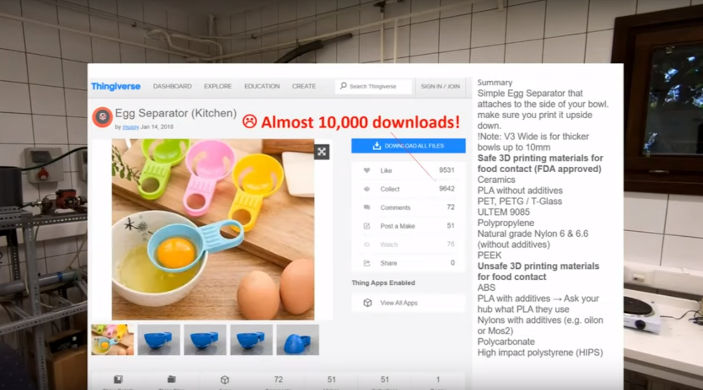
This is where the plot thickens. A resin might be certified food-safe. But that certification usually applies to the raw, cured material under specific, controlled lab conditions. It doesn't necessarily mean that your specific 3D printed object, with its unique geometry, layer lines, and post-processing routine, will automatically be food-safe in practice.
What about heat? What about acidity from certain foods? What about prolonged contact? These are all factors that can influence whether those supposedly inert chemicals decide to go for a swim in your soup. Most manufacturers will tell you that their food-safe resins are for "short-term contact" or "dry food contact" only. That's a huge qualifier, isn't it? It means your dream of a printed coffee mug might be more suited to holding pencils.
So, What’s a Maker to Do?
Don't despair! This doesn't mean your kitchen-related 3D printing dreams are dead. It just means we need to be a little smarter and a lot more cautious. Here are a few friendly pointers, offered with the same playful skepticism:
- Coating is King: If you absolutely must use a printed object with food, consider coating it with a truly food-safe epoxy or sealant. Think of it as giving your print a little raincoat that keeps all the questionable bits safely inside.
- Dry Foods Only: Stick to things like candy dishes for individually wrapped candies, or holders for fruit that still has its skin. Avoid anything wet, hot, or acidic.
- Decorative, Not Dinnerware: Embrace the beauty! Print that amazing cookie cutter, but maybe use it as a stencil for flour on a cake, or as a mold for clay, rather than direct dough contact. Or use it to cut paper for crafts!
- Think "Indirect": Print a stand for a bowl you already own. Print a napkin holder. Print a fun bottle opener handle. There are tons of ways to integrate 3D prints into your kitchen without them ever touching your actual meal.
Ultimately, the joy of 3D printing is in making things. And sometimes, the most fun things are the ones we don’t have to worry about leaching chemicals into our morning smoothie. So, while the idea of a truly, unconditionally food-safe 3D printed resin object remains a delightful fantasy, let's keep printing, keep creating, and perhaps, keep our actual food on plates that came from a less microscopically complex origin. Happy (and safe) making!
![Food Safe - Food contact transparent resin 1.55 kg [3,41 lb] - ResinPro](https://resinpro.eu/wp-content/uploads/2019/10/foodsafe-990x1000.png)