Examples Of Alternating Current And Direct Current
-vs-direct-current-(dc).png)
Alright, gather 'round, folks! Let's talk about electricity. Not the kind that makes your hair stand on end when you rub a balloon on it (though that's fun too), but the kind that powers our lives. Specifically, Alternating Current (AC) and Direct Current (DC). Think of them as the feuding families of the electrical world, except instead of Montagues and Capulets, we have, well, AC and DC. Catchy, right?
Now, I know what you’re thinking: “Electricity? That sounds boring!” But trust me, it’s more exciting than watching paint dry… mostly. Okay, maybe equally exciting as watching really fast-drying paint dry. But stick with me!
AC: The Party Animal of Power
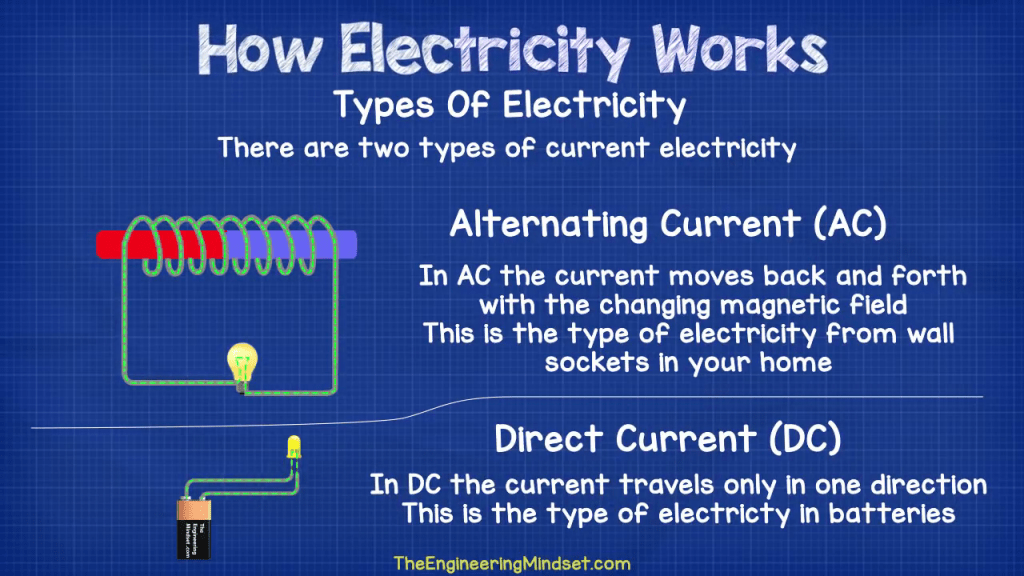
Let's start with AC. Imagine AC as that friend who can't sit still. It's always changing direction, like a toddler who just discovered the joy of running back and forth. This “alternating” thing is key. The electrons in AC flow first in one direction, then reverse and go the other way, doing this dance repeatedly. It's basically the electric slide, but for tiny, invisible particles.
Must Read
Why is AC so popular? Well, it's super efficient for long-distance travel. Think of it like this: Imagine you're trying to send a message across a crowded room. Would you rather whisper (DC) or shout (AC)? AC can be "stepped up" to higher voltages, which means you can send it farther with less energy loss. This is thanks to something called a transformer, which is basically like a power amplifier for electricity. It's the reason why we can have electricity in our homes, even if the power plant is miles away. Without AC, we'd probably be living in a world powered by hamster wheels. And while that's a fun image, it's not exactly practical for running your Netflix binge.
Examples of AC in your daily life? Oh, tons! Your toaster? AC. Your hairdryer? AC. That fancy blender you bought and used exactly twice? Yep, AC. Basically, anything plugged into a wall socket is probably running on AC. Your power company is sending you the AC love, and you’re using it to toast your bagels and dry your hair. It’s a beautiful, electrically-powered circle of life.

DC: The Steady Eddy of Electricity
Now, let's meet DC. DC is the opposite of AC. It's like that one friend who always follows the rules and never changes their mind. Direct Current flows in only one direction, like a diligent little river. No back-and-forth shenanigans here. Just a steady, unwavering flow of electrons from positive to negative.
DC is a bit of a homebody. It's best for powering things that are close to the source. Imagine trying to shout across that crowded room. It just won’t work as well. That’s why you don’t typically see DC being used for long-distance power transmission. It’s more comfortable in smaller, self-contained environments.

Where do you find DC? Batteries! That's right, your phone, your laptop, your car battery – all DC. Anything that runs on batteries uses DC. Even your electric toothbrush (the rechargeable kind) is using DC. Although it might get its power from AC wall wart, internally it's converting to DC for storage and use. You're surrounded by DC, even if you don't realize it. It's the quiet, reliable workhorse of the electronic world.
Think of it this way: AC is like a roller coaster, thrilling and exciting but maybe a bit overwhelming. DC is like a slow, steady train ride, reliable and consistent. Both have their place, and we need both to power our modern lives.

The Great Conversion: AC/DC!
Here's where things get interesting. Sometimes, we need to convert AC to DC, or vice versa. This is where magic...err, I mean, electronics, comes in. That little brick that plugs into your laptop? It's a power adapter, and its job is to convert the AC coming from the wall into the DC that your laptop needs to run. These magical devices are called rectifiers. They’re the translators between the AC and DC worlds.
Similarly, you can convert DC into AC using an inverter. Think of solar panels. They generate DC power, but most homes run on AC. So, an inverter is used to convert that DC power into AC, so you can power your TV, blender (that you rarely use), and all your other AC-powered gadgets. It's like a language translator for electrons, allowing them to communicate and work together seamlessly.
So there you have it: a whirlwind tour of AC and DC. They may be different, but they both play crucial roles in our lives. And just like any good family feud, they sometimes need to work together to get the job done. Now, if you'll excuse me, I need to go plug in my phone. It's running on DC, and I wouldn't want it to run out of juice!