
E To The Power Of Natural Log

Hey there, ever stumbled upon some math jargon that makes your eyes glaze over? Things like "e to the power of natural log"? Sounds like something a wizard would chant, right? Well, let's pull back the curtain on this little numerical magic trick. It's actually super simple, quite elegant, and quietly working behind the scenes in ways that might just make you crack a smile.
Imagine you're at a party, and you meet two intriguing characters: e and ln (that's "natural log" for short). They seem a bit mysterious at first, but once you get to know them, you realize they're actually a pair of inseparable, yet opposing, best friends.
Meet "e": Nature's Favorite Growth Storyteller
First, let's chat about e. Don't worry, it's not some scary, abstract number. Think of it as Mother Nature's personal accountant. e is roughly 2.718, and it pops up whenever things grow continuously.
Must Read
Picture this: You're baking bread. That yeast isn't growing in sudden jumps; it's expanding smoothly, constantly, every tiny fraction of a second. Or think about a population of rabbits (the stereotypical math example, I know, but it works!). They're not just having litters once a year; there's a constant, ongoing process of growth. That continuous, compounding growth? That's e right there, elegantly describing how things grow in the most natural, unceasing way.
It's like compound interest, but taken to the extreme. Instead of interest calculated yearly, monthly, or even daily, imagine it's compounded every single instant. That's the magic number e at play. It's the ultimate efficiency expert for growth!
Meet "ln" (Natural Log): The Great Un-Grower
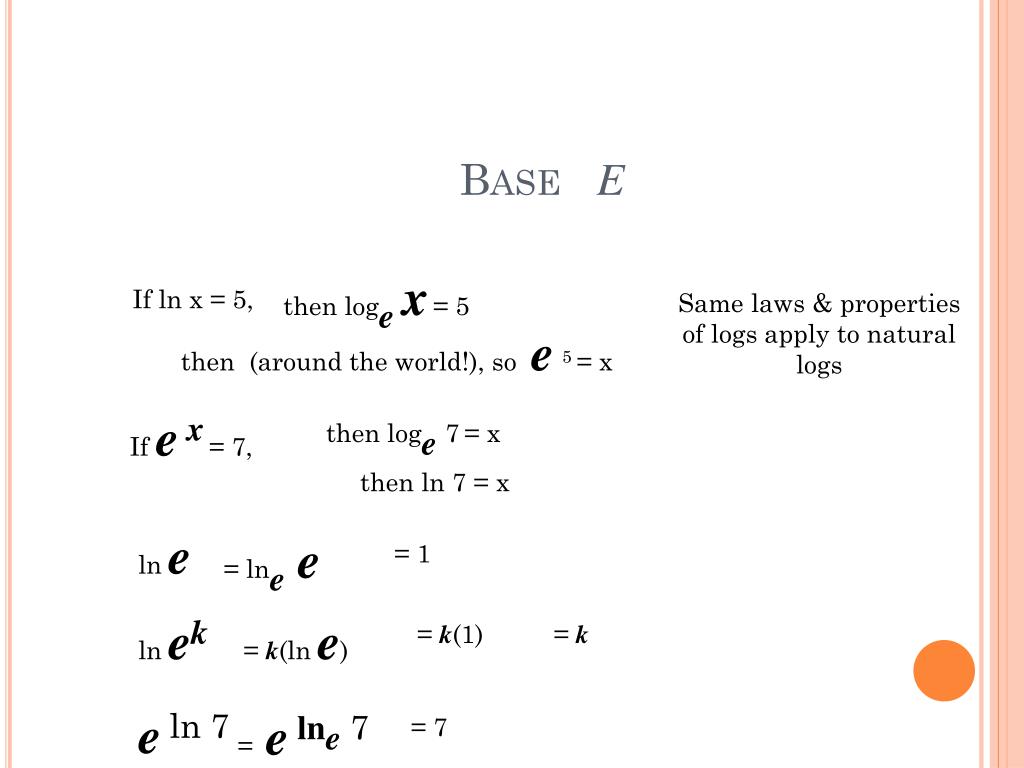
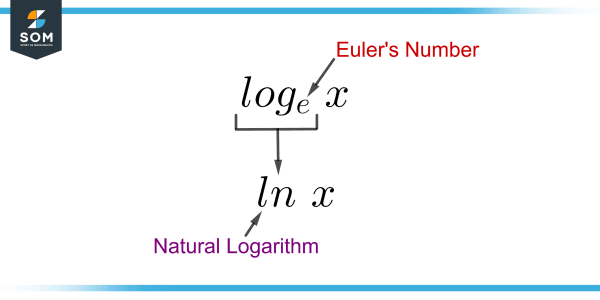
Now for its partner in crime, ln, or the natural logarithm. If e is all about telling you how much something grows when it grows continuously, then ln is like its curious detective friend asking, "how long did it take to get that big?" Or, more precisely, "what power do I need to raise e to, to get this specific number?"
Think of it as the ultimate "undo" button for e.
Let's go back to our bread example. If you know how big your dough got, and you know e is the natural growth rate, then ln can help you figure out how long you left it to rise. It reverses the process. It's like having a recipe where the final dish is given, and ln helps you figure out the precise cooking time if you know the oven's "natural" heating rate. Pretty cool, huh?
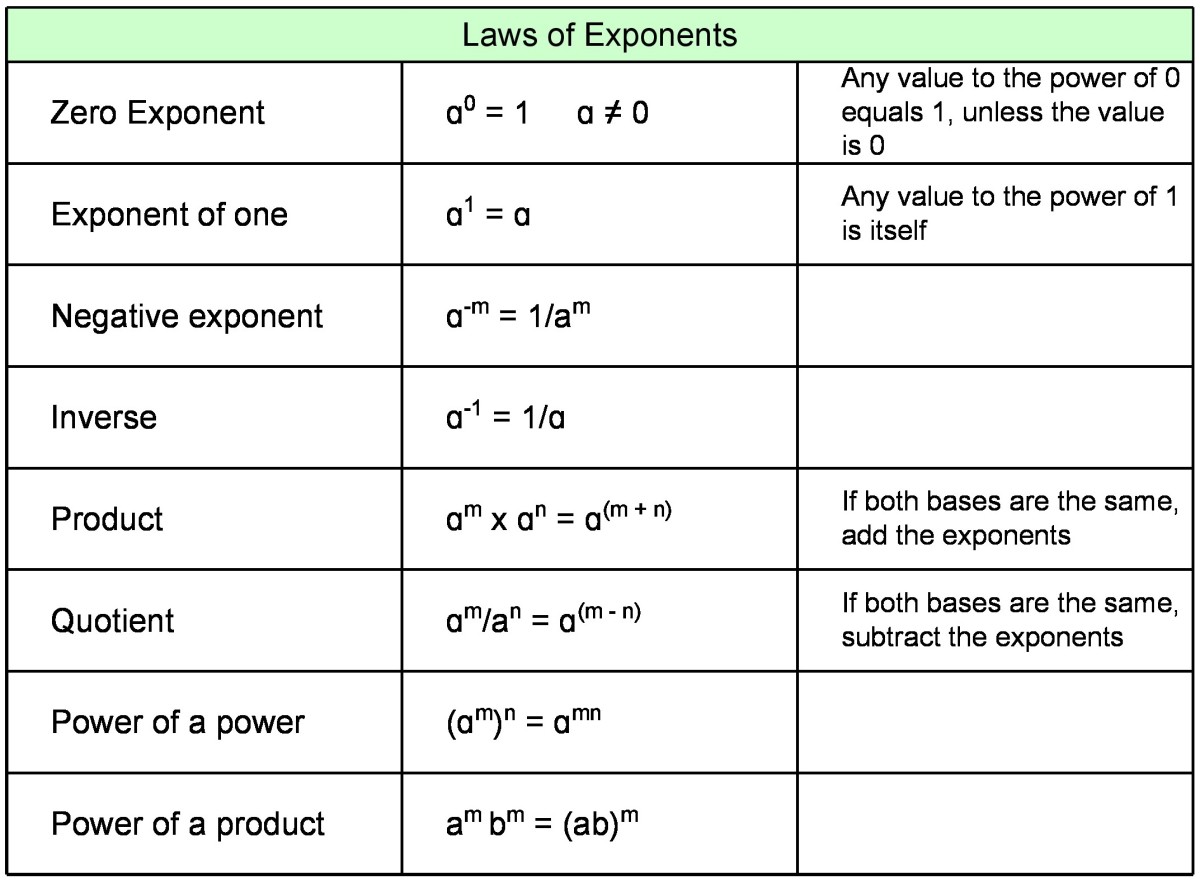
So, e tells you the natural growth factor, and ln asks "what's the exponent needed for e to reach this value?" They're inverses, like adding and subtracting, or multiplying and dividing.
The Big Reveal: "e to the Power of Natural Log"
Now for the grand finale! What happens when you put these two together? When you take e to the power of natural log of a number (let's call it 'x')?
It's like this: you say, "Hey, ln, what power do I need to raise e to, to get 'x'?" And then, immediately after, you actually do that – you raise e to exactly that power!
What do you get? You get x!
It's like putting on your socks, and then immediately taking them off. You're back where you started. Or opening a door with a key, then immediately locking it again with the same key. The actions cancel each other out.
So, if you ever see eln(x), just know it's a fancy way of saying x. It's the mathematical equivalent of a secret handshake that only looks complicated. In reality, it simplifies perfectly.

Why Should We Even Care About This Numerical Tandem?
"Okay," you might be thinking, "that's neat, but why should I, a regular person who just wants their coffee hot and their Wi-Fi fast, care about this numerical tango?" Great question!
Because this elegant cancellation is hiding behind a lot of the things that make our modern world tick, often simplifying complex calculations for the folks building those systems.
- Your Money Grows Smarter: While you might not see eln(x) on your bank statement, the principles of continuous compounding (e) and working backwards from growth (ln) are foundational to financial models, helping banks and investors understand how money grows and decays over time.
- Science & Nature's Secrets: From population growth to radioactive decay, from how chemicals react to how electrical signals fade, this dynamic duo helps scientists model natural processes with incredible accuracy. It allows them to simplify equations that would otherwise be monstrously complex.
- Behind Your Digital World: Many algorithms in computer science, from signal processing to data compression, quietly rely on these fundamental exponential and logarithmic relationships. They help engineers design more efficient systems that bring you clearer phone calls, faster internet, and smoother streaming.
- A Universal "Undo" Button: For mathematicians and scientists, knowing that eln(x) = x is like having a universal "undo" button. It lets them elegantly simplify equations, solve for unknown variables in complex growth scenarios, and generally make their lives a whole lot easier when dealing with natural, continuous changes.
So, the next time you hear "e to the power of natural log," don't let it intimidate you. Remember the best friends who cancel each other out, the bread rising, or the detective asking "how long did that take?" It's not just abstract math; it's a powerful tool that helps us understand, predict, and build the world around us. And that's pretty cool, if you ask me!