
Do Transition Metals Have Valence Electrons
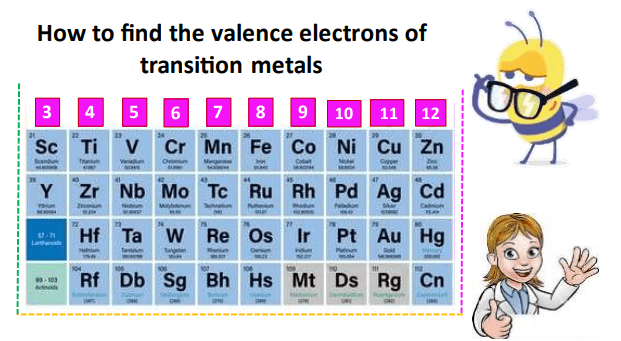
Ever wondered why your jewelry gleams with such vibrant colors, or why certain catalysts are super effective at speeding up chemical reactions? The secret lies, at least in part, with a group of elements known as transition metals! And a crucial piece of understanding these metals is figuring out their valence electrons. Now, "valence electrons" might sound like something out of a sci-fi movie, but trust me, it's a concept that helps us understand a whole lot about how the world works at a chemical level. So, buckle up, because we're diving into the fascinating world of transition metal valence electrons!
So, what's the big deal about valence electrons anyway? Simply put, valence electrons are the electrons in the outermost shell of an atom. These are the electrons that are most likely to interact with other atoms, forming chemical bonds. Think of them as the atom's "social butterflies," always ready to mingle and react. Understanding valence electrons helps us predict how different elements will react with each other, what kind of compounds they'll form, and even the properties of those compounds.
Now, here's where things get a little "transitional," if you will. For main group elements (the ones in the "tall" columns of the periodic table), determining valence electrons is pretty straightforward – you just look at the group number. But transition metals? They play by slightly different rules. Because they're filling their d orbitals (those electrons live in the d-block of the periodic table), they can have a varying number of valence electrons. It’s not always as simple as just counting. Often, both the s and d electrons contribute to bonding. This is precisely why transition metals can form multiple different ions (atoms with a charge), each with different properties.
Must Read
This ability to have variable valence is what gives transition metals their unique and often desirable properties. For instance, iron, a vital transition metal, can exist as Fe2+ or Fe3+, each with different reactivity and roles in biological systems like carrying oxygen in your blood. Similarly, copper's ability to easily gain or lose electrons makes it an excellent conductor of electricity, perfect for wiring your house. The brilliant colors often seen in transition metal compounds are also a direct consequence of their d-orbital electron configurations and the ways these electrons absorb and emit light. Think of the vibrant blues of copper sulfate crystals or the rich greens of nickel-containing compounds.
Understanding the complexities of transition metal valence electrons might seem like a deep dive into chemistry, but even a basic understanding opens the door to appreciating the science behind everyday phenomena. From the corrosion resistance of stainless steel (containing chromium, another transition metal) to the catalytic converters in your car (relying on platinum, palladium, and rhodium), transition metals and their dynamic valence electrons are constantly working to improve our lives. So next time you admire a piece of jewelry or marvel at a chemical reaction, remember the tiny, energetic valence electrons of the transition metals, hard at work making the world a more colorful and functional place!

.PNG)

