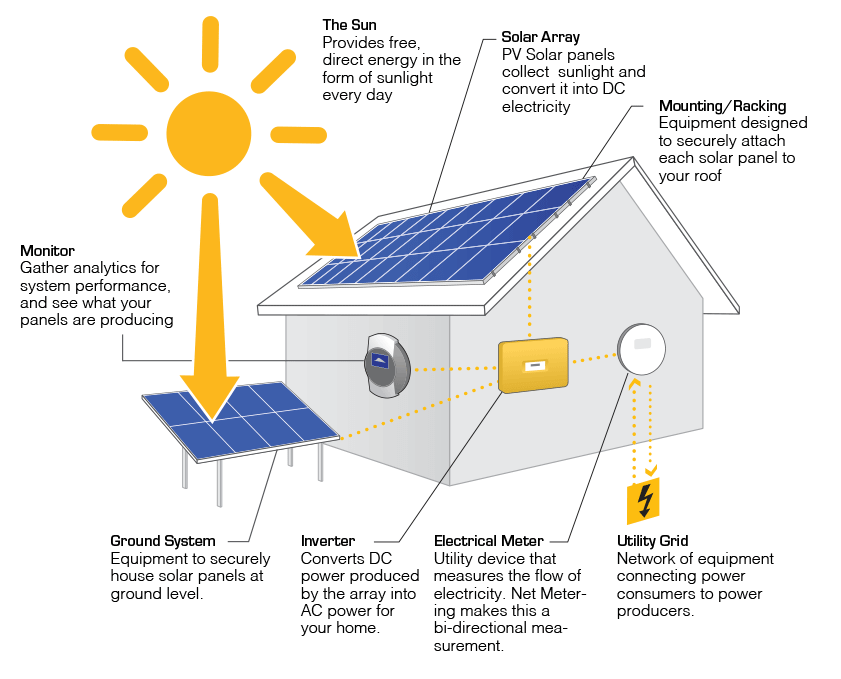
Diagram On How Solar Panels Work

Alright, let's talk solar panels, shall we? You've seen the diagrams, probably glazed over them like I do with furniture assembly instructions. All those arrows and squiggly lines look like a secret alien language, right? But fear not, my friend! We're going to break down how those shiny rooftop squares actually work, and I promise, it'll be less like a physics lecture and more like a chat over a ridiculously large cup of coffee.
Think of that big, friendly diagram as a sort of "day in the life" of a sunbeam trying to get your Netflix streaming. It all starts with the sun, obviously. Our big, bright, celestial buddy is just doing its thing, shining down like a proud parent showing off their kid's finger painting. Those rays aren't just for tanning and squinting; they're carrying tiny energy packets called photons. And these photons are the real MVPs here, trust me.
The Panel Party: Where Photons Get the Job Done
So, the sun blasts these photons down to your solar panel. Imagine each panel as a giant, super-sensitive bouncer at an exclusive club. When a photon hits the panel, it's like ringing the doorbell. But it's not just any doorbell; it’s a doorbell that immediately triggers a rave inside! The panels are made of something called silicon, which is basically sand that went to a fancy private school and got all sciency, making it excellent at conducting electricity under the right conditions.
Must Read
Inside these clever silicon layers, there are tiny, eager beavers called electrons. Now, normally, electrons are pretty chill, just hanging out, minding their own business. But when a photon hits them, BAM! It's like someone just blasted their favorite song – they get super excited and start bouncing around. This isn't just a happy bounce; it's a purposeful bounce. They're trying to escape their current silicon confines, like teenagers sneaking out of the house for a concert!
The panel is cleverly designed with positive and negative layers, kind of like two sides of a magnet. This creates an electric field, which is essentially a cleverly laid out path for those hyped-up electrons. They see this path and think, "Aha! An escape route!" So, they all start moving in one direction, like a disciplined queue for the hottest new taco truck, or cars on a one-way street, all heading towards the delicious destination. This organized, one-way movement of electrons is what we call Direct Current (DC) electricity. It's electricity that flows in one continuous direction, like a river always heading downstream.
The Inverter: The Translator of Power
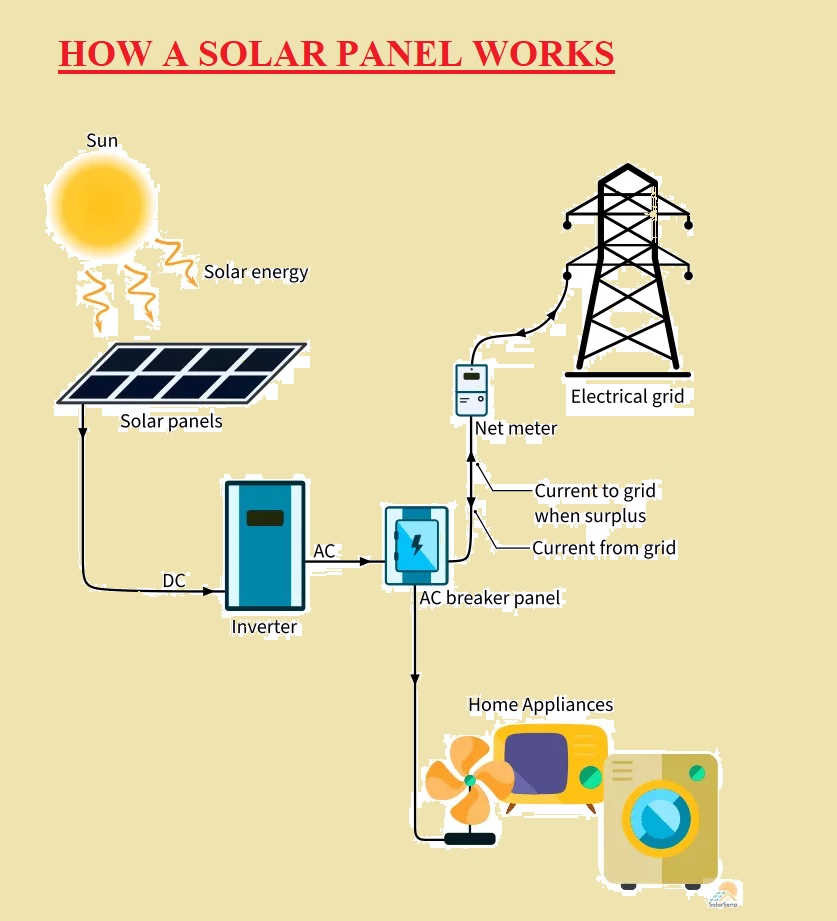
Now, here's a small snag: your house doesn't speak "DC." Your microwave, your phone charger, your trusty old toaster – they all speak Alternating Current (AC) electricity. DC is like that really cool, niche indie band that's amazing but only your super-hip friends know about; AC is the pop star everyone knows and loves, playing on every radio station. So, we need a translator, someone to bridge the gap. Enter the inverter!
The inverter is the unsung hero in your solar setup. It takes that raw, one-way DC power from your panels and magically converts it into the wobbly, back-and-forth AC power that all your home appliances understand. Think of it as a super-smart interpreter, taking something like "Hola" and instantly turning it into "Hello" so everyone can understand, or perhaps a chef taking raw ingredients and turning them into a delicious, usable meal. Without the inverter, your panels would just be sunbathing silicon, and your blender would remain sadly dormant, no matter how much sun they soaked up.

The Grand Tour: From Panel to Plug
Once the inverter has done its magic, that newly minted AC power flows into your home's main electrical panel. This is like the central nervous system of your house, or the air traffic controller at a busy airport, directing all the power where it needs to go. Need to charge your laptop? Zap! Turn on the living room light? Zoom! Power your ridiculously over-the-top gaming PC? Whoosh! It’s all coming from that glorious sun energy, transmuted into something useful for your daily grind, or rather, your daily chill.
But what if your panels are making more electricity than your house needs at that very moment? Maybe it’s a super sunny day, and everyone’s out enjoying a picnic, so the house is practically empty. Do you just... waste it? Absolutely not! That excess electricity doesn't just evaporate. Instead, it gets sent back to the electrical grid, like lending your neighbor a cup of sugar when they run out, or returning a library book you finished early. Your utility company then credits you for that power, often reducing your next bill. Pretty sweet, right? It's like your house is subtly saying, "Thanks, neighbor! Here's some sunshine for your troubles!"
So, there you have it! From tiny photons kicking off an electron dance party to a clever box translating power languages, that diagram you once feared is actually a friendly map of energy freedom. Next time you see a solar panel, you can smile, nod knowingly, and think of those excited electrons heading off to power your next binge-watching session or that extra load of laundry. Pretty cool, huh? It’s energy from the sun, delivered right to your couch, all thanks to a little bit of silicon magic.