
Chopin Waltz No 9 In A Flat Sheet Music
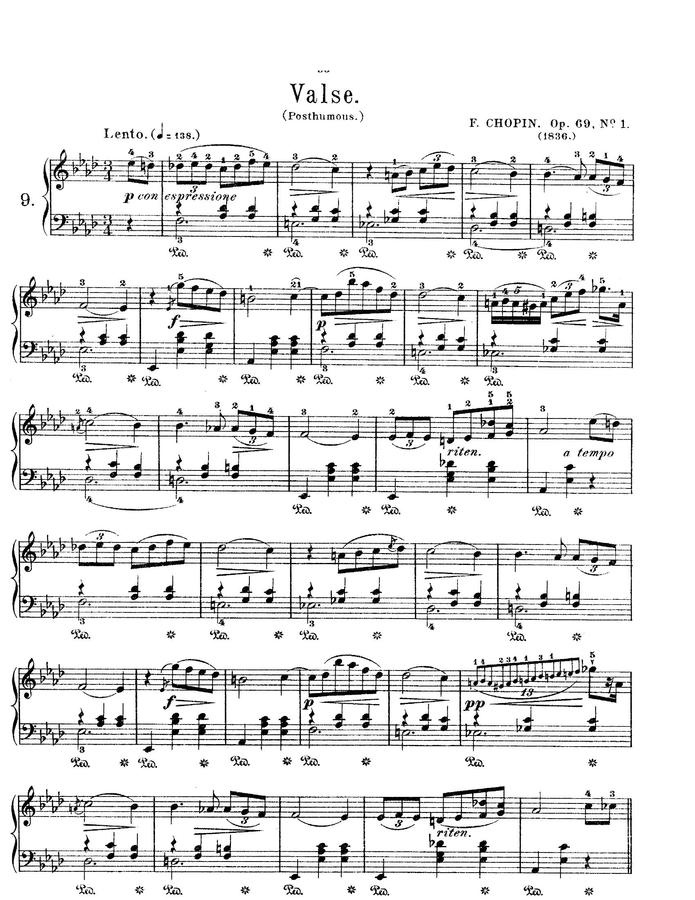
Hey music lover! Ever wanted to sprinkle a little bit of Parisian charm into your piano playing? Well, have I got a treat for you! We're diving headfirst into the delightful world of Chopin's Waltz No. 9 in A Flat Major, Op. 69, No. 1. Or, as I like to call it, the "Au Revoir Waltz" because it sounds like you're waving goodbye to all your troubles. Especially if you play it right!
Now, I know what you're thinking: "Chopin? Isn't that, like, super hard?" Don't let the name scare you! Yes, some of his stuff is brain-meltingly complex, but this waltz? It's surprisingly approachable. Think of it as Chopin-lite, a gateway drug to his more intricate works. (But don’t tell the serious pianists I said that!) So, let's talk about getting your hands on the sheet music.
Finding Your A Flat Adventure Map (aka Sheet Music)
Okay, first things first, where do you snag the sheet music? Luckily, it's practically everywhere! You can find it online at sites like IMSLP (the motherlode of public domain scores), Musicnotes, or even just a quick Google search for "Chopin Waltz No. 9 sheet music" will yield a treasure trove of options. Choose a version that suits your reading level – some are simplified, others are the full-on, uncut Chopin experience. Start with something manageable; nobody wants to wrestle a musical octopus on their first try!
Must Read
Pro Tip: When downloading online, double-check the quality! A blurry, faded score is about as helpful as a chocolate teapot. Make sure it's clear and easy to read, especially the accidentals (those pesky sharps and flats). Trust me, your eyes will thank you.
Decoding the A Flat Language
So, you’ve got the sheet music. Now what? Let's break it down. The first thing you'll notice is that it's in A Flat Major. Don’t run screaming! A Flat is a beautiful key, and it's got a lovely, mellow vibe. (Think rolling hills and fluffy clouds, not sharp, pointy cacti). The key signature will have four flats: B flat, E flat, A flat, and D flat. These are your friends! Get to know them. Treat them kindly.
The waltz is written in 3/4 time, meaning there are three beats per measure. Think "one-two-three, one-two-three." It's the quintessential waltz rhythm. Practice getting that rhythm solid before you even start worrying about the notes. A shaky foundation makes for a shaky performance! Imagine you're dancing with a very sophisticated ghost. He wouldn't appreciate you stumbling all over his spectral feet, would he?
Listen, Listen, Listen! Seriously, before you even attempt to play a single note, listen to recordings of the piece. Hear how the melody flows, how the dynamics change, and how different pianists interpret it. My personal favorite is Arthur Rubinstein’s – he just gets Chopin. Listening will give you a feel for the music and help you understand its nuances. It's like learning a new language by immersion. Except instead of awkward conversations about the weather, you get beautiful music.

Tackling the Tricky Bits
Okay, let's be real. There are a few spots in this waltz that can be a bit… challenging. There are some runs that require a bit of finger agility (think of it as a mini-workout for your digits). Don't try to play them at full speed right away! Slow practice is key. Break the run down into smaller sections and practice each section until it's smooth and even. Then, gradually increase the tempo. Think tortoise, not hare. Unless you are a hare, in which case, go for it!
Pay attention to the dynamics! Chopin was a master of using dynamics to create emotion. The sheet music will be peppered with markings like p (piano, soft), f (forte, loud), and cresc. (crescendo, gradually getting louder). Follow these markings carefully to bring the music to life.

Don’t be afraid to put your own spin on it! Chopin wanted you to feel the music, not just play the notes. Once you're comfortable with the basics, experiment with different tempos and dynamics to find what works for you. After all, music is about expression! Unless you're playing for a panel of grumpy judges. Then maybe stick to the sheet music. (Just kidding… mostly.)
Bravo! Encore! (And a Few Final Thoughts)
Learning Chopin's Waltz No. 9 is a journey, not a sprint. Be patient with yourself, celebrate your progress, and don't be afraid to make mistakes. Every mistake is a learning opportunity! And remember, even the greatest pianists in the world started somewhere. The important thing is to have fun and enjoy the process of making music. So grab your sheet music, dust off your piano, and prepare to waltz your way to musical bliss. You’ve got this! Now go forth and create some beautiful sounds!
