
Boron Is A Metal Or Nonmetal

Alright, buckle up, science explorers! We're about to dive into one of the most intriguing identity crises in the entire universe – okay, maybe just the periodic table. We’re talking about an element that really keeps us on our toes. Get ready to meet Boron, the ultimate enigma!
Imagine you're at a party, and everyone easily fits into neat little boxes. You’ve got the flashy, loud, conduct-all-the-electricity types over here – those are your metals. They’re shiny, they’re strong, they make great jewelry and wires.
Then, in another corner, you have the quiet, often dull, sometimes crumbly crowd. These are your nonmetals. They’re usually terrible at conducting electricity, and they often just hang out as gases or brittle solids.
Must Read
But then there’s Boron. Boron walks into the party and everyone whispers, "Is it... one of them? Or one of those?" It’s like Boron just can’t pick a team, and frankly, that’s what makes it so spectacularly cool!
The Metal Mix-Up? Not Quite!
When you think of a metal, what comes to mind? Probably something gleaming, right? Like a polished spoon or a shiny car bumper. Metals have that undeniable 'bling' factor.
They’re also excellent conductors of heat and electricity. You can feel the heat transfer when you stir hot soup with a metal spoon, and electricity zips right through copper wires powering your devices.
Now, let's look at Boron. If you held a piece of pure Boron, you wouldn't be reaching for your sunglasses. It's often described as a dark, rather dull-looking solid. Picture something more like a really fancy, super hard charcoal.
It definitely doesn't have that classic metallic luster. It's not going to reflect your grinning face back at you like a mirror. So, right off the bat, its appearance makes us think: "Hmm, probably not a metal."
And when it comes to conducting electricity? Well, Boron is kind of a reluctant performer. It's not completely hopeless like some nonmetals, but it's certainly no superstar conductor like gold or copper.
It's more like a hesitant dancer on the conductivity dance floor, showing up for a slow song but definitely not leading the charge. So, if "shiny" and "super conductive" are your main metal rules, Boron is already bending them pretty aggressively.
The Nonmetal Nudge? Getting Closer!
Okay, so it's not a flashy metal. Does that make it a plain old nonmetal then? Many nonmetals are gases, like oxygen in the air we breathe, or they're brittle solids, like the carbon in pencil lead.
When you encounter Boron, it's typically a solid. And guess what? It's pretty darn brittle. You wouldn't try to hammer a chunk of Boron into a new shape; it would likely just shatter into smaller pieces.
This brittleness is a hallmark of many nonmetals. Think about dropping a piece of chalk – it crumbles. That's a very nonmetallic trait, indeed.
It also doesn't like to give up its electrons easily. Metals are famously generous with their outer electrons, which is why they conduct electricity so well. Nonmetals, on the other hand, are electron hoarders.

Boron falls squarely into the electron-hoarding category. It likes to keep its electrons close, forming strong covalent bonds rather than sharing them freely in a metallic sea.
So, we've got dullness, brittleness, and electron-hoarding tendencies. These are all pointing us pretty strongly towards the "nonmetal" club, right? It seems like Boron might just be a nonmetal after all, albeit a very interesting one.
The Big Reveal: It's a Metalloid!
Hold the phone! Just when you think you’ve figured Boron out, the plot thickens. The truth is, Boron doesn’t fully commit to being a metal OR a nonmetal. It’s too cool for just one label!
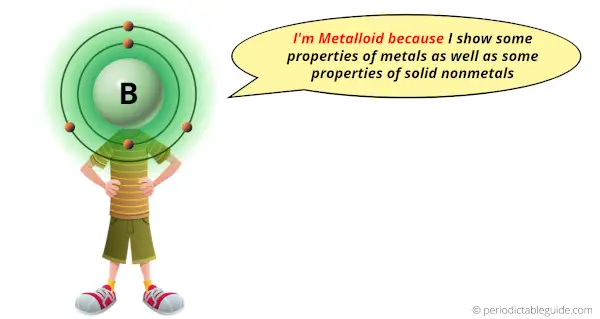
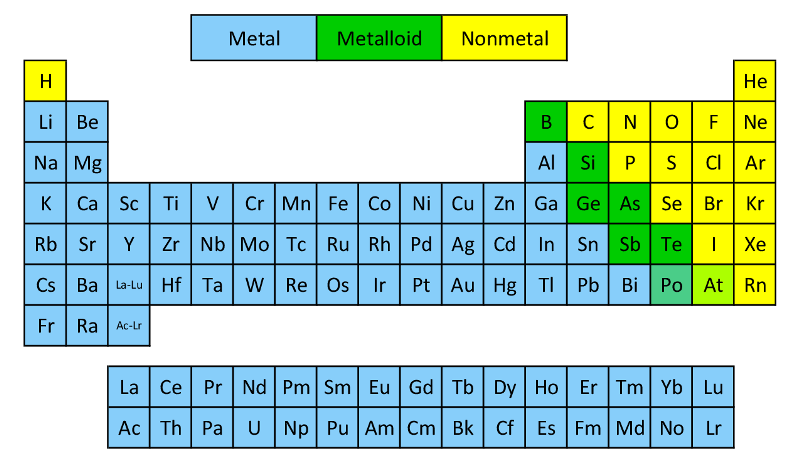
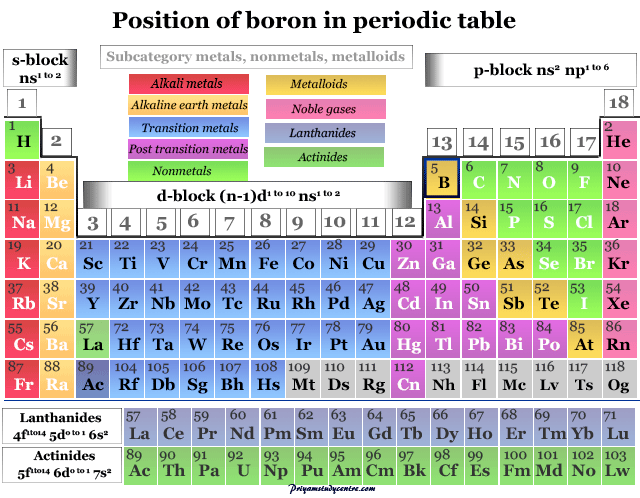
It belongs to a super exclusive, super fascinating club called the metalloids. Think of metalloids as the ultimate chameleons of the periodic table. They have properties that are a delightful mix of both metals and nonmetals.
They’re not quite shiny enough to be metals, but not always as dull as some nonmetals. They conduct electricity, but not as well as true metals, making them semiconductors – a property that’s actually incredibly useful!
"Boron is like that friend who's great at both baking intricate cakes AND fixing a leaky faucet. It defies easy categorization!"
This "middle-ground" existence is what makes Boron so special. It gets to pick and choose the best attributes from both worlds, creating its own unique chemical personality.
It’s not trying to be difficult; it’s just being incredibly versatile. And in the world of science, versatility is a superpower!
Boron's Superpowers in the Real World!
Because Boron is this amazing shape-shifter, it pops up in some truly unexpected and vital places. Its dual nature isn't a weakness; it's its greatest strength!
Ever heard of rocket fuel? Yep, some rocket fuels get their incredible energy boost from Boron compounds. Imagine that dull, brittle element powering a colossal machine into space!
It’s also crucial for plants! Just like you need vitamins, plants need tiny amounts of Boron to grow strong and healthy. Too much is bad, too little is bad – Boron is a very precise ingredient in nature's recipe.
And talk about tough! Materials like boron carbide are so incredibly hard, they’re used in things like bulletproof vests and the nozzles of sandblasting equipment. It literally helps stop bullets and shape metal!
You also find Boron in the super-strong glass used in scientific labware and certain ceramic glazes. Its ability to form incredibly strong bonds gives these materials their legendary durability.
Remember that semiconductor property? That's what makes Boron incredibly important in electronics. It helps control the flow of electricity in microchips and other advanced tech, making our smartphones and computers possible.
It’s even used in nuclear reactors to control nuclear reactions – absorbing neutrons like a tiny, elemental sponge! From super-fast computers to incredibly strong armor, Boron is silently making our world better.
So, the next time someone asks, "Is Boron a metal or a nonmetal?" you can confidently tell them, "It's both! And neither! It's a magnificent metalloid!"
It’s the ultimate individualist, carving out its own niche and showing us that sometimes, the most interesting things don’t fit neatly into any single box. And that, my friends, is a truly fantastic lesson from a truly fantastic element!