Ever heard of tungsten? Maybe you've seen it on a lightbulb filament, bravely glowing without giving up the ghost. It's a pretty impressive metal, and it's all thanks to its crazy high melting point.
What's the Big Deal About Melting?
Melting, in super simple terms, is when a solid turns into a liquid. Think of an ice cube transforming into a puddle of water on a warm day. Each substance has its own melting point: the specific temperature when this happens.
Chocolate melts pretty easily, which is why it's a gooey mess in your pocket on a sunny afternoon. Rocks, on the other hand, require a lot more heat to become molten. That is a big difference.
Tungsten: The Undisputed Champion of Heat Resistance
Now, let's talk about tungsten. This metal scoffs at temperatures that would turn other materials into puddles. It's like the marathon runner of the metal world, with incredible endurance when the heat is on!
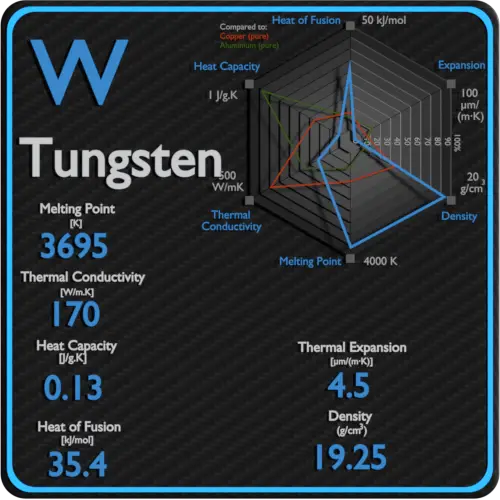
So, what's the magic number? Drumroll, please! Tungsten's melting point is a staggering 3,410 degrees Celsius (6,170 degrees Fahrenheit). That's hotter than the surface of some stars!
Why is Tungsten so Tough?
It's all about the atoms! Tungsten atoms are incredibly strongly bonded to each other. They cling on tight and resist being separated even when faced with intense heat.
Imagine a group of friends holding hands really tightly. It takes a lot of effort to pull them apart. That's kind of like what's happening inside tungsten.
Tungsten in Action: Beyond Lightbulbs
Okay, so we know tungsten is used in lightbulb filaments, where it glows brightly without melting into a puddle. But its uses don't stop there!
Think about welding. Welding involves creating intense heat to join metal pieces together. Tungsten electrodes are often used because they can withstand the extreme temperatures.
It's also found in high-speed tools like drill bits and cutting tools. The durability from a strong metal like tungsten helps them resist wear and tear when working on tough materials.
A Historical Glimpse at Tungsten
The story of tungsten is pretty cool too. It was officially identified as an element in 1781, but it took a while to figure out how to isolate it in its pure form.
Imagine the early chemists, struggling to work with this stubborn metal. It’s quite a change from the easy metal work we do today.
It's discovery led to a revolution in lighting and manufacturing. Tungsten became a key ingredient in electric lighting, thanks to its high melting point.
Tungsten Fun Facts: Things You Might Not Know
Here's a quirky fact: the word "tungsten" comes from the Swedish words "tung" and "sten," meaning "heavy stone." It's a pretty accurate description!
Tungsten is also used in some types of jewelry. Especially wedding bands that are known for being scratch-resistant and durable. It makes them good for a long marriage.
And get this: because it's so dense, tungsten is sometimes used as a counterweight in aircraft and racing cars. It provides weight in a small space. This makes it important to flight.
Tungsten: A Metal That Keeps its Cool Under Pressure
In conclusion, tungsten is a fascinating metal with a truly remarkable melting point. It's a testament to the power of atomic bonds and the ingenuity of scientists and engineers who have harnessed its unique properties.
So, the next time you switch on a light or see a welder at work, take a moment to appreciate the unsung hero: tungsten!
Beyond the Technical: The Spirit of Tungsten
Let's shift gears a little. Think about what tungsten's high melting point symbolizes.
Isn't it a little like the human spirit? The ability to persevere and stay strong, even when facing intense pressure or difficult circumstances? It represents endurance.
Tungsten reminds us that some things are built to last. They can withstand the test of time and emerge stronger on the other side. It gives hope.
The Everyday Relevance of Extreme Properties
Okay, so most of us aren't building rocket ships or welding bridges. But the properties of materials like tungsten affect our lives in subtle but important ways.
The electronics we use, the cars we drive, the tools we rely on - all depend on materials with specific properties, including melting points, strength, and conductivity.
Understanding these properties allows engineers to design better, safer, and more efficient products. It impacts everyone.
Tungsten's Legacy: A Symbol of Strength and Resilience
Tungsten's story isn't just about a high melting point. It's about innovation, perseverance, and the power of understanding the world around us.
It's a reminder that even the most extreme properties can be harnessed for the benefit of humanity. From light bulbs to medical devices, it is everywhere.
So, let's raise a metaphorical toast to tungsten, the metal that stays cool under pressure. May we all strive to be a little more like tungsten in our own lives: resilient, durable, and shining brightly, even when things get hot!
And remember, the next time someone asks you what the melting point of tungsten is, you can impress them with your newfound knowledge. You can also share the story of its many uses and its symbolic meaning of strength and resilience!