Ever stood in a river and felt the water rushing past your legs? Or maybe you've noticed how the ocean waves crash in predictable patterns? Well, you've just experienced currents in action! Currents are just water moving, but guess what? It turns out there are two main types, and understanding them is easier than figuring out why socks disappear in the laundry.
Surface Currents: The Ocean's Highway System
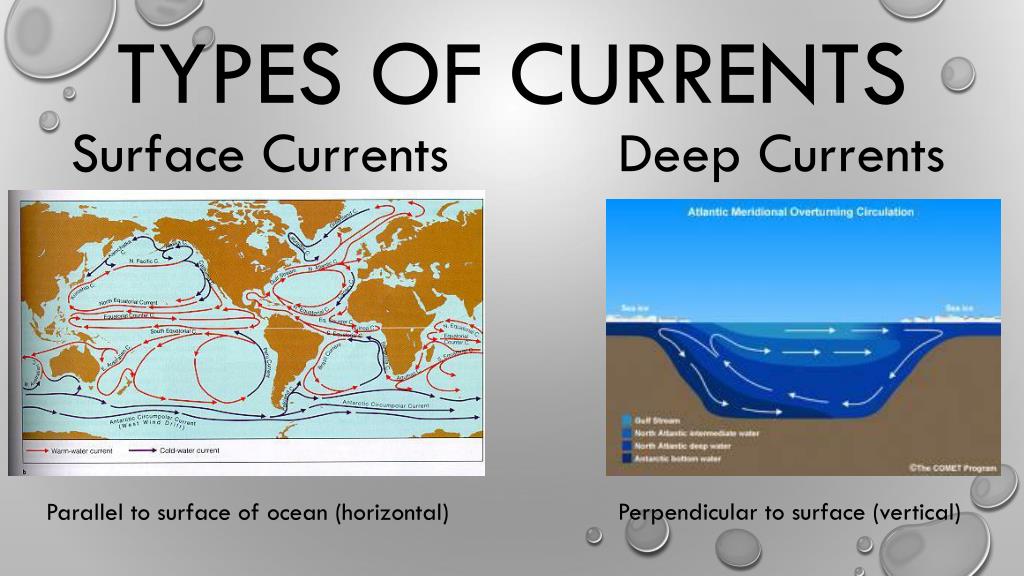
Think of surface currents as the ocean's highway system. They’re driven mainly by the wind. Seriously! The wind blows across the water's surface, dragging the water along with it. Now, the Earth is round and spins, so these currents don't just go straight. Thanks to the "Coriolis effect" (don't worry, you don't need to pronounce it), they curve. In the Northern Hemisphere, they bend to the right, and in the Southern Hemisphere, they bend to the left. It's like trying to bowl a straight line on a slightly tilted bowling alley. Tricky!
These surface currents are responsible for a lot more than just moving sailboats around. They're huge players in regulating the Earth's climate. Think of the Gulf Stream, for example. It's a warm current that carries warm water from the Gulf of Mexico up the eastern coast of the United States and across the Atlantic to Europe. Without it, Europe would be a much colder place – more like Iceland than, say, the French Riviera. So, next time you're enjoying a mild winter, thank a surface current!
I remember this one time I was at the beach. I was happily splashing around when I realized I was slowly drifting away from my beach towel. Panic set in! (Okay, slight exaggeration, but still!) Turns out I was caught in a rip current. Rip currents are strong, narrow currents flowing away from the shore. They're basically sneaky little escape routes for the ocean. The good news is, if you ever get caught in one, don't swim directly against it. Swim parallel to the shore until you're out of the current, then swim back to land. Learned that the hard way (slightly panicky beach towel memory, remember?).
Deep Ocean Currents: The Silent Movers
Now, let's dive a little deeper, literally. Deep ocean currents are a whole different ballgame. They aren't driven by wind. Instead, they're all about density. Think of density as how much "stuff" is packed into a certain amount of water. Colder water is denser than warmer water, and saltier water is denser than fresher water. So, when cold, salty water forms (usually near the poles), it sinks. This sinking water then starts to flow along the ocean floor, creating these deep ocean currents.
These deep ocean currents are like the ocean's underground rivers, moving incredibly slowly but carrying massive amounts of water. They play a crucial role in distributing heat, nutrients, and oxygen throughout the ocean. Imagine them as the ocean's circulatory system, keeping everything healthy and balanced. It's a slow, steady process, but it's absolutely vital for marine life and the overall health of the planet.
Think of it like this: surface currents are like the express delivery service, getting things from A to B quickly, while deep ocean currents are like the slow, steady cargo ships, moving massive amounts of goods over long distances. Both are essential for the ocean's economy, so to speak.
So, there you have it! Two types of currents: surface currents driven by wind and deep ocean currents driven by density. Next time you're at the beach or even just thinking about the ocean, remember these two types of currents and the important roles they play. It's all connected, from the wind on the surface to the slow, steady movement in the deep. And who knows, maybe you'll even avoid a slightly panicky beach towel drift thanks to your newfound knowledge!