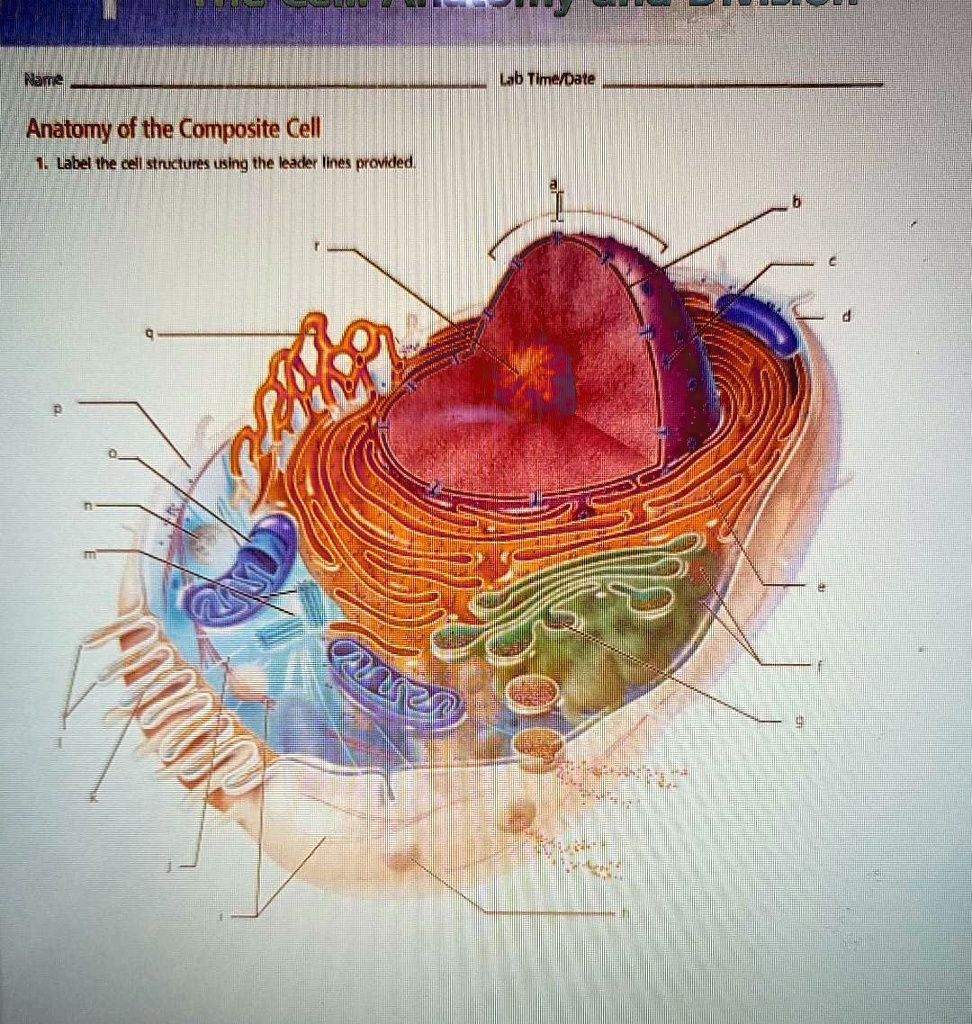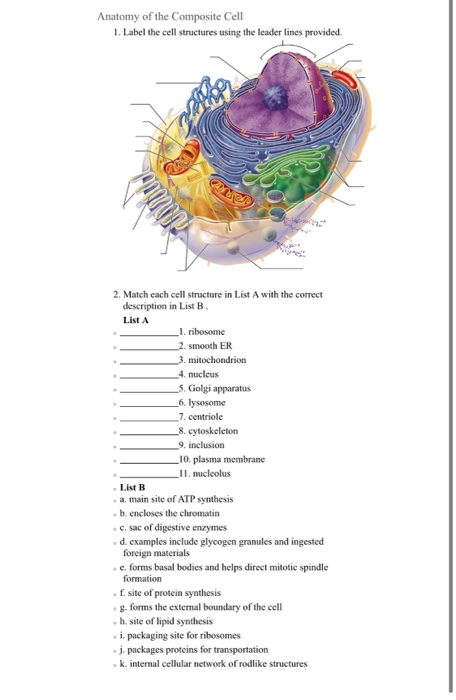
Alright, gather 'round folks, because we're about to dive headfirst into the wild and wacky world of cells! And before you start yawning and thinking back to that dull high school biology class, let me assure you, this isn't going to be your grandma's lecture. We're ditching the boredom and cranking up the fun. Our mission? To label the cell structures using those pesky leader lines... and hopefully, not mess it up too badly. Think of it as microscopic connect-the-dots, but with way more complicated names.
Now, imagine your typical cell. It's basically a tiny, self-contained city. And like any good city, it's got all sorts of specialized districts, each with its own weird and wonderful purpose. And that’s where our leader lines come in! They're like tiny, microscopic tour guides, pointing us to the cool spots.
The Nucleus: The Brainy Boss
First up, let's find the big cheese, the nucleus. This is the cell's command center, the place where all the important decisions are made. It's where you'll find all the DNA, that twisted ladder of genetic information that makes you... well, you! Think of it as the cell's super-secret recipe book, containing instructions for everything from building proteins to deciding whether you'll have curly hair or not. Spot the leader line pointing to that blobby, often centrally located structure? That's your nucleus. High five!
Inside the nucleus, there's usually a darker, denser region called the nucleolus. This is like the nucleus's executive assistant, specifically responsible for making ribosomes (we’ll get to them later). It's the ribosome factory floor, constantly churning out these little protein-making machines. Label that one carefully, or you might offend the boss!
Mitochondria: The Powerhouse (Cue Dramatic Music!)
Next, we have the mighty mitochondria! These are the power plants of the cell, responsible for generating the energy that keeps everything running smoothly. They take in sugars and other nutrients, and through a complex process called cellular respiration, they convert it into ATP, the cell's primary energy currency. So, when you're feeling sluggish, blame your mitochondria. They're probably on a coffee break. Look for the bean-shaped structures with the squiggly inner membranes – those are your mitochondria, hard at work (hopefully!).
Fun fact: Mitochondria actually have their own DNA! Scientists believe they were once independent bacteria that got incorporated into our cells way back in evolutionary history. Talk about a roommate situation!
Ribosomes: The Protein Factories
Speaking of ribosomes, let's hunt them down! These little guys are the protein factories of the cell. They read the instructions from the DNA (delivered by a special messenger called mRNA) and assemble proteins, the workhorses of the cell. Some ribosomes float freely in the cytoplasm (the cell's goo), while others are attached to the endoplasmic reticulum (we're getting there, I promise!). They're tiny dots, so keep your eyes peeled!
Endoplasmic Reticulum (ER): The Cellular Highway
Ah, the endoplasmic reticulum, or ER for short. Think of it as the cell's internal highway system. There are two types: smooth ER and rough ER. Rough ER is covered in ribosomes, giving it a bumpy appearance. It's responsible for making and processing proteins that are destined to be secreted from the cell or embedded in the cell membrane. Smooth ER, on the other hand, lacks ribosomes and is involved in lipid synthesis and detoxification. So, if your cell is having a rough day, blame the rough ER (or the smooth ER for being too smooth... just kidding!).
Golgi Apparatus: The Packaging and Shipping Center
Now, let's head over to the Golgi apparatus (also sometimes called the Golgi complex or Golgi body). This is the cell's packaging and shipping center. Proteins and lipids from the ER are processed, sorted, and packaged into vesicles, tiny membrane-bound sacs that transport them to their final destinations. It's like the cell's version of Amazon Prime, but much, much smaller (and hopefully with better working conditions!). Look for a stack of flattened, membrane-bound sacs resembling a stack of pancakes – that's your Golgi apparatus.
Lysosomes: The Recycling Crew
Time for the lysosomes! These are the cell's recycling crew, containing enzymes that break down waste materials and cellular debris. They're like the cell's tiny garbage disposals, ensuring that everything stays clean and tidy. Without lysosomes, your cell would quickly become a toxic waste dump. So, give a little cheer for the lysosomes, the unsung heroes of cellular sanitation!
Cell Membrane: The Security Guard
Finally, let's not forget the cell membrane! This is the outer boundary of the cell, acting as a selective barrier that controls what enters and exits. It's like the cell's security guard, carefully screening visitors and ensuring that only authorized personnel (and molecules) get in. The cell membrane is made up of a phospholipid bilayer, with proteins embedded throughout. Find the line pointing to the outer edge of the cell. Boom! You found the cell membrane.
So there you have it! You've successfully navigated the treacherous terrain of cell structure labeling. You’ve conquered the leader lines and emerged victorious! Now go forth and impress your friends and family with your newfound cellular knowledge. Just try not to sound *too* smug.