Alright, gather 'round, folks! You wanna turn your two perfectly good 12-volt batteries into a slightly less good, but higher-voltage 24-volt power source? Maybe you're building a giant robot that needs that extra oomph, or you just like tinkering – no judgment here! But seriously, electricity can be a bit bitey if you're not careful. So, let's talk about how to wire those batteries in series, which is the fancy way of saying we're gonna link 'em up for more voltage. Think of it like connecting train cars, except with electrons instead of cargo (and hopefully fewer derailments).
Safety First (Seriously!)
Before we get started, let's address the elephant in the room – the shocking reality (pun intended!) of electricity. I'm not talking about a mild static shock from a doorknob. I'm talking about the kind of shock that could make you see your ancestors. So, DISCONNECT the batteries *before* you do anything. Seriously. Pretend they're filled with angry hornets. Wear safety glasses (unless you enjoy the thrill of having battery acid splash in your eyes – I don't). And, uh, maybe don't do this in the bathtub. Common sense, people!
Also, a little surprising fact: did you know that a human body is only 100,000 ohms of resistance when dry, but only 1,000 ohms when wet? So don’t do this wet! It’s like the universe is trying to tell you something. Hint: It's telling you to be careful.
The Series Connection: Voltage Booster!
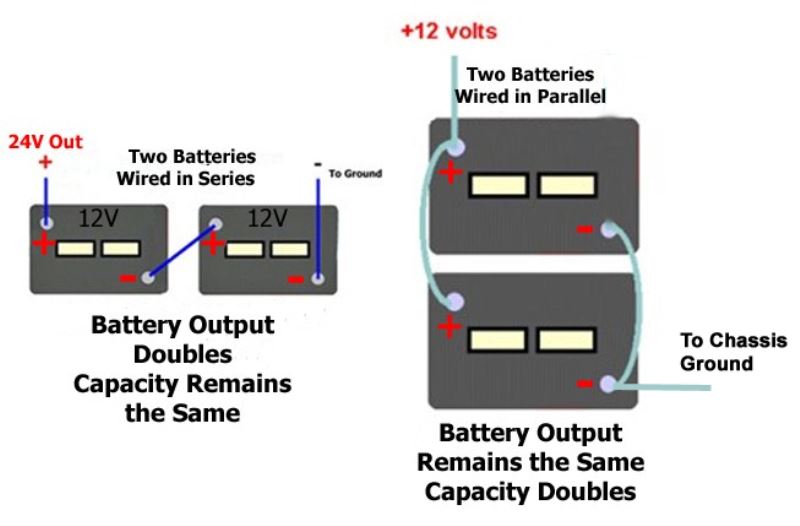
Okay, now for the fun part (well, *after* the safety part). Wiring batteries in series is all about adding their voltages together. Remember your grade school math? 12 + 12 = 24! Boom. 24 volts. Einstein would be proud.
Here's the lowdown:
- Take your first battery (let’s call her Brenda). Find the positive (+) terminal. It's usually marked with a plus sign, or a big, friendly smile (okay, maybe not the smile, but definitely a plus sign).
- Take your second battery (let’s name him Bob). Find the negative (-) terminal. It's usually marked with a minus sign, or the face you make when you accidentally step on a LEGO.
- Now, grab a short piece of wire (a "jumper wire"). Connect Brenda's positive (+) terminal to Bob's negative (-) terminal. This is the magic connection. Think of it like Brenda and Bob holding hands to boost each other's power.
- You should now have Brenda’s negative (-) terminal left unconnected, and Bob’s positive (+) terminal also unconnected. These are your *new* terminals! Brenda's negative (-) is your 24V negative, and Bob's positive (+) is your 24V positive. Congratulations, you’ve invented sliced bread... with batteries!
Important Note: Make sure both batteries are the same type and have the same voltage. You wouldn't pair a chihuahua with a Saint Bernard for a weight-lifting competition, would you? Same principle applies here.
Checking Your Work (Before Things Go Kablooey!)
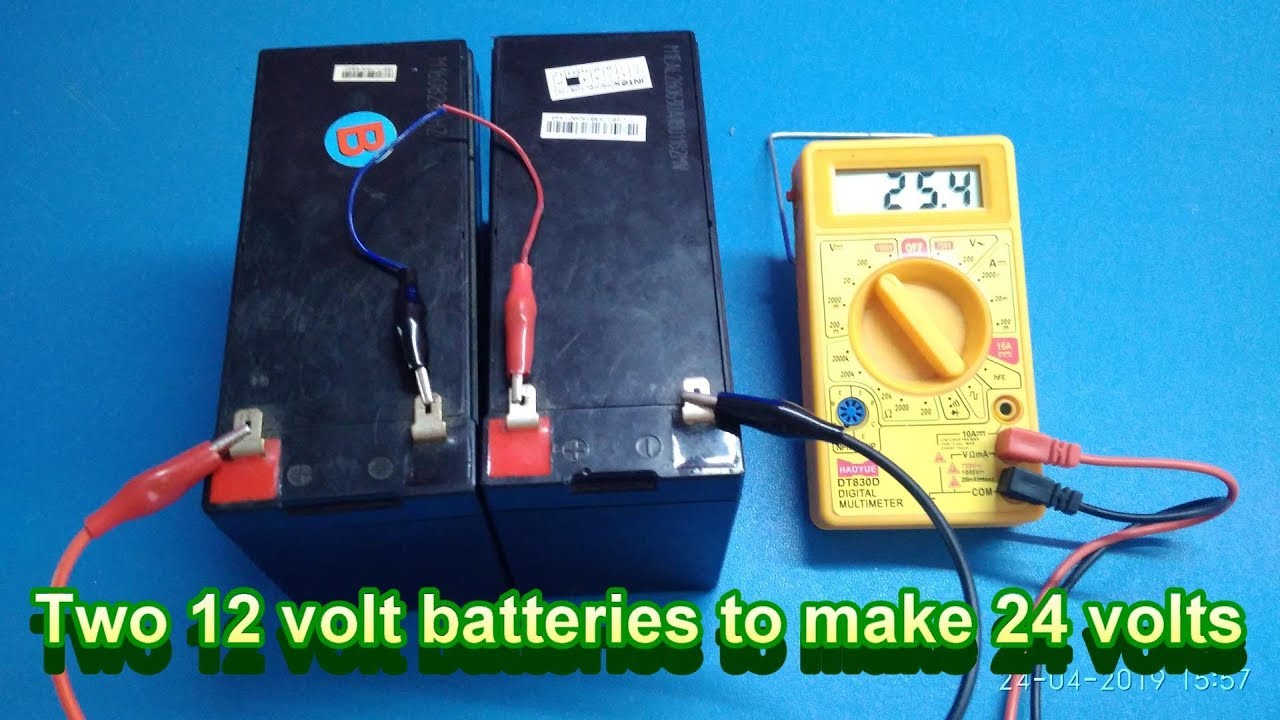
Alright, you've wired everything up. Time to double-check your work. This isn't the time for wishful thinking. Get a voltmeter (they're cheap and readily available at any hardware store) and put it across your new 24V connections. If it reads somewhere around 24 volts (or a little higher if the batteries are fully charged), you're golden! If it reads something crazy like 0 volts, or 12 volts, or the number of hairs on your head, then something is WRONG. Disconnect everything and start over.
Side note: If you *do* accidentally short-circuit something, prepare for sparks and maybe a small fire. Just kidding... mostly. Have a fire extinguisher handy, just in case. It’s always a good idea to be prepared.
Troubleshooting (Because Murphy's Law is a Jerk)
So, you followed all the steps, checked everything twice, and you're *still* not getting 24 volts? Don't panic! Here are a few things to check:
- Bad Connections: Make sure all your connections are clean and tight. Loose connections are like gremlins in the system, causing all sorts of havoc.
- Dead Battery: One of your batteries might be deader than disco. Test each battery individually to make sure they're holding a charge.
- Wrong Wiring: Double-check that you've wired everything correctly. It's easy to get confused, especially when dealing with multiple wires and terminals.
If you're still stuck, don't be afraid to ask for help! Find a friend who knows about electricity, or consult a professional. Better safe than sorry (and slightly crispy).
Final Thoughts (and a Disclaimer)
Wiring batteries in series is a pretty straightforward process, but it's important to be careful and take your time. Remember, electricity is like a mischievous puppy – fun to play with, but it can bite if you're not paying attention. So, follow these instructions carefully, and always prioritize safety. And, of course, I'm not responsible if you accidentally create a robot uprising or set your garage on fire. Use your newfound knowledge responsibly!
Now go forth and conquer, armed with your 24-volt power! Just promise me you won't use it to power a giant laser pointer aimed at passing airplanes. That's just... rude.