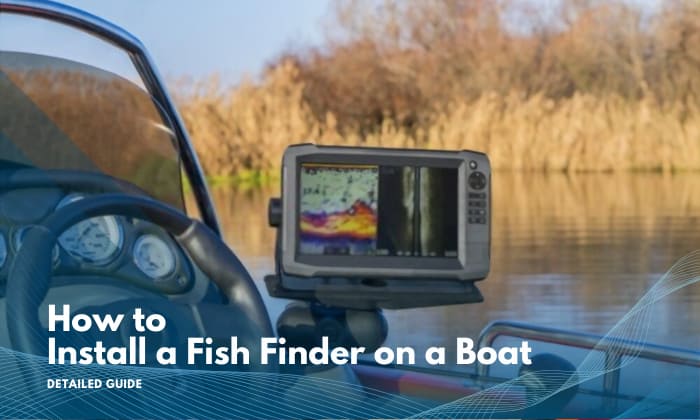
So, you're ready to up your fishing game, huh? Trading in those hopeful casts for calculated strikes? Good on ya! Installing a fish finder on your boat is like giving yourself a superpower. It's like having Aquaman whispering secrets about what's lurking beneath the surface. Let's dive in (pun intended!) and get that bad boy installed.
Gear Up, Captain!
Before you get all Jacques Cousteau on us, let's make sure you have everything you need. We're talking about more than just the fish finder itself. Think of it like building a gourmet burger; the patty's important, but you need the bun, the cheese, and maybe some fancy aioli, right?
Here's your checklist:
- Your shiny new fish finder (obviously).
- The transducer (that's the thingy that sends and receives the sonar signals).
- Mounting hardware for both the display unit and the transducer. Check that the bolts are stainless steel. Salt water and rust are NOT friends!
- A power cable and fuse. Electricity is like the Force; use it wisely.
- A drill (preferably cordless, because tangled cords and water don't mix).
- A wire stripper/crimper.
- Screwdrivers (Phillips and flathead).
- Marine sealant (because nobody wants a leaky boat).
- A measuring tape.
- Safety glasses. We're trying to catch fish, not eyeball injuries.
Location, Location, Location!
Choosing the right spot for your fish finder is crucial. Think of it as real estate; it's all about location, location, location! You want the display unit somewhere easily visible while you're steering and fishing. Consider glare and weather conditions. Can you still see the screen clearly in bright sunlight?
The transducer is even more critical. Ideally, it should be mounted on the transom (the back of the boat) where it will have a clear, unobstructed view of the water. Avoid areas with turbulence or near strakes (those ridges on the hull). You want clean sonar readings, not a confusing jumble.
Pro Tip: Do a dry run! Temporarily tape the transducer to different spots and check the sonar readings. Experimentation is key!
The Installation Tango
Alright, time to get your hands dirty! (Or at least a little damp.)
- Mount the Display Unit: Follow the instructions that came with your fish finder. Usually, this involves drilling a few holes and securing the mounting bracket. Remember that marine sealant!
- Install the Transducer: This is where things get a little more technical. Choose your mounting method (thru-hull, transom, or trolling motor). Transom mounts are the most common for smaller boats. Again, drill carefully and use plenty of sealant. Make sure the transducer is parallel to the waterline.
- Wire It Up: Connect the power cable to your boat's battery. Always use a fuse to protect your electronics. Red is positive, black is negative. It's not rocket science, but double-check!
- Tidy Up: Route the cables neatly and securely. Nobody wants a tripping hazard. Use zip ties to keep things organized.
Testing, Testing, 1, 2, 3!
Once everything is installed, it's time to test your new setup. Head out to the water and turn on the fish finder. Play around with the settings and familiarize yourself with the display. Learn to interpret the sonar readings. Are those fish? Are those rocks? Is that Nessie?
Fun Fact: Fish finders use sonar, which stands for Sound Navigation and Ranging. It's the same technology that bats use to navigate in the dark!
Troubleshooting Tip: If you're getting a lot of interference, try adjusting the sensitivity settings or repositioning the transducer.
The Ripple Effect
Installing a fish finder isn't just about catching more fish (although that's a definite perk!). It's about embracing the spirit of exploration, about learning new skills, and about connecting with the natural world. It's a reminder that sometimes, the greatest rewards come from taking on a challenge, from learning something new, and from venturing beyond our comfort zone. Whether it’s mastering new technology or simply casting a line into the unknown, the willingness to learn and explore enriches our lives in countless ways, just like the ripples that spread across the water after a perfect cast.