Okay, let's be real. You've probably heard the phrase "modulus of resilience" thrown around. Maybe in a physics class that you vaguely remember. Or perhaps during a particularly intense conversation about...well, anything stressful.
And chances are, you nodded politely, pretending you knew exactly what everyone was talking about. Don't worry, we've all been there. Today, we're going to find out how to find it! (Kind of...in a fun, non-intimidating way.)
First Things First: What Even Is It?
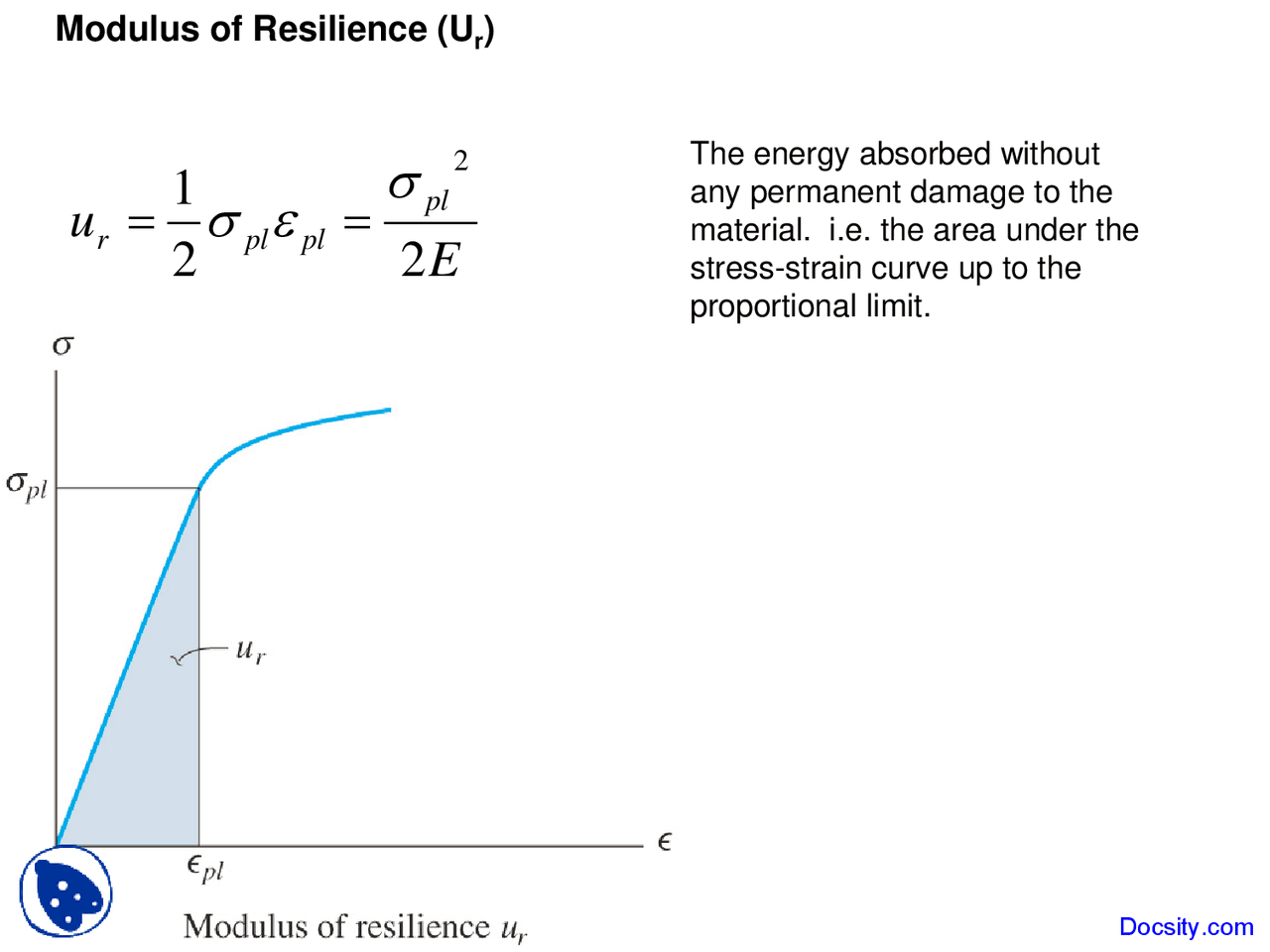
Imagine stretching a rubber band. You pull it, and it goes back to its original shape, right? That’s resilience in action. The modulus of resilience is basically a material's ability to absorb energy when it's deformed elastically (meaning it springs back!), and then release that energy when the stress is removed. It's like the material's "bounce-back-ability."
Think of it like this: your favorite comfy sweatpants. They stretch when you sit on the couch for that extra-long binge-watching session, but they snap right back into shape when you stand up. The *sweatpants* (hypothetically) have a good modulus of resilience. Your resolve to get off the couch? Debatable.
The Formula: Dun Dun DUN!
Alright, alright, I know. Formulas. They can be scary. But this one's not *that* bad. Promise.
The most common way to find the modulus of resilience (usually denoted as *Ur*) involves a couple of key players:
Ur = (Sy^2) / (2E)
Yeah, I know, symbols. But let's break it down:
- Sy: This is the material's yield strength. It's the amount of stress the material can take before it starts to permanently deform. Think of bending a paperclip. You can bend it a little and it springs back. That's below the yield strength. Bend it too far, and it stays bent. That's *past* the yield strength.
- E: This is Young's Modulus (also sometimes called the elastic modulus). It's a measure of a material's stiffness. How much does it resist being stretched or compressed? A steel beam has a high Young's Modulus. A gummy bear? Not so much.
So, you square the yield strength, divide it by two, and *then* divide by Young's Modulus. Boom! Modulus of Resilience. Kinda.
"But Wait!" I Hear You Cry. "Where Do I Get These Numbers?!"
Excellent question! This is where things get...interesting. Finding the yield strength and Young's Modulus can involve some actual testing. Labs use fancy machines to stretch and compress materials, measuring how they respond. It's all very scientific and impressive.
Or, you know, you could Google it. (Unpopular opinion: Googling is highly underrated as a scientific tool...within reason, of course.) Many common materials have these values readily available in tables and charts. Just make sure you're using reliable sources!
Real-World (Sort Of) Example
Let's say we're looking at some fancy steel. Suppose it has a yield strength (Sy) of 400 MPa (Megapascals) and a Young's Modulus (E) of 200 GPa (Gigapascals). Remember to convert your units to be consistent! We'll convert GPa to MPa by multiplying by 1000 (200 GPa = 200,000 MPa).
Now, plug those numbers into the formula:
Ur = (400 MPa)^2 / (2 * 200,000 MPa)
Ur = 160,000 MPa^2 / 400,000 MPa
Ur = 0.4 MPa
So, the modulus of resilience for this particular steel is 0.4 MPa. What does that *mean*? Well, it means this steel can absorb 0.4 Megapascals of energy per unit volume before it starts to permanently deform. Impressive, right?
The "So What?" Factor
Okay, you know how to *find* the modulus of resilience. But why should you care? Well, it's super important for engineers designing things that need to withstand impacts, vibrations, or other types of stress. Things like springs, bridges, and even, yes, aircraft parts. They want materials that can absorb a lot of energy *without* breaking or permanently bending. The higher the modulus of resilience, the better!
And hey, even if you're not an engineer, understanding this concept can give you a newfound appreciation for the materials all around you. Next time you bounce on your mattress, you can think about its modulus of resilience and marvel at the science that keeps you comfy. You're welcome.
Now, if you'll excuse me, I'm going to go contemplate the modulus of resilience of my couch... while binge-watching TV. You?