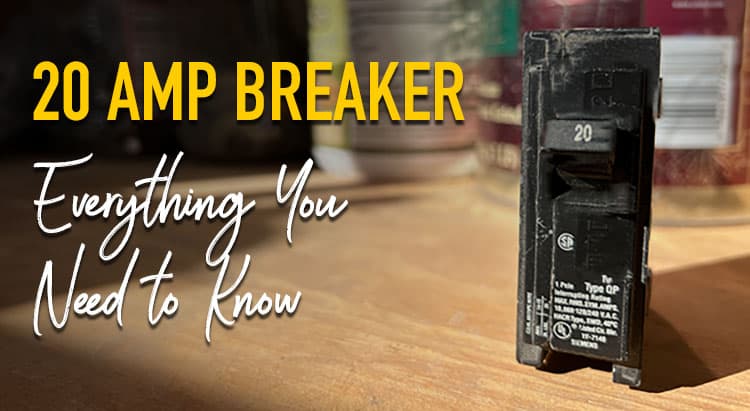
Ever wondered how many electronic gadgets you can joyfully plug into a single circuit without plunging your home into darkness? It all boils down to understanding watts and amps, and how they tango on your trusty 20-amp breaker. Prepare for an electrifying adventure!
The 20-Amp Breaker: Your Electrical Guardian
Think of your 20-amp breaker as the bouncer at the hottest club in town – your electrical system. It's there to prevent things from getting too wild and dangerous.
This watchful protector keeps the current flow in check, preventing overloads that could lead to a fiery finale, or at least a very inconvenient power outage. Breakers are not only cool, but they are also required.
Decoding the Electrical Alphabet Soup: Volts, Amps, and Watts
Okay, let's break down the key players in this electrical drama. We have volts (the pressure), amps (the current), and watts (the power). It might sound complicated, but I guarantee it is not!
Imagine volts as the water pressure in a pipe, amps as the amount of water flowing, and watts as the overall power of the water stream. Still confused? Don't worry, it gets easier!
The basic formula to remember is: Watts = Volts x Amps. Write it down, tattoo it on your arm, whatever helps!
Calculating the Wattage Wonderland
In most homes in the US, the standard voltage is around 120 volts. This is like the established speed limit on the highway of electricity. Let's do some math!
So, for a 20-amp breaker, we have: Watts = 120 volts x 20 amps = 2400 watts. Woo-hoo! That's our magic number.
That means, theoretically, you can plug in devices that consume up to 2400 watts total on that circuit.
The 80% Rule: A Safety Buffer for the Cautious
Hold on a second, partner! Don't go maxing out that breaker just yet. There's a crucial rule we need to consider: the 80% rule.
Electrical codes often recommend not loading a circuit beyond 80% of its capacity. This is because circuits need some breathing room to prevent overheating and potential hazards. Always better safe than sorry!
So, let's recalculate: 2400 watts x 0.80 = 1920 watts. That's our new, safer maximum wattage.
Examples: Powering Your Everyday Life
Alright, now for the fun part! Let's see what kind of appliances and gadgets we can safely power on our 20-amp circuit, staying within our 1920-watt limit.
A standard coffee maker might use around 1000 watts. A hair dryer could be another 1500 watts. A desktop computer could take about 200 watts.
A fancy TV might slurp up 150 watts, while a game console could add another 100 watts to the mix. Feel free to experiment and mix and match!
The Appliance Wattage Detective: How to Find the Clues
How do you know how many watts your devices are using? Fear not, intrepid wattage detective!
Most appliances have a sticker or label on the back or bottom that lists the wattage. Look for a "W" or "Watts" followed by a number. This is the key clue!
If you can't find the wattage, look for the amperage (A) and voltage (V) and use our magic formula: Watts = Volts x Amps.
Potential Overload Scenarios: A Cautionary Tale
Imagine this: You're brewing coffee (1000 watts), blow-drying your hair (1500 watts), and running a space heater (1200 watts) all on the same circuit.
That's a grand total of 3700 watts! Uh oh! You've exceeded your 1920-watt limit by a mile.
Suddenly, the lights flicker, and then... darkness. The breaker has tripped, heroically sacrificing itself to prevent a potential electrical disaster. The breaker is a true hero!
The Breaker Trip Blues: Resetting and Troubleshooting
So, the breaker tripped. Don't panic! It's a safety mechanism doing its job. First, unplug some of the devices on the circuit. Less is more.
Then, locate your electrical panel. Find the tripped breaker (it will usually be in the "off" or a middle position). Flip it all the way to the "off" position and then back to the "on" position. Voila! Power restored!
If the breaker trips repeatedly, even after unplugging devices, you might have a more serious electrical issue. Call a qualified electrician.
Extension Cords and Power Strips: Handle with Care
Extension cords and power strips can be handy, but they can also be sneaky culprits in overloading a circuit. These things should be used with care.
Make sure your extension cords are heavy-duty and rated for the amount of power you're using. Avoid daisy-chaining power strips together, as this can easily exceed the circuit's capacity.
Always check the wattage rating of your power strips and ensure they can handle the combined wattage of the devices plugged into them. Safety first!
Beyond the Breaker: Whole-House Wattage Wisdom
While we've focused on a single 20-amp breaker, remember that your entire house has a total wattage capacity determined by your main service panel.
If you're planning on adding a major appliance, like an electric vehicle charger or a hot tub, you may need to upgrade your electrical service to handle the increased load.
Consult with an electrician to assess your home's electrical capacity and ensure you have enough power to safely operate all your devices. Electricity is fun, but safety is key!
Embrace the Power of Knowledge!
Understanding how many watts you can safely run on a 20-amp breaker empowers you to use electricity responsibly and avoid those pesky power outages.
Now you can confidently navigate the world of watts and amps, plugging in your devices with the knowledge of a seasoned electrical guru.
So, go forth and conquer the electrical universe, armed with your newfound wattage wisdom! Remember to play it safe, and have fun with electricity.