Ever wondered just how much juice your appliances can slurp up before your lights start doing the disco (aka flickering frantically)? Let's unravel the mystery of watts in a 20 amp circuit, without needing a degree in electrical engineering!
The Wattage Wonder
Think of electricity like water flowing through a pipe. Amps are like the width of the pipe, dictating how much water can flow at once. Watts are the total amount of "water power" being delivered.
So, how do these two relate? It’s a simple math equation: Watts = Volts x Amps. Most household circuits in the US run at 120 volts.
Crunching the Numbers
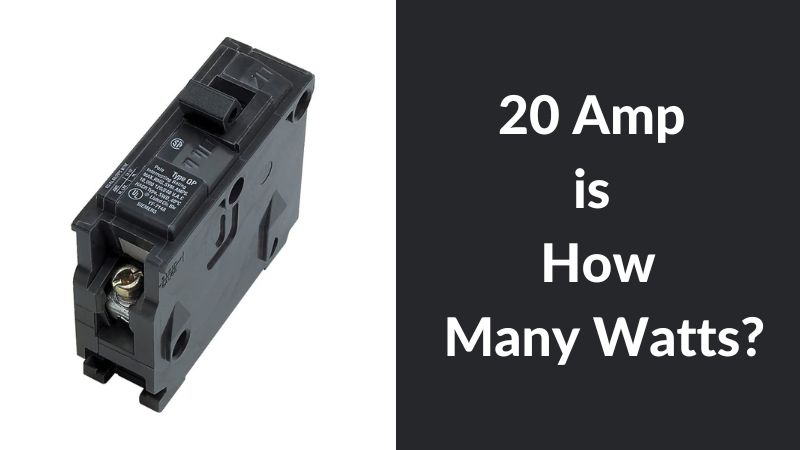
A 20 amp circuit at 120 volts can handle 20 x 120 = 2400 watts. That's your magic number! 2400 watts is the ceiling for everything plugged into that circuit.
Imagine a pizza party. This circuit is like the pizza box – it can only hold so many delicious slices (watts) before it overflows.
Wattage Detectives
Finding out how many watts an appliance uses is easier than finding a matching pair of socks. Just look for the sticker or plate, usually on the back or bottom.
It'll tell you the wattage. For example, a microwave might say 1000 watts, and a coffee maker 800 watts. Note these down!
Now, think of those holiday lights that were a Christmas gift. Let's say they use 200 watts. Add them to the list!
The Shocking Truth About Overloading
Here's where the fun begins (or rather, the potential for minor electrical drama). If you plug too many things into a single circuit, you’ll exceed that 2400-watt limit.
This is like trying to fit too many toppings on your pizza – things are going to get messy, and in this case, messy means a tripped circuit breaker. No one wants a cold pizza!
A tripped breaker is the circuit's way of saying, "Woah there, buddy! Too much!" It's a safety mechanism to prevent overheating and, potentially, a fire. This is a good thing. Be nice to your circuit breaker.
The Breaker's Lament
Picture your circuit breaker as a tiny, overworked security guard. He’s constantly monitoring the flow of electricity, making sure no one’s trying to sneak in too much wattage.
When the wattage exceeds 2400, he slams the gate shut (trips the breaker). It's not personal; he's just doing his job.
He’s basically saying, "I'm not mad, just disappointed... and overloaded!" Resetting the breaker is like giving him a well-deserved coffee break.
Real-Life Wattage Scenarios
Let's paint some wattage pictures. Imagine you're getting ready in the morning. Your hair dryer (1500 watts) is blasting away. Your curling iron (800 watts) is heating up. You have a light on too (60 watts).
That’s 1500 + 800 + 60 = 2360 watts! You're cutting it close! Don't plug in your phone charger (5 watts) or something, or else... bang! Darkness!
Now, picture this: You're using your powerful blender (700 watts) and your significant other decides to use the microwave (1000 watts) on the same circuit. Suddenly you hear a click.
The Microwave Mayhem
The microwave is often the biggest culprit. It’s a wattage hog, gobbling up a significant portion of your circuit's capacity. That is why it's important to have the right wattage outlet.
During the holidays, beware of space heaters! They are notorious for overloading circuits. They are like a wattage black hole.
Remember, a little awareness can go a long way in preventing tripped breakers and potential electrical hazards. Think before you plug!
Wattage Wisdom
Spread the load! Don't cram everything into one circuit. Utilize different outlets and circuits throughout your home.
Consider energy-efficient appliances. They use fewer watts, freeing up precious capacity on your circuits. Think LEDs versus incandescents.
If you consistently trip breakers, consult an electrician. It could indicate a deeper problem with your wiring. This is not the time to be a DIY hero.
The Electrician's Perspective
An electrician is like a doctor for your electrical system. They can diagnose issues, perform upgrades, and ensure everything is running safely and efficiently.
They have the tools and knowledge to handle complex electrical problems. Don't be afraid to call them if you're unsure about something.
Think of them as the wattage whisperers, fluent in the language of electricity. They can help you understand your home's electrical needs and ensure everything is up to code.
The Wattage Takeaway
Knowing the wattage limitations of your 20 amp circuits empowers you to use electricity safely and efficiently.
It's about understanding the balance – knowing how much power you can draw without overloading the system.
So, the next time you plug in an appliance, remember the 2400-watt limit. Your circuit breaker will thank you. And so will your sanity.
The Wattage Legacy
Understanding watts and amps isn't just about avoiding tripped breakers; it's about understanding the energy consumption of your home. It could be that Christmas gift that keeps giving all year round.
It’s about being mindful of your energy footprint and making choices that are both safe and sustainable. That would be the best kind of gift to get.
So, embrace your newfound wattage wisdom and go forth, plug responsibly, and may your circuits never trip!
Wattage Quiz
Quick quiz time! Is this statement true or false?
A 20 amp circuit running at 120 volts can safely handle a 2500 watt appliance.
The answer is false! Always stay below the 2400-watt threshold.