Ever looked at a wall outlet and wondered, "What's the deal with all those little holes?" More importantly, how much *oomph* can they actually handle? Well, buckle up, buttercup, because we're about to dive into the surprisingly exciting world of outlet wattage!
The Watt's Up: A Simple Explanation
Let's ditch the confusing technical jargon and break it down like this: an outlet is basically a doorway for electricity. It's the point where power from the grid enters your home and becomes available for your gadgets, gizmos, and that questionable toaster oven you inherited from your Aunt Mildred.
The amount of power flowing through that doorway is measured in watts. Think of watts like tiny electric ponies, all running to power your devices. The more ponies, the more powerful your appliance!
Decoding the Standard: Volts and Amps
Okay, okay, I hear you. You want numbers! In most homes in the United States, a standard outlet operates at 120 volts. Don't worry, we're not getting too sciency here; just remember that volts are like the speed at which those electric ponies are running.
And then there are amps. Amps are the number of electric ponies galloping through the doorway. To find out the wattage of an outlet, we use a super-simple formula: Watts = Volts x Amps.
Most standard household circuits are either 15-amp or 20-amp circuits. Let’s do the math!
Crunching the Numbers: 15-Amp Circuits
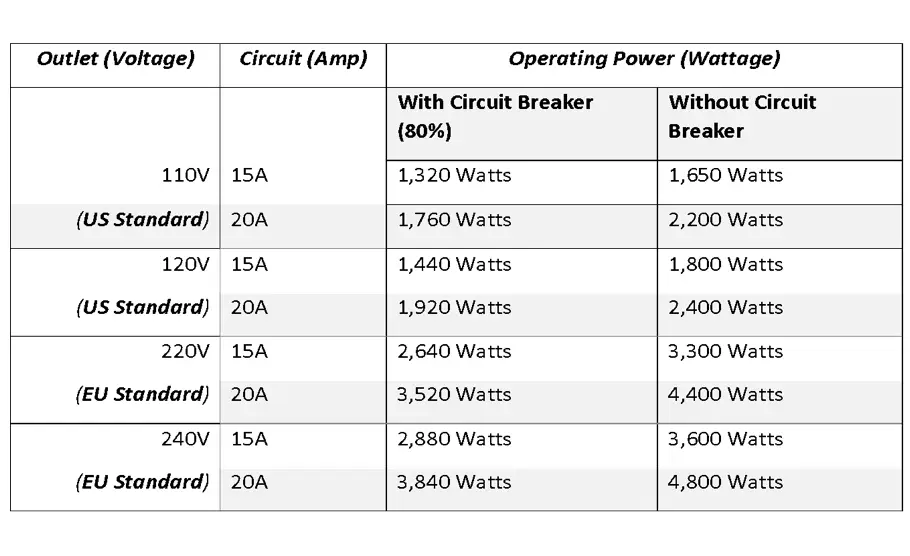
If you have a 15-amp circuit, here's the calculation: 120 volts x 15 amps = 1800 watts. Boom! Your standard 15-amp outlet can safely handle 1800 watts.
That means you could *theoretically* plug in eighteen 100-watt light bulbs! (Please don't actually do that, unless you want your living room to resemble a miniature sun.)
Unleashing the Power: 20-Amp Circuits
Now, let's crank up the juice! If you've got a 20-amp circuit (often found in kitchens and laundry rooms), the calculation is: 120 volts x 20 amps = 2400 watts.
That's a whole lotta electric ponies! You're practically running a miniature power plant at that point. Well, not really, but you get the idea.
Watt's the Catch? (There's Always a Catch!)
Hold your horses! (Electric horses, naturally.) Just because an outlet can handle a certain wattage doesn't mean you should go hog wild and plug in every power-hungry appliance you own.
Circuits have limits. Overloading a circuit can trip a breaker, plunging you into darkness and potentially causing a fire hazard. Nobody wants that!
Think of it like this: your home's electrical system is like a highway. Each circuit is a lane. You can only fit so many cars (appliances) in each lane before things get congested (overloaded).
The Appliance Wattage Detective
So, how do you avoid electrical gridlock? Become an appliance wattage detective! Most appliances have a sticker or plate that lists their wattage. It's usually on the back or bottom.
Before plugging anything in, take a peek at that wattage. Add up the wattages of everything plugged into a single outlet (or, more accurately, everything on the same circuit). If you're getting close to 1800 watts (for a 15-amp circuit) or 2400 watts (for a 20-amp circuit), it's time to unplug something!
Common Culprits: Wattage Hogs
Some appliances are notorious wattage hogs. These energy-guzzling culprits can quickly max out your circuits.
- Hair dryers: These are the sports cars of the appliance world, burning rubber (and watts) with every use.
- Space heaters: They’re cozy, yes, but they suck up more electricity than a vampire at a blood drive.
- Microwaves: Perfect for reheating leftovers, but a major draw on power.
- Toasters and toaster ovens: These breakfast buddies can be surprisingly power-hungry.
- Coffee makers: Essential for survival, but also energy intensive.
Be especially careful when using these appliances simultaneously on the same circuit.
Extension Cords: Handle with Care
Extension cords can be handy, but they can also be a source of problems if used improperly. Always use heavy-duty extension cords for high-wattage appliances.
And never, ever daisy-chain extension cords together. That's like creating a superhighway to electrical disaster!
Make sure the extension cord is rated for the same amperage as the circuit you're using.
Beyond the Basics: Specialty Outlets
While standard outlets are the workhorses of your electrical system, there are a few specialty outlets to be aware of.
GFCI Outlets: Safety First!
You've probably seen those outlets with the "test" and "reset" buttons in bathrooms and kitchens. Those are GFCI (Ground Fault Circuit Interrupter) outlets.
These outlets are designed to protect you from electrical shock in damp locations. They're super sensitive and will trip if they detect even a tiny leakage of current.
They don’t necessarily have different wattage, but their importance cannot be overstated. They save lives!
240-Volt Outlets: Heavy Hitters
Some appliances, like electric stoves, dryers, and air conditioners, require a 240-volt outlet. These outlets have a different shape than standard 120-volt outlets.
These are the powerhouses of your home. They deliver twice the voltage, allowing them to handle much larger loads.
Do *not* attempt to plug a 120-volt appliance into a 240-volt outlet. It won't end well.
Watt's the Verdict?
So, how many watts does an outlet have? The answer, as with most things in life, is "it depends." A standard 15-amp outlet can handle 1800 watts, while a 20-amp outlet can handle 2400 watts.
But remember to be mindful of your circuits and avoid overloading them. A little knowledge about wattage can go a long way in keeping your home safe and your electric ponies happy!
Now, go forth and conquer the world of wattage, armed with your newfound knowledge! And maybe go easy on that space heater. Just a thought.