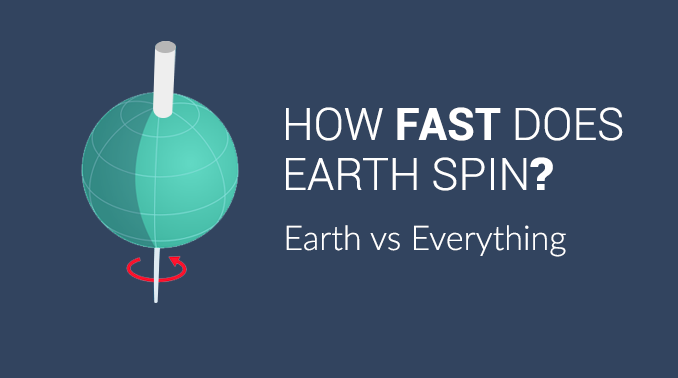
Hey, ever wonder how fast we're spinning right now? I mean, literally, the Earth is like a giant playground merry-go-round! Let's talk about it. It's way cooler than you think!
The Need for Speed (Earth Edition)
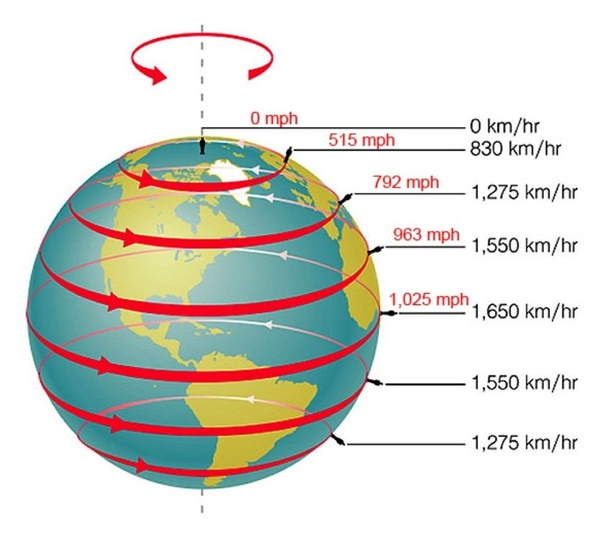
Okay, so how many mph are we talking? Buckle up! At the equator, you're spinning at roughly 1,000 mph! Whoa! That's faster than most commercial airplanes. Can you feel it? Nope! More on that later.
Think about that for a second. One. Thousand. Miles. Per. Hour. That's like driving from Los Angeles to Seattle in just over an hour. On a planet! Wild, right?
It's All About Location, Location, Location
But here's the kicker: that speed isn't constant. If you're chilling at the North or South Pole, you're practically standing still. You're just doing a slow pirouette.
Why? Because the Earth is a sphere (or, you know, an oblate spheroid, but let's keep it simple). The closer you are to the poles, the smaller the circle you're traveling in during each rotation. Think of it like this: a tiny ant crawling around the center of a record spins way slower than one on the edge. Same idea!
So, if you’re planning a super-fast trip around the world, stick to the equator! Though, you know, planes are probably still faster.
Why Don't We Feel Like We're on a Wild Ride?
Great question! It's all about inertia and gravity. Everything around us – the air, the trees, your pet hamster – is spinning along with the Earth at the same speed.
Imagine you're on that aforementioned airplane. Once you're cruising at 500 mph, you don't feel like you're moving at all, right? You can walk to the bathroom, drink a ginger ale, maybe even juggle some peanuts (don’t). It's the same principle. We're all moving together, so we don't perceive the motion. Phew!
Plus, gravity is a strong force. It's keeping us firmly planted on the ground, preventing us from being flung off into space. Thanks, gravity! You're a real one.
Fun Facts to Drop at Your Next Party
Want to impress your friends? Here are a few quirky facts about Earth's rotation:
- The Earth's rotation is actually slowing down... very slowly. We're talking milliseconds per century. But, hey, eventually, days will be longer!
- That slowing down is mostly due to the Moon's gravitational pull on the Earth's tides. Blame the moon!
- Scientists sometimes add "leap seconds" to our clocks to account for this slowing. Fancy!
- If the Earth suddenly stopped spinning, everything not attached to bedrock would go flying eastward at, you guessed it, around 1,000 mph. Talk about a bad hair day! Don't worry, this is highly improbable.
So, What’s the Point?
Besides being a fascinating cocktail party topic, understanding Earth's rotation helps us understand a lot about our planet. It affects weather patterns, ocean currents, and even the shape of the Earth itself.
The spinning of the Earth creates the Coriolis effect, which deflects winds and ocean currents. This is why hurricanes spin in different directions in the Northern and Southern Hemispheres. Pretty cool, huh?
Final Spin
So, there you have it! We're all spinning around the Sun on a giant rock at about 1,000 mph (at the equator, anyway). It's a mind-boggling thought, but it's also what makes life on Earth possible.
Next time you're feeling bored, just remember you're on a cosmic rollercoaster. Enjoy the ride!
And hey, maybe go outside and try to feel the Earth's rotation. You probably won't, but it's fun to pretend. Just don't get dizzy!