Ever wondered how much oomph your window AC unit needs to keep you cool as a cucumber? It’s all about the amps, baby! Let's unravel this electrifying mystery together.
Amps: The Current Craze (of Electricity!)
Think of amps as the electricity flowing through a wire, like water through a pipe. More amps? More electricity. Simple as that!
Your window AC needs these amps to power its compressor, fan, and all those other gizmos that make the magic happen. Finding out how many it needs is easier than you think.
Decoding the AC's Power Needs
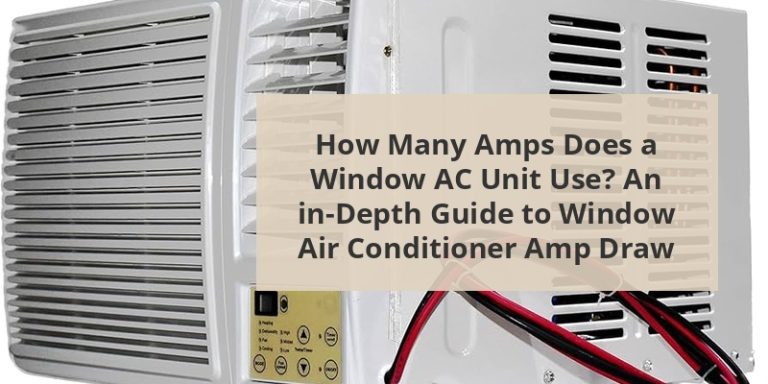
First, check the sticker! Usually located on the side or back of your AC unit. This magical sticker holds all the secrets to your AC’s power consumption.
Look for "Amps" or "Current" followed by a number and the letter "A." This is your golden ticket, telling you exactly how many amps your AC unit draws.
Can't find a sticker? No worries! We can still do some detective work to uncover the answer.
BTUs to Amps: A Conversion Caper
BTU stands for British Thermal Units. It measures how much heat your AC can remove from a room per hour. Higher BTU means more cooling power!
Generally, a 5,000 BTU AC unit might pull around 5 amps. A beefier 10,000 BTU unit could need around 9-10 amps. But these are just estimates!
Always confirm the exact amperage on the unit itself, if possible. This will give you the most accurate answer.
Why Does Amperage Matter, Anyway?
Knowing the amps your AC uses is essential for safety and preventing electrical hiccups. You don't want to trip a breaker or, worse, cause a fire!
Each circuit in your home can only handle a certain number of amps. Overloading a circuit is a recipe for disaster. This is why understanding amperage is so crucial.
Plus, you can use the amperage to estimate how much it costs to run your AC. Knowledge is power, especially when it comes to your electricity bill!
Calculating Cooling Costs: An Electrifying Equation
To estimate your cooling costs, you need to know the wattage. Watts are related to amps and volts (the voltage in your home, typically 120V in the US).
Use the formula: Watts = Amps x Volts. So, if your AC uses 5 amps at 120 volts, that's 600 watts. Pretty neat, huh?
Then, find out the cost per kilowatt-hour (kWh) from your electricity bill. A kilowatt is 1000 watts. Multiply the AC's wattage (in kilowatts) by the cost per kWh, and you'll see the hourly cost of running your AC.
Example Time!
Let’s say your AC is 600 watts (0.6 kW) and your electricity costs $0.15 per kWh. Running your AC for one hour would cost 0.6 kW x $0.15 = $0.09. Not bad!
Now multiply that by how many hours you run your AC each day, and then by the number of days in a month. That will give you a good estimate of your monthly cooling costs.
Remember, this is just an estimate. Your actual costs may vary depending on usage and other factors.
AC Size and Amperage: A Chilling Correlation
Smaller AC units (5,000 - 6,000 BTU) usually draw fewer amps. Perfect for smaller rooms where you just need a little chill.
Larger units (8,000 BTU and up) need more amps to cool larger spaces. Think living rooms or master bedrooms where you want to create an arctic oasis.
Extra-large units (12,000 BTU and beyond) require the most amps. These are beasts meant for cooling multiple rooms or very large areas.
The Sweet Spot: Finding the Right Balance
Choosing the right size AC for your space is crucial for efficiency. An oversized unit will cool the room too quickly and cycle on and off frequently, wasting energy.
An undersized unit will struggle to cool the room adequately, running constantly and driving up your electricity bill. Aim for Goldilocks territory – just right!
Consider the size of your room, insulation, and the amount of sunlight it receives when selecting an AC unit. This helps you find the perfect fit for your cooling needs.
Energy Efficiency: Amps and the Art of Saving
Look for Energy Star certified AC units. These models are designed to be more energy-efficient, drawing fewer amps while providing the same cooling power.
Investing in an Energy Star AC can save you money on your electricity bill in the long run. It’s like getting paid to stay cool!
Also, keep your AC unit clean and well-maintained. A dirty filter restricts airflow, making the unit work harder and draw more amps. Regular cleaning is key!
Simple Tips for Energy Savings
Close windows and doors while running your AC. You're essentially air conditioning the outdoors if you don't.
Use curtains or blinds to block sunlight during the hottest parts of the day. This helps to reduce the heat load on your AC.
Consider using a fan in conjunction with your AC. The fan circulates the cool air, allowing you to set the AC to a higher temperature and save energy.
Wiring and Outlets: The Amp-le Truth
Make sure your wiring and outlets are capable of handling the amperage of your AC unit. Overloaded circuits are a fire hazard. Safety first!
If you're unsure about your wiring, consult a qualified electrician. They can assess your electrical system and ensure it's up to the task.
Some larger AC units may require a dedicated circuit. This means the outlet is only used for the AC, preventing it from overloading the circuit with other appliances.
Avoiding Electrical Overload
Don't plug your AC unit into an extension cord or power strip unless it's specifically rated for high-amperage appliances. Cheap extension cords can overheat and cause a fire.
Avoid plugging multiple high-draw appliances into the same circuit. Your AC, refrigerator, and microwave should ideally be on separate circuits.
If your breaker trips frequently, it's a sign that you're overloading the circuit. Unplug some appliances and consult an electrician to address the issue.
The Future of AC: Amps Down, Cooling Up!
Manufacturers are constantly developing more energy-efficient AC units. Expect to see models with even lower amperage draws in the future.
Technological advancements like variable-speed compressors and smart controls are helping to reduce energy consumption while maintaining optimal cooling performance.
The goal is to provide comfortable cooling without breaking the bank or harming the environment. It's a win-win situation!
Smart AC: The Intelligent Choice
Smart AC units can be controlled remotely via smartphone apps. You can adjust the temperature, set schedules, and monitor energy usage from anywhere.
Some smart ACs even learn your preferences and adjust the cooling automatically. They're like having a personal climate control assistant!
Investing in a smart AC can help you save energy and stay comfortable while simplifying your life. Who wouldn't want that?
Amps and Your AC: A Conclusion That's Electrifying!
Understanding the amperage of your window AC unit is essential for safety, energy efficiency, and cost savings. Now you’re armed with the knowledge to stay cool without blowing a fuse!
So, go forth and conquer the heat! Remember to check your AC's sticker, consider Energy Star models, and practice energy-saving habits.
Stay cool, stay safe, and enjoy the electrifying world of air conditioning!