Okay, so you’re staring at an appliance, a breaker box, or maybe even just a lightbulb and you see the dreaded "kW" staring back at you. Then you remember you need to figure out the "amps" to make sure you don't, you know, accidentally summon a small electrical fire. We've all been there, right? It's like trying to decipher hieroglyphics after a long day – your brain just wants pizza, not electrical equations.
Don’t worry, converting kilowatts (kW) to amps (A) isn't as scary as it sounds. Think of it like converting dog years to human years. It seems complicated, but with a little cheat sheet, you're golden. This isn't rocket science; it's more like... toaster science. And trust me, we can all handle toaster science!
The Basic Formula: It's Easier Than Remembering Your Anniversary
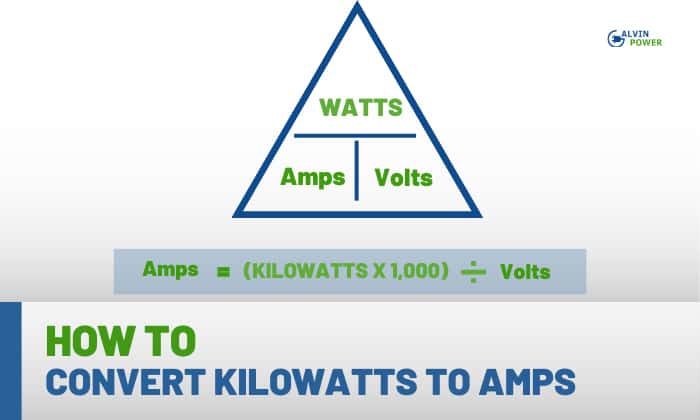
The core concept is pretty simple, though it does involve a tiny bit of math. Remember PEMDAS from grade school? Yeah, me neither. But here's the good news: we only need division! The formula for finding amps is:
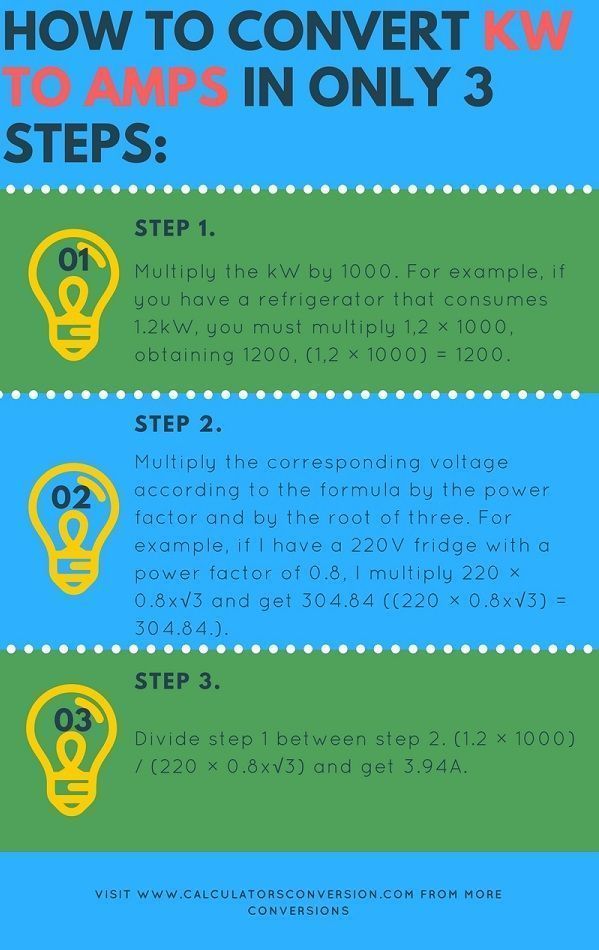
Amps (A) = (Kilowatts (kW) x 1000) / Voltage (V)
Let’s break that down like a day-old donut:
- Kilowatts (kW): This is the power rating of your device. Think of it as how much "electrical muscle" it uses.
- 1000: This is just a constant to convert kW to watts (W), because the voltage is usually based on watts. It's like multiplying inches to feet – it's just a unit change.
- Voltage (V): This is the electrical pressure. In most homes in the US, it's 120V or 240V. Check your appliance or electrical panel to be sure!
Real-Life Examples: Because Theory is Boring
Let's say you have a space heater rated at 1.5 kW. You plug it into a standard 120V outlet. What's the amperage? Let's do the math!
A = (1.5 kW x 1000) / 120V
A = 1500 / 120
A = 12.5 Amps
So, your space heater is drawing 12.5 amps. Now, check the breaker for that outlet. If it's a 15-amp breaker, you're good to go. If it's a 10-amp breaker... uh oh! Time to find a different outlet, or you'll be plunging your room into darkness… and possibly setting off the smoke alarm. Nobody wants that!
What about that fancy new electric stove you're eyeing? Let's assume it’s a whopping 6 kW and runs on 240V.
A = (6 kW x 1000) / 240V
A = 6000 / 240
A = 25 Amps
This stove will need a dedicated 25-amp (or higher, depending on the specifics) circuit. Don't even *think* about plugging it into a regular outlet. That's a recipe for disaster. A very hot, smoky disaster.
Important Caveats: Because Electricity is Serious Business
Always double-check your voltage! Using the wrong voltage in the formula is like using teaspoons instead of tablespoons in a recipe – it just won't work right.
Know your breaker size! Breakers are there to protect your wiring from overheating and causing fires. Exceeding the breaker's amperage rating is a bad idea. Think of it as trying to squeeze an elephant through a doggy door – something's going to break.
When in doubt, call an electrician! If you’re unsure about anything, don't play electrician. Electricity is dangerous, and it's always better to be safe than sorry (and shocked!). They're the pros, and they can make sure everything is safe and sound.
So there you have it! Converting kilowatts to amps isn't so intimidating after all, is it? Just remember the formula, double-check your voltage, and don’t be afraid to ask for help. Now go forth and conquer those electrical calculations! And maybe reward yourself with that pizza afterward – you deserve it.