Ever sliced a pizza and thought, "Hmm, I wonder how much pizza I’m actually getting here?" Or maybe you're baking a pie and need to figure out how much filling you need for just one slice. Well, my friend, you’ve stumbled into the land of sectors and their areas! And guess what? It’s not as scary as it sounds. Trust me, if I can do it, fueled by nothing but lukewarm coffee and the burning desire to understand the mysteries of pastry, so can you.
What in the World is a Sector Anyway?
Think of a circle, like a perfect, glorious donut. Now, imagine taking a bite (or two) straight from the center. That wedge-shaped piece you’ve just liberated? That, my friend, is a sector. It's basically a slice of a circle, defined by two radii (the lines going from the center to the edge) and the arc (the curved part of the slice).
It's like cutting a cake – you're not just randomly hacking away, are you? (Okay, maybe sometimes you are, no judgment). But if you’re trying to be somewhat civilized, you're creating sectors, baby!
Finding the Area: The Easy-Peasy Formula
Alright, enough talk about food (for now). Let’s get down to the nitty-gritty: calculating the area of that shaded sector. Don't freak out; it’s simpler than parallel parking in a crowded city. We only need a couple of things:
- The radius (r) of the circle (the distance from the center to the edge). Think of it as how big your pizza is.
- The angle (θ) of the sector, measured in degrees. This is how "wide" your slice is. Imagine how much of the pizza you're claiming as your own!
The magic formula is this:
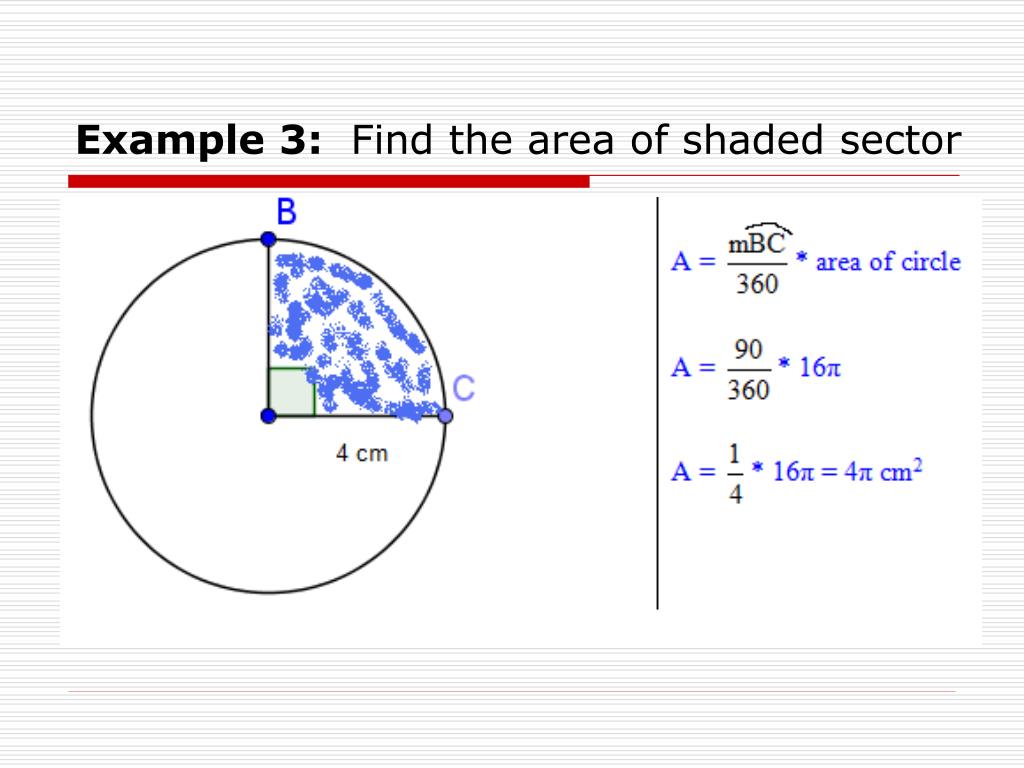
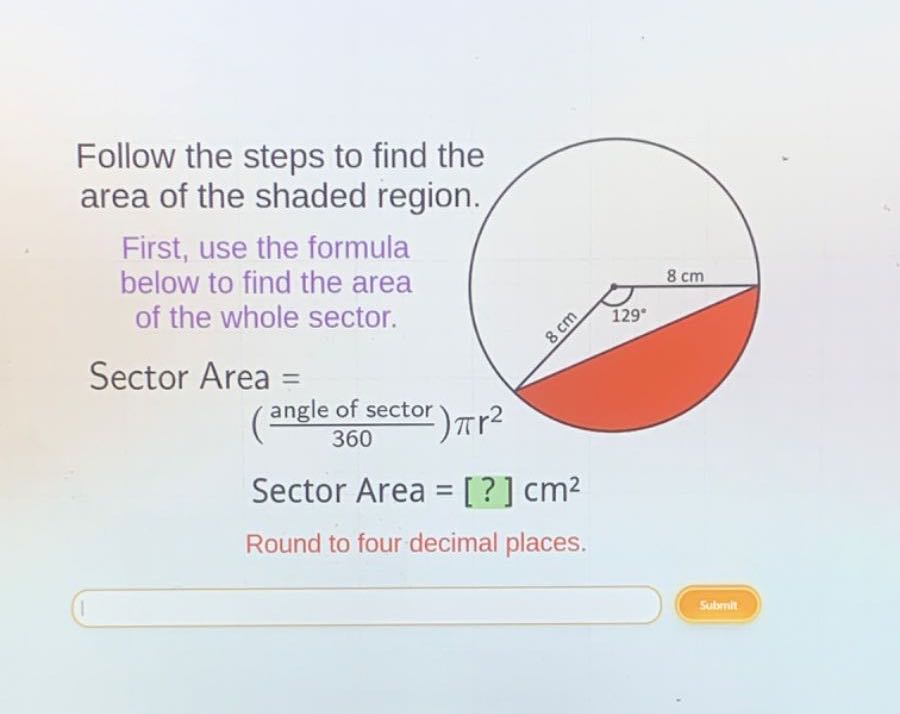
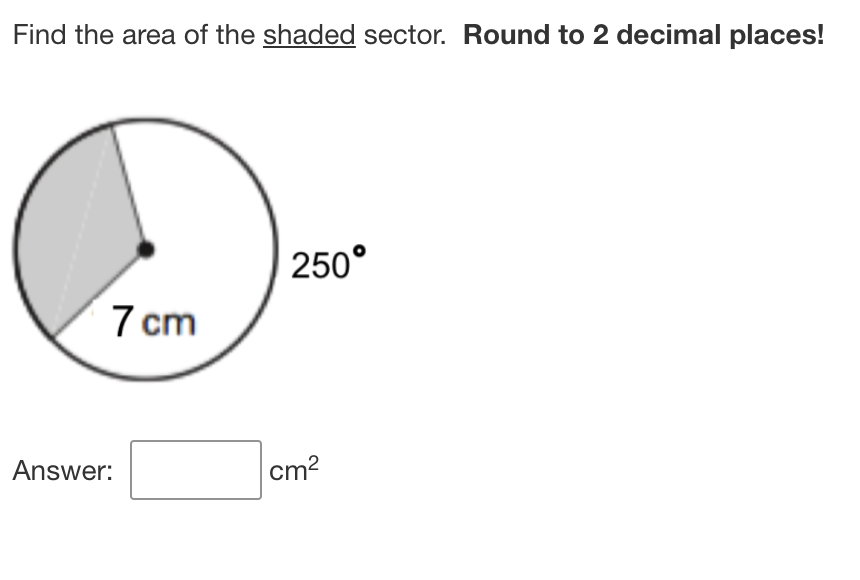
Area of Sector = (θ / 360) * π * r²
Yep, that's it. Let's break it down like a perfectly ripe avocado:
- (θ / 360): This is just the fraction of the whole circle that your sector represents. If your angle is 90 degrees, you have 90/360 = 1/4 of the circle. A quarter of the pie, if you will!
- π (pi): This is that famous number, approximately 3.14159... You probably know it, even if you don’t remember exactly what it means. Think of it as a crucial ingredient in any circle-related recipe.
- r² (radius squared): This is the radius multiplied by itself. It's essential for calculating the area based on the size of your circle.
Let's Do an Example!
Imagine you have a circular swimming pool with a radius of 5 meters. You want to build a small, shaded area (a sector) around the edge for relaxing. You decide the angle of this shaded area should be 60 degrees. What's the area you'll need to cover?
1. **Identify the givens:** r = 5 meters, θ = 60 degrees
2. **Plug into the formula:** Area = (60 / 360) * π * 5²
3. **Simplify:** Area = (1/6) * π * 25
4. **Calculate:** Area ≈ (1/6) * 3.14159 * 25 ≈ 13.09 square meters
So, you'll need to cover approximately 13.09 square meters to create your relaxing shaded area. Pretty cool, huh?
Why Does This Matter in Real Life?
Okay, beyond the pizza and pie analogies (though those are pretty compelling, right?), calculating sector areas pops up more than you think. Architects use it when designing curved structures, landscapers need it for planning circular gardens, and even engineers rely on it for calculations involving circular components in machines.
Plus, it's a great party trick. Imagine whipping out this knowledge at your next gathering: "Oh, this circular hors d'oeuvre platter? I can calculate the area of each individual cheese wedge! Prepare to be amazed!" Okay, maybe don't actually do that. Unless you're at a math convention. Then, go for it!
Final Thoughts
Finding the area of a shaded sector isn't just a boring math exercise. It's about understanding the world around us, one slice of pie at a time. So, next time you encounter a circle, remember this formula. And remember, even if you mess up, you can always eat the evidence.
Keep calm and calculate on, my friends!