Ever wonder what makes some things super shiny and strong, like your bike frame, while others are dull and brittle, like that old ceramic mug? It all boils down to whether something's a metal or a non-metal. But what exactly does that mean?
What Makes a Metal a Metal?
Think of metals as the cool kids of the element table. They've got a certain swagger, a set of properties that make them stand out. The big one? Conductivity. Imagine a crowded concert venue, and the electrons in a metal are like the fans, easily passing energy (like electricity or heat) from one to another. That's why metals are used in wires and cooking pots!
Another thing metals are known for is their lustre. That's a fancy word for saying they're shiny. Think about a freshly polished silver spoon. Why does it gleam? It's because the electrons on the metal's surface are bouncing light back at us in a very organized way. Pretty neat, huh?
And then there's malleability and ductility. Say what now? Malleability means you can hammer a metal into thin sheets (think aluminum foil), and ductility means you can draw it into wires (like copper wires in your phone charger). Try doing that with a piece of chalk! Wouldn't work, would it?
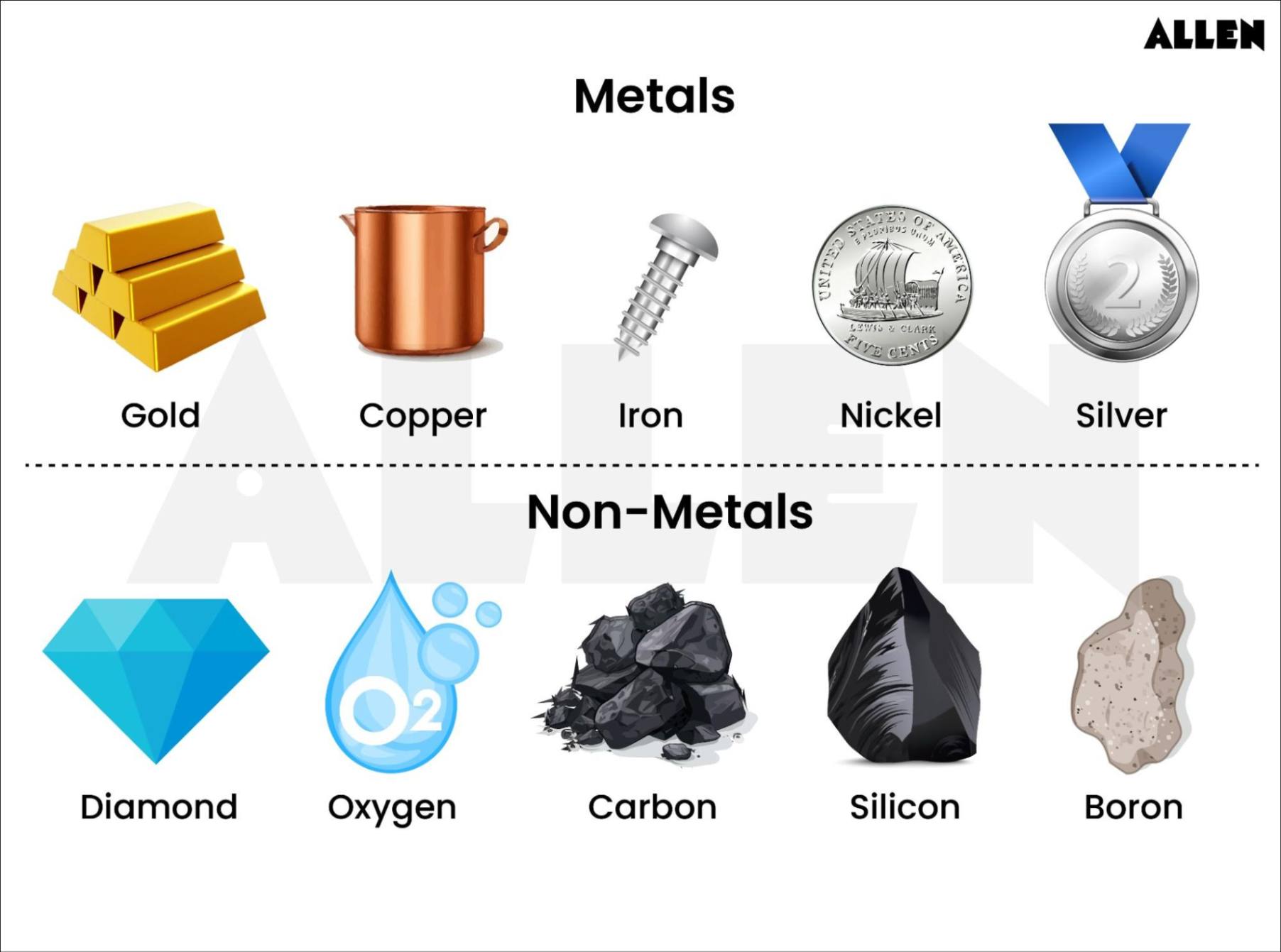
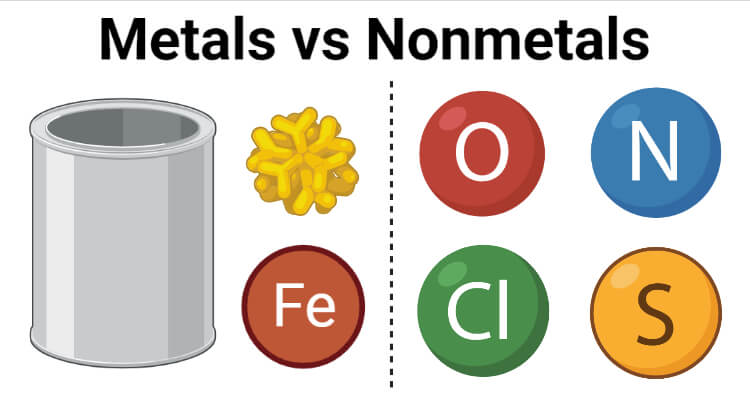
So, metals are generally strong, shiny, good conductors of heat and electricity, and can be shaped easily. Examples include: Iron, Gold, Copper, Aluminum. See a pattern? They’re everywhere!
Non-Metals: The Underdogs with Unique Talents
Now, let's talk about non-metals. They're kind of like the indie band compared to the metal rock stars. They don't always get the spotlight, but they have their own special characteristics.
Unlike metals, non-metals are generally poor conductors of heat and electricity. Think of trying to heat your soup with a wooden spoon versus a metal one. Which one heats up faster? Exactly! Non-metals are insulators; they resist the flow of electricity. That’s why the handles of your cooking pots are often made of wood or plastic – they prevent you from burning your hand.
They also tend to be dull in appearance. Sure, some non-metals, like diamonds (which are made of carbon!), can be incredibly beautiful, but most are not naturally shiny like metals. Think about sulfur or chlorine. Not exactly dazzling, are they?
And when it comes to shaping them, forget about it! Non-metals are often brittle, meaning they'll break or shatter easily. Try bending a piece of charcoal. It'll snap, right? No malleable sheets or ductile wires here!
Examples of non-metals include: Oxygen, Nitrogen, Sulfur, Chlorine, and yes, even Carbon (which can exist as diamond, graphite, or coal – talk about versatile!). They're essential for life, making up the air we breathe and the organic molecules that build our bodies.
Metal vs. Non-Metal: A Quick Cheat Sheet
To recap, here's a quick comparison:
- Metals: Shiny, good conductors, malleable, ductile, typically solid at room temperature (except for mercury).
- Non-Metals: Dull, poor conductors, brittle, can be solid, liquid, or gas at room temperature.
But Wait, There's More! Metalloids: The In-Betweeners
Just when you thought you had it all figured out, here come the metalloids! These elements, like silicon and germanium, are like the teenagers of the element family – not quite metal, not quite non-metal. They have properties of both! They're often called semi-metals or semiconductors. You will find them on a zig-zag staircase on periodic table.
Why are they so important? Because they're the backbone of the electronics industry! They are crucial in things like computer chips, solar panels, and other electronic devices that enable our modern lives.
Why Should You Care?
So, why should you care about the difference between metals and non-metals? Because it's all around you! Understanding these basic properties helps you understand why things are made the way they are. Why are bridges made of steel? Why are balloons filled with helium (a non-metal)? It's all chemistry, and it's all fascinating!
Next time you look around, take a moment to think about the materials you see. Are they metals, non-metals, or maybe even metalloids? You might be surprised at how much you already know! And who knows, maybe you'll even become a materials scientist someday, inventing new materials with amazing properties. Now wouldn't that be cool?