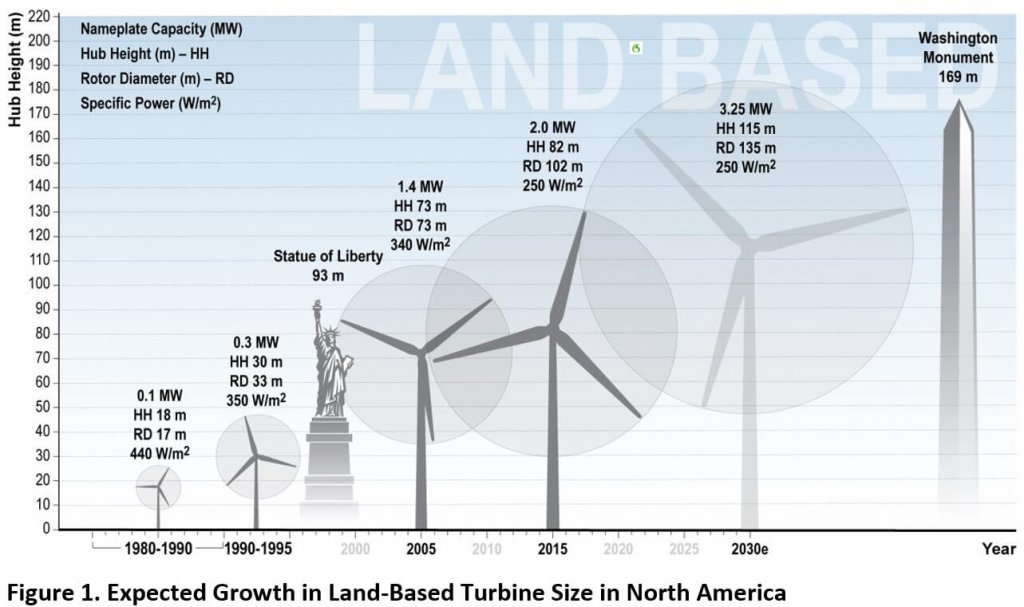
Average Size Of A Wind Turbine

Have you ever been driving down a highway, spotted one of those colossal wind turbines majestically spinning on the horizon, and just thought, "Wow, how big is that thing, really?" If so, you're not alone! It's a natural reaction to these towering giants that are becoming an increasingly familiar sight in our landscapes. Understanding the average size of a wind turbine isn't just a fun fact; it helps us appreciate the incredible engineering behind our clean energy future and the scale of the effort to power our world sustainably.
At their core, wind turbines have one primary purpose: to harness the kinetic energy of the wind and convert it into electricity. They are, quite literally, the sails of the 21st century, driving us towards a greener tomorrow. The benefits are immense and far-reaching. By generating electricity from a renewable source, wind turbines help us reduce our reliance on fossil fuels, curb greenhouse gas emissions, and combat climate change. They offer a sustainable, endless supply of energy that doesn't pollute the air or water, contributing to cleaner environments and healthier communities. Plus, the wind energy sector creates jobs, fosters technological innovation, and enhances energy independence for nations.
So, what exactly is the "average" size? Well, it's a bit of a moving target, as turbine technology is constantly evolving and growing. However, for modern, utility-scale turbines (the ones you typically see in large wind farms), we're talking about some truly impressive dimensions. An onshore wind turbine often has a hub height (the center of the rotor) of around 90 to 120 meters (about 300 to 400 feet) – roughly the height of a 30- to 40-story building! The rotor diameter, which is the full sweep of the blades, can range from 100 to 150 meters (330 to 500 feet). That's wider than a football field is long! Offshore turbines tend to be even larger, with hub heights exceeding 150 meters and rotor diameters pushing past 200 meters, truly making them the giants of the sea.
Must Read
This understanding of scale can pop up in various aspects of our lives. In education, learning about turbine size can be a fantastic way to teach physics, engineering, and environmental science. Imagine a STEM lesson where students calculate the swept area of a rotor or compare its height to local landmarks! In daily life, knowing these dimensions helps us better interpret news about new wind farm projects, understand the logistics of their construction, or simply marvel at their design when we pass them on a road trip. They are direct contributors to the electricity that powers our homes, charges our phones, and lights our schools – often without us even realizing the source.
Want to explore this fascinating topic further? It's easier than you might think! Next time you see a wind turbine, take a moment to really look at it and try to visualize its immense scale. You can also use online tools like Google Maps or Google Earth to "fly over" existing wind farms and get a bird's-eye view of their layout and size. Many wind turbine manufacturers publish detailed specifications online, allowing you to dive into the exact dimensions of specific models. Watching documentaries or virtual tours of wind farms can also provide an immersive experience, showcasing their construction and operation. Ultimately, by simply paying a little more attention to these incredible machines, we can all gain a deeper appreciation for the silent, powerful force working to create a cleaner, brighter future.