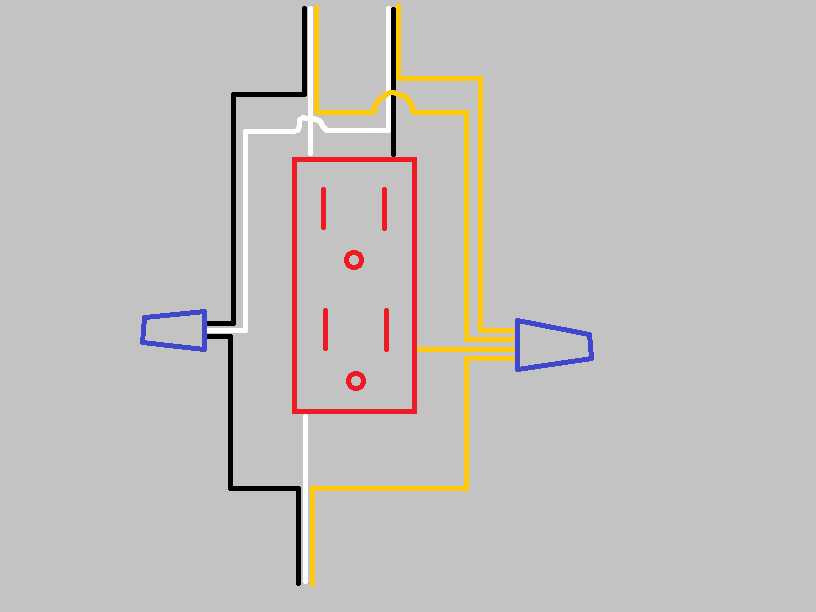
3 Sets Of Wires In One Outlet

Alright, grab your imaginary latte and settle in, because I've got a tale for you. It's a mystery, a puzzle, and frankly, a bit of an electrical head-scratcher that many homeowners eventually encounter. We're talking about that moment when you, intrepid DIY-er or just curious observer, decide to swap out an old, ugly outlet for something sleek and modern. You flip the breaker (because safety first, kids!), unscrew the cover plate, and there it is: a spaghetti junction of copper and plastic, staring back at you with a smug, silent challenge. But not just any spaghetti junction. Oh no. This is the big leagues. This is when you discover three separate sets of wires in one humble outlet box.
Now, if you're like me, your brain probably does a quick electrical calculation: "Okay, hot and neutral, maybe a ground… that's one set. Maybe two if it's feeding another outlet. But three? Is my house secretly a hidden substation?" You stare, you blink, you poke cautiously with a non-contact voltage tester (still off, of course!). It feels like finding an extra limb on your favorite pet – surprising, a little concerning, and definitely worth a closer look.
The Standard Suspects: A Quick Zap of Knowledge
Before we dive into the bizarre, let's refresh. A normal outlet typically has one set of wires coming in: a black wire (the "hot" one, carrying the electricity), a white wire (the "neutral" one, taking it back to the panel), and a bare copper or green wire (the "ground," a safety net to prevent shocks). That's your basic power delivery system, like a tiny electrical highway. If you have two sets, it usually means the power is coming in, connecting to the outlet, and then continuing on to power another outlet down the line. We call that daisy-chaining, and it's perfectly normal, if a little confusing at first glance.
Must Read
But three? That's where things get juicy. It's like finding a secret passage in your basement, except instead of treasure, it's… more wires. Let's unravel this shocking mystery with a few potential culprits.
Culprit #1: The Daisy-Chain Deluxe - Your Outlet is a Popular Hub
This is probably the most common explanation for our three-wire conundrum. Imagine your outlet isn't just getting power and passing it on to one other outlet. What if it's acting like a miniature electrical Grand Central Station, sending power off in two different directions?

Think of it this way: you have the main power coming into the box. That's one set. Then, one set of wires takes power out to, say, the next outlet in the living room. But wait! There's a third set that's branching off to power something else entirely—maybe a light fixture in the hallway, or a completely different string of outlets in another room. Your little outlet box is a junction box masquerading as a simple receptacle. It's the electrical equivalent of sharing your internet hotspot, but with multiple devices demanding a signal. It's efficient, if a bit visually overwhelming when you're looking at it naked.
Culprit #2: The Split Personality – Partially Switched Outlets
Sometimes, life isn't just about on or off; it's about half on and half off. Ever seen an outlet where only one of the two receptacles turns on with a wall switch? That's a switched outlet, usually for a lamp in a room where ceiling lights are absent or inconvenient. This is where things get a touch more complicated, but still manageable.

In this scenario, you might have one set of wires bringing in constant power. Another set might be taking constant power out to another regular outlet. And then, the third set could be the "switch leg" – the wire that carries power from a wall switch to one half of the outlet. So, your outlet box is a combination of power-in, constant power-out, and switched power-in (for itself, or for another fixture further down). It's an electrical tango with an extra dance partner, making sure your reading lamp knows when to shine.
Culprit #3: The Dedicated Detective – Specialized Circuits Passing Through
This one is a bit rarer for a standard outlet, but not impossible. Sometimes, an electrician might have found an existing outlet box to be a convenient pass-through for a dedicated circuit. Maybe you have a heavy-duty appliance (like a freezer in the garage, or a window AC unit) that needs its own dedicated circuit directly from the breaker panel, meaning it doesn't share power with anything else. While that appliance has its own outlet, the dedicated circuit's wires might have been run through your regular outlet box on their way to their final destination.

So, you'd have your regular incoming power, your regular outgoing power to the next outlet, and then a third set of wires that are simply passing through, unburdened by your outlet's humble needs, heading off to power something much more demanding. It's like a VIP lane for electricity, just cutting through your common-folk outlet box on its way to somewhere important.
The Golden Rule: Don't Be a Hero, Be a Live Hero!
No matter the reason, the moment you see three sets of wires, a few things should happen. First, a tiny gasp of surprise. Second, a silent nod to the wonders of modern (and not-so-modern) electrical wiring. And third, and most importantly: Double-check that breaker! Seriously, if you're not 100% confident about what you're doing, please, call a professional. Electricity is not a toy, and it bites harder than your grumpy neighbor's Chihuahua. The goal is to understand your home, not to become a glowing human light bulb.
So, the next time you peek behind an outlet and find yourself in a wire wonderland, don't panic. Take a breath, appreciate the complexity of your home's hidden veins and arteries, and know that you've just solved a small, but surprisingly common, electrical mystery. Now, about that imaginary latte… I think I need a refill after all that excitement!