
220v Plug Adapter For Welder

Alright, gather 'round, my friends, and let me spin you a yarn about a truly majestic beast and its quest for… a suitable power outlet. No, I’m not talking about my teenager trying to find a charger for their phone; I’m talking about something far more electrifying: a welder.
Picture this: You’ve just acquired a magnificent, beefy welding machine. Maybe it’s a shiny new MIG, maybe a TIG, or perhaps an old stick welder that looks like it could have survived an apocalypse. You’ve got visions of forging metal, creating works of art, or at least fixing that perpetually broken fence post. You drag this industrial-grade titan into your humble garage, feeling like a modern-day Vulcan. You plug it in, brimming with anticipation… and then… crickets. Or, worse, a pitiful little spark that wouldn't even start a marshmallow on fire. What gives?
The Mighty 220v: When 110v Just Isn't Enough
See, most of the gadgets we plug into our walls – your phone charger, your toaster, your secret squirrel detector – operate on 110-120 volts. That’s your standard household current, perfectly adequate for brewing coffee or watching cat videos. But a welder? Oh no, my dear friends. A welder is like a muscle car; it needs the good stuff. It craves power. It demands 220-240 volts, sometimes known as “double pole” or just "the big juice."
Must Read
Why 220v? Because welding involves creating an arc of electricity hot enough to melt metal. You’re essentially bringing a miniature lightning storm to your workpiece. And you simply cannot summon a proper lightning storm with a wimpy 110v outlet, unless you enjoy tripping breakers and possibly summoning a very disappointed ghost. So, your beautiful new welder, which looks like it could weld the Titanic back together, sits there, tragically unplugged because its plug looks like something from a space shuttle.
The Plug Problem: A Square Peg in a Round Hole (Literally, Sometimes)
This is where our hero, the 220v plug adapter for a welder, enters the scene, capes fluttering dramatically. You see, while your welder needs 220v, the type of 220v outlet it expects might not be the type of 220v outlet you actually have in your garage. It’s like owning a Ferrari but only having access to petrol stations that sell diesel. Frustrating, right?

Common 220v outlets in homes are usually for things like clothes dryers, electric ranges, or central air conditioning units. They have different shapes, pin configurations, and amperage ratings. Your welder, on the other hand, likely comes with a NEMA 6-50P plug. It’s a flat-bladed, three-prong beast designed specifically for heavy-duty 220v tools like, you guessed it, welders. It's built to handle serious current without melting itself into a sad puddle of plastic.
The Adapter: Your Electrical Translator and Peacemaker
So, you’re standing there with your welder’s big, burly 6-50P plug, staring forlornly at your dryer’s equally burly, but entirely different-shaped, 220v outlet (which might be a NEMA 10-30R or 14-30R, depending on how old your house is). This is where the adapter comes in. It's not just a fancy dongle; it's a transformer of frustration into functionality. It bridges the gap.

But here’s the kicker, and this is where you need to put on your grown-up pants: you absolutely, positively, 100% need the right adapter.
You can’t just grab any old 220v adapter and hope for the best. That’s like trying to put a square wheel on a car. Or, more accurately, trying to plug your welder into an adapter that isn't rated for the amperage your welder draws. Most welders need a 50-amp circuit. If you try to run it off a 30-amp dryer outlet with an adapter that isn't smart about current, you're going to have a bad time. Circuit breakers will trip faster than you can say "hot metal," and in a worst-case scenario, you could risk overheating wires. Nobody wants a garage fire, especially not one caused by an eager but ill-informed welder-wannabe.
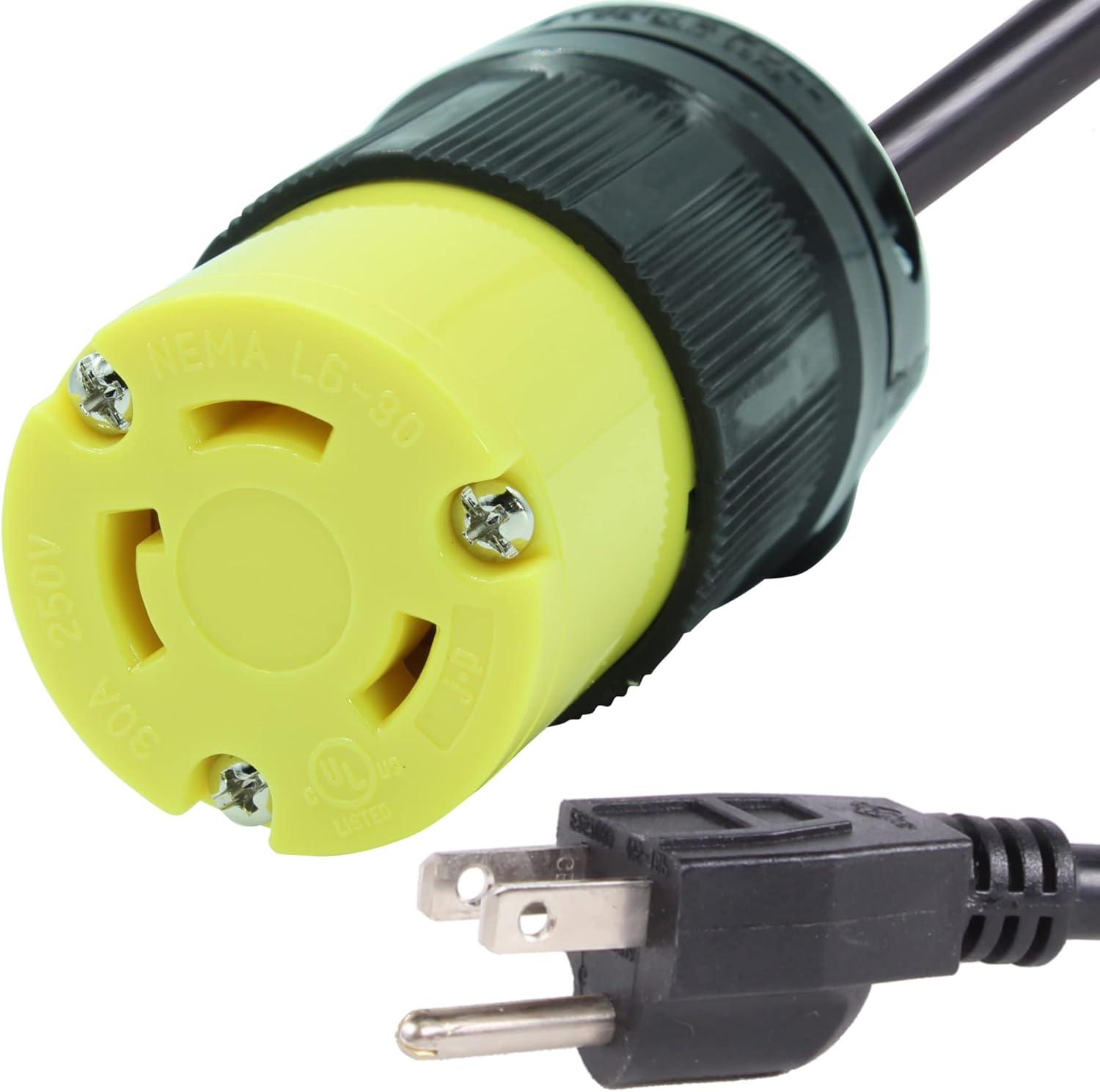
The Nitty-Gritty (but still fun) Details: Matching is Key!
Before you hit "add to cart" on that adapter, do a quick detective work. Look at your welder's power requirements (usually on a sticker or in the manual). Then, look at the outlet you intend to use. Does it say 30A or 50A? Is it a 3-prong or 4-prong? The most common scenarios are:
- Welder (NEMA 6-50P) to Dryer (NEMA 10-30R or 14-30R): These are popular. Just make sure the adapter is appropriately fused or designed to prevent your welder from drawing too much current from a smaller circuit. Some smart adapters even have built-in circuit protection.
- Welder (NEMA 6-50P) to Range (NEMA 14-50R): Often a beefier option, as range outlets are typically 50-amp. This is often a better match for a welder.
The adapter itself needs to be made of heavy-duty gauge wire, because it's handling serious power. Think thick, robust cables, not flimsy extension cord material. It’s the kind of adapter that looks like it lifts weights in its spare time.

The Moment of Truth: Sparks Will Fly (Safely!)
Once you have the correct adapter – one that proudly bridges the gap between your magnificent welder and your perfectly good but oddly shaped 220v outlet – the world changes. You plug it in. There's no drama, no tripped breakers, just the satisfying hum of raw power ready to be unleashed. You strike an arc, sparks fly (safely, with your proper PPE, of course!), and suddenly, you are a master of metal, a sculptor of sparks, a… well, you’re welding!
It’s a truly glorious moment when you realize that a small, often overlooked piece of electrical ingenuity is all that stood between you and your metalworking dreams. So, next time you’re wrestling with a powerful appliance and an incompatible plug, remember the humble 220v plug adapter for a welder. It’s not just a connector; it’s a promise of potential, a bridge to a brighter, sparkier future.
Just remember to always double-check your specs, prioritize safety, and maybe don't try to weld your car in the living room. Unless, of course, you have a really, really long and correctly rated extension cord. (Just kidding, please don't do that.)