
2 To The Power Of What Is 256

Okay, picture this: I was scrolling through some old photos the other day, you know, the ones from like, early 2000s digital cameras. And I stumbled upon this blurry masterpiece of my cat, probably taken with about a 0.3-megapixel sensor. The file name was something cryptic like "IMG_0256.JPG". My mind, being the curious little badger it is, immediately fixated on that "256". Why 256? Why not 250? Or 300? It just felt… significant.
It sent me down a bit of a rabbit hole, which, if you’re anything like me, happens about five times before noon. And eventually, I landed on a question that pops up surprisingly often in the digital realm: 2 to the power of what is 256?
The Power of Two (Literally!)
Now, before you groan and think we’re heading into a high-school math class, hear me out. This isn't just about numbers; it's about understanding a fundamental building block of the digital world we live in. Everything from your smartphone to that weirdly specific file name has powers of two lurking underneath.
Must Read
When we talk about "powers of two," we're simply talking about multiplying the number 2 by itself a certain number of times. So, 2 to the power of 1 (written as 2¹) is just 2. Easy, right? 2 to the power of 2 (2²) is 2 multiplied by 2, which gives you 4. Getting the hang of it?
These numbers – 2, 4, 8, 16, 32, 64, 128, 256 – they show up everywhere. Ever noticed how memory sticks or hard drives often come in sizes like 16GB, 32GB, 64GB, 128GB? Or how a game console might be described as "8-bit" or "16-bit"? That’s the power of two at play, my friend. It’s all about binary, the language of computers, which uses only zeros and ones.

Let’s Count It Out
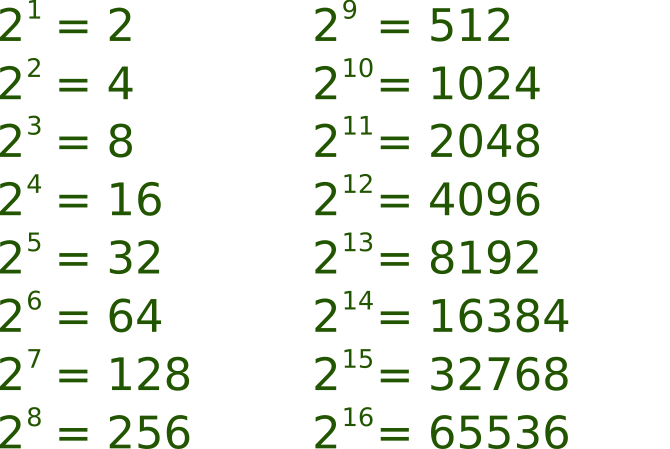
So, back to our original mystery: 2 to the power of what equals 256? Let’s work our way up, shall we? You can count along if you like, it's quite satisfying:
- 2¹ = 2
- 2² = 4
- 2³ = 8
- 2⁴ = 16
- 2⁵ = 32
- 2⁶ = 64
- 2⁷ = 128
- And finally… 2⁸ = 256!
Boom! There it is. The answer is 8. Two to the power of eight is 256. It’s like finding that last puzzle piece, isn't it?

Why Is This Eight So Important?
Knowing that 2⁸ = 256 might seem like a cool little math fact, but it’s actually profoundly significant in the tech world. This number, 256, is absolutely foundational because it’s the number of unique values that can be represented by eight bits.
And what's a group of eight bits called? You guessed it: a byte! That’s right, the basic unit of digital information. One byte can hold 256 different values (from 0 to 255). This simple fact underpins so much of what we do with computers:
Colors: Ever tweaked a color in an image editor? You often see RGB values going from 0 to 255 for each channel (Red, Green, Blue). That’s 256 shades for each, allowing for millions of possible colors. Ta-da!
IP Addresses: Remember those IPv4 addresses (like 192.168.1.1)? Each of those four numbers, or "octets," can range from 0 to 255. Again, 256 possibilities per octet, thanks to our good friend, the byte.

Character Sets: Many early character encoding systems, like the original ASCII, used 8 bits to represent characters. That gave them 256 slots for all the letters, numbers, and symbols you could want.
Old-school Graphics: When we talk about "8-bit graphics" in retro video games, it literally means the system could display 2⁸ (256) colors at a time. Pixel perfection, 1980s style!
So, the next time you see the number 256 pop up – be it in a file name, a setting, or some technical spec – you’ll know it’s not just a random sequence of digits. It’s the incredibly efficient and versatile result of two raised to the power of eight, a tiny mathematical cornerstone holding up a huge chunk of our digital universe. Pretty neat, right?